May 24, 2011
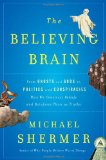
The Believing Brain: From Ghosts and Gods to Politics and Conspiracies—How We Construct Beliefs and Reinforce Them as Truths by Michael Shermer (Times Books, 2011)
(kindle ed.), (amazon.co.uk)
Product description from the publisher:
Bestselling author Michael Shermer’s comprehensive and provocative theory on how beliefs are born, formed, reinforced, challenged, changed, and extinguished
In this work synthesizing thirty years of research, psychologist, historian of science, and the world’s best-known skeptic Michael Shermer upends the traditional thinking about how humans form beliefs about the world. Simply put, beliefs come first and explanations for beliefs follow. The brain, Shermer argues, is a belief engine. From sensory data flowing in through the senses, the brain naturally begins to look for and find patterns, and then infuses those patterns with meaning. Our brains connect the dots of our world into meaningful patterns that explain why things happen, and these patterns become beliefs. Once beliefs are formed the brain begins to look for and find confirmatory evidence in support of those beliefs, which accelerates the process of reinforcing them, and round and round the process goes in a positive-feedback loop of belief confirmation. Shermer outlines the numerous cognitive tools our brains engage to reinforce our beliefs as truths.
Interlaced with his theory of belief, Shermer provides countless real-world examples of how this process operates, from politics, economics, and religion to conspiracy theories, the supernatural, and the paranormal. Ultimately, he demonstrates why science is the best tool ever devised to determine whether or not a belief matches reality.
See also: Author’s website
Comments (0)
- cognitive science,new books,psychology
May 19, 2011
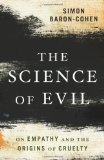
The Science of Evil: On Empathy and the Origins of Cruelty by Simon Baron-Cohen (Basic Books, 2001)
(kindle ed.)
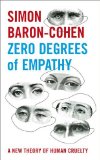
(UK ed. – Zero Degrees of Empathy – at amazon.co.uk)
Product description from the publisher:
Borderline personality disorder, autism, narcissism, psychosis, Asperger’s: All of these syndromes have one thing in common–lack of empathy. In some cases, this absence can be dangerous, but in others it can simply mean a different way of seeing the world.
In Cruel or Unusual Simon Baron-Cohen, an award-winning British researcher who has investigated psychology and autism for decades, develops a new brain-based theory of human cruelty. A true psychologist, however, he examines social and environmental factors that can erode empathy, including neglect and abuse.
Based largely on Baron-Cohen’s own research, Cruel or Unusual will change the way we understand and treat human cruelty.
See also: Reuters article “Scientist seeks to banish evil, boost empathy,” Royal Institution lecture with audio archive
Comments (0)
- cognitive science,new books,psychology
April 29, 2011
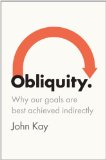
Recently published in the US: Obliquity: Why Our Goals Are Best Achieved Indirectly by economist John Kay (Penguin, 2011)
(kindle ed.), (amazon.co.uk)
Product description from the publisher:
A leading economist charts the indirect road to happiness and wealth.
Using dozens of practical examples from the worlds of business, politics, science, sports, literature, even parenting, esteemed economist John Kay proves a notion that feels at once paradoxical and deeply commonsensical: The best way to achieve any complex or broadly defined goal-from happiness to wealth to profit to preventing forest fires-is the indirect way. As Kay points out, we rarely know enough about the intricacies of important problems to tackle them head-on. And our unpredictable interactions with other people and the world at large mean that the path to our goals-and sometimes the goals themselves-will inevitably change. We can learn about our objectives and how to achieve them only through a gradual process of risk taking and discovery-what Kay calls obliquity.
Kay traces this pathway to satisfaction as it manifests itself in nearly every aspect of life. The wealthiest people-from Andrew Carnegie to Bill Gates-achieved their riches through a passion for their work, not because they set materialistic goals. Research has shown that companies whose goal (as declared in mission statements) is excellent products or service are more profitable than companies whose stated goal is increasing profits. In the personal realm, a large body of evidence shows that parenthood is on a daily basis far more frustrating than happy- making. Yet parents are statistically happier than nonparents. Though their short-term pleasure is often thwarted by the demands of childrearing, the subtle-oblique-rewards of parenthood ultimately make them happier.
Once he establishes the ubiquity of obliquity, Kay offers a wealth of practical guidance for avoiding the traps laid by the direct approach to complex problems. Directness blinds us to new information that contradicts our presumptions, fools us into confusing logic with truth, cuts us off from our intuition (which is the subconscious expression of our experience), shunts us away from alternative solutions that may be better than the one we’re set on, and more. Kay also shows us how to acknowledge our limitations, redefine our goals to fit our skills, open our minds to new data and solutions, and otherwise live life with obliquity.
This bracing manifesto will convince readers-or confirm their conviction-that the best route to satisfaction and success does not run through the bottom line.
See also: Author’s website
Comments (0)
- happiness,new books,psychology
April 27, 2011
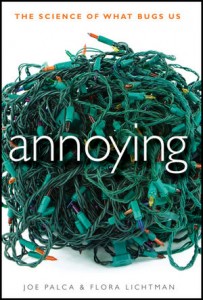
Annoying: The Science of What Bugs Us by Joe Palca and Flora Lichtman (Wiley, 2011)
(kindle ed.), (amazon.co.uk)
Product description from the publisher:
Two crackerjack science journalists from NPR look at why some things (and some people!) drive us crazy
It happens everywhere – offices, schools, even your own backyard. Plus, seemingly anything can trigger it: cell phones, sirens, bad music, constant distractions, your boss, or even your spouse. We all know certain things get under our skin. Can science explain why? Palca and Lichtman take you on a scientific quest through psychology, evolutionary biology, anthropology, and other disciplines to uncover the truth about being annoyed. What is the recipe for annoyance? For starters, it should be temporary, unpleasant, and unpredictable, like a boring meeting or mosquito bites
* Gives fascinating, surprising explanations for why people react the way they do to everything from chili peppers to fingernails on a blackboard
* Explains why irrational behavior (like tearing your hair out in traffic) is connected to worthwhile behavior (like staying on task)
* Includes tips for identifying your own irritating habits!
How often can you say you’re happily reading a really Annoying book? The insights are fascinating, the exploration is fun, and the knowledge you gain, if you act like you know everything, can be really annoying.
See also: New York Times review
Comments (0)
- cognitive science,new books,psychology
April 18, 2011
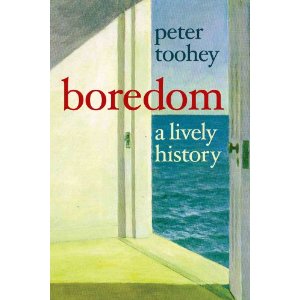
Boredom: A Lively History by Peter Toohey (Yale University Press, 2011)
(amazon.co.uk)
Product description from the publisher:
In the first book to argue for the benefits of boredom, Peter Toohey dispels the myth that it’s simply a childish emotion or an existential malaise like Jean-Paul Sartre’s nausea. He shows how boredom is, in fact, one of our most common and constructive emotions and is an essential part of the human experience.
This informative and entertaining investigation of boredom—what it is and what it isn’t, its uses and its dangers—spans more than 3,000 years of history and takes readers through fascinating neurological and psychological theories of emotion, as well as recent scientific investigations, to illustrate its role in our lives. There are Australian aboriginals and bored Romans, Jeffrey Archer and caged cockatoos, Camus and the early Christians, Dürer and Degas. Toohey also explores the important role that boredom plays in popular and highbrow culture and how over the centuries it has proven to be a stimulus for art and literature.
Toohey shows that boredom is a universal emotion experienced by humans throughout history and he explains its place, and value, in today’s world. Boredom: A Lively History is vital reading for anyone interested in what goes on when supposedly nothing happens.
See also: “boredom” – more books at amazon.com
Comments (0)
- cognitive science,new books,psychology