[ View menu ]

Archive for 'psychology'

new book – ‘The Myth of Choice: Personal Responsibility in a World of Limits’

September 21, 2011
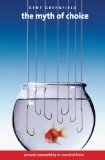
The Myth of Choice

The Myth of Choice: Personal Responsibility in a World of Limits by Kent Greenfield (Yale University Press, 2011)

(amazon.co.uk – 11 Oct)

Book description from the publisher:

Americans are fixated on the idea of choice. Our political theory is based on the consent of the governed. Our legal system is built upon the argument that people freely make choices and bear responsibility for them. And what slogan could better express the heart of our consumer culture than “Have it your way”?

In this provocative book, Kent Greenfield poses unsettling questions about the choices we make. What if they are more constrained and limited than we like to think? If we have less free will than we realize, what are the implications for us as individuals and for our society? To uncover the answers, Greenfield taps into scholarship on topics ranging from brain science to economics, political theory to sociology. His discoveries—told through an entertaining array of news events, personal anecdotes, crime stories, and legal decisions—confirm that many factors, conscious and unconscious, limit our free will. Worse, by failing to perceive them we leave ourselves open to manipulation. But Greenfield offers useful suggestions to help us become better decision makers as individuals, and to ensure that in our laws and public policy we acknowledge the complexity of choice.

See also: Author’s website

Book trailer:

Comments (0) - culture,new books,philosophy of mind,psychology
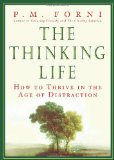
new book – ‘The Thinking Life: How to Thrive in the Age of Distraction’

September 13, 2011

Today’s featured new release received a starred review from Kirkus Reviews:

The Thinking Life

The Thinking Life: How to Thrive in the Age of Distraction by P.M. Forni (St Martin’s Press, 2011)

(kindle ed.), (amazon.co.uk – 17 Oct)

Book description from the publisher:

Professor Forni, founder of The Civility Initiative at Johns Hopkins, is America’s civility expert. In his first two books, Choosing Civility and The Civility Solution, he taught readers the rules of civil behavior and ways of responding to rudeness. Now, in The Thinking Life, he looks at the importance of thinking in our lives: how we do it, why we don’t do enough of it and why we need to do more of it.

In twelve short chapters, he gives readers a remedy for the Age of Distraction, an age fuelled by the internet, Blackberries and cellphones, all of which make constant demands on our attention, diverting it from one thing to another. After suggesting ways we can find time to think more, Forni shows readers how we can improve our abilities of:

—Attention
—Reflection
—Introspection
—Self-control
—Positive thinking
—Proactive thinking
—Effective decision-making strategies
—Creative thinking
—Problem-solving strategies

Just as he did with civility, he puts the importance of good thinking front and center in a book as simple and as profound as his earlier works.

See also: Author’s website, Google Books preview

Comments (0) - culture,mind,new books,psychology

new book – ‘Duels and Duets: Why Men and Women Talk So Differently’

September 5, 2011

Duels and Duets

Duels and Duets: Why Men and Women Talk So Differently by John L. Locke (Cambridge University Press, 2011)

(amazon.co.uk)

Book description from the publisher:

Why do men and women talk so differently? And how do these differences interfere with communication between the sexes? In search of an answer to these and other questions, John Locke takes the reader on a fascinating journey, from human evolution through ancient history to the present, revealing why men speak as they do when attempting to impress or seduce women, and why women adopt a very different way of talking when bonding with each other, or discussing rivals. When men talk to men, Locke argues, they frequently engage in a type of ‘dueling’, locking verbal horns with their rivals in a way that enables them to compete for the things they need, mainly status and sex. By contrast, much of women’s talk sounds more like a verbal ‘duet’, a harmonious way of achieving their goals by sharing intimate thoughts and feelings in private.

See also: More on the book (author’s blog post on Cambridge Extra at Linguist List)

Comments (0) - language,new books,psychology

new book – ‘Macro Cultural Psychology: A Political Philosophy of Mind’

September 3, 2011

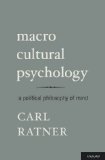
Macro Cultural Psychology

Macro Cultural Psychology: A Political Philosophy of Mind by Carl Ratner (Oxford University Press, USA, 2011)

(amazon.co.uk)

Book description from the publisher:

This book articulates a bold, new, systematic theory of psychology, culture, and their interrelation. It explains how macro cultural factors — social institutions, cultural artifacts, and cultural concepts — are the cornerstones of society and how they form the origins and characteristics of psychological phenomena. This theory is used to explain the diversity of psychological phenomena such as emotions, self, intelligence, sexuality, memory, reasoning, perception, developmental processes, and mental illness. Ratner draws upon Lev Vygotsky’s sociocultural psychology, Bronfenbrenner’s ecological psychology, as well as work in sociology, anthropology, history, and geography, to explore the political implications and assumptions of psychological theories regarding social policy and reform.

The theory outlined here addresses current theoretical and political issues such as agency, realism, objectivity, subjectivism, structuralism, postmodernism, and multiculturalism. In this sense, the book articulates a systematic political philosophy of mind to examine numerous approaches to psychology, including indigenous psychology, cross-cultural psychology, activity theory, discourse analysis, mainstream psychology, and evolutionary psychology.

Comments (0) - culture,mind,new books,philosophy of mind,psychology

new book – ‘Willpower: Rediscovering the Greatest Human Strength’

September 1, 2011

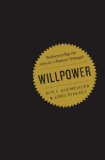
Willpower

Willpower: Rediscovering the Greatest Human Strength by Roy F. Baumeister and John Tierney (Penguin, 2011)

(kindle ed.), (amazon.co.uk)

Book description from the publisher:

One of the world’s most esteemed and influential psychologists, Roy F. Baumeister, teams with New York Times science writer John Tierney to reveal the secrets of self-control and how to master it.

In Willpower, the pioneering researcher Roy F. Baumeister collaborates with renowned New York Times science writer John Tierney to revolutionize our understanding of the most coveted human virtue: self-control.

In what became one of the most cited papers in social science literature, Baumeister discovered that willpower actually operates like a muscle: it can be strengthened with practice and fatigued by overuse. Willpower is fueled by glucose, and it can be bolstered simply by replenishing the brain’s store of fuel. That’s why eating and sleeping- and especially failing to do either of those-have such dramatic effects on self-control (and why dieters have such a hard time resisting temptation).

Baumeister’s latest research shows that we typically spend four hours every day resisting temptation. No wonder people around the world rank a lack of self-control as their biggest weakness. Willpower looks to the lives of entrepreneurs, parents, entertainers, and artists-including David Blaine, Eric Clapton, and others-who have flourished by improving their self-control.?

The lessons from their stories and psychologists’ experiments can help anyone. You learn not only how to build willpower but also how to conserve it for crucial moments by setting the right goals and using the best new techniques for monitoring your progress. Once you master these techniques and establish the right habits, willpower gets easier: you’ll need less conscious mental energy to avoid temptation. That’s neither magic nor empty self-help sloganeering, but rather a solid path to a better life.

Combining the best of modern social science with practical wisdom, Baumeister and Tierney here share the definitive compendium of modern lessons in willpower. As our society has moved away from the virtues of thrift and self-denial, it often feels helpless because we face more temptations than ever. But we also have more knowledge and better tools for taking control of our lives. However we define happiness–a close-knit family, a satisfying career, financial security–we won’t reach it without mastering self-control.

See also: “Do you suffer from decision fatigue” – 8/17/11 New York Times Magazine article adapted from the book, “How to Learn Self-Control,” article on the book at BookBeast

Google Books preview:

Comments (0) - new books,psychology