November 3, 2011
What Makes Your Brain Happy and Why You Should Do the Opposite by David DiSalvo (Prometheus, 2011)
(amazon.co.uk)
Product description from the publisher:
Why do we routinely choose options that don’t meet our short-term needs and undermine our long-term goals? Why do we willingly expose ourselves to temptations that undercut our hard-fought progress to overcome addictions? Why are we prone to assigning meaning to statistically common coincidences? Why do we insist we’re right even when evidence contradicts us?
In What Makes Your Brain Happy and Why You Should Do the Opposite, science writer David DiSalvo reveals a remarkable paradox: what your brain wants is frequently not what your brain needs. In fact, much of what makes our brains “happy” leads to errors, biases, and distortions, which make getting out of our own way extremely difficult. DiSalvo’s search includes forays into evolutionary and social psychology, cognitive science, neurology, and even marketing and economics—as well as interviews with many of the top thinkers in psychology and neuroscience today.
From this research-based platform, DiSalvo draws out insights that we can use to identify our brains’ foibles and turn our awareness into edifying action. Ultimately, DiSalvo argues, the research does not serve up ready-made answers, but provides us with actionable clues for overcoming the plight of our advanced brains and, consequently, living more fulfilled lives.
See also: Author’s website
Comments (0)
- cognitive science,happiness,new books,psychology
November 1, 2011
Neurogastronomy: How the Brain Creates Flavor and Why It Matters by Gordon Shepherd (Columbia University Press, 2011)
(amazon.co.uk- 1 Dec)
Product description from the publisher:
Leading neuroscientist Gordon M. Shepherd embarks on a paradigm-shifting trip through the “human brain flavor system,” laying the foundations for a new scientific field: neurogastronomy. Challenging the belief that the sense of smell diminished during human evolution, Shepherd argues that this sense, which constitutes the main component of flavor, is far more powerful and essential than previously believed.
Shepherd begins Neurogastronomy with the mechanics of smell, particularly the way it stimulates the nose from the back of the mouth. As we eat, the brain conceptualizes smells as spatial patterns, and from these and the other senses it constructs the perception of flavor. Shepherd then considers the impact of the flavor system on contemporary social, behavioral, and medical issues. He analyzes flavor’s engagement with the brain regions that control emotion, food preferences, and cravings, and he even devotes a section to food’s role in drug addiction and, building on Marcel Proust’s iconic tale of the madeleine, its ability to evoke deep memories.
Shepherd connects his research to trends in nutrition, dieting, and obesity, especially the challenges that many face in eating healthily. He concludes with human perceptions of smell and flavor and their relationship to the neural basis of consciousness. Everyone from casual diners and ardent foodies to wine critics, chefs, scholars, and researchers will delight in Shepherd’s fascinating, scientific-gastronomic adventures.
Comments (0)
- cognitive science,new books,psychology
October 29, 2011
You Are Not So Smart: Why You Have Too Many Friends on Facebook, Why Your Memory Is Mostly Fiction, and 46 Other Ways You’re Deluding Yourself by David McRaney (Gotham, 2011)
(kindle ed.), (amazon.co.uk)
Product description from the publisher:
An entertaining illumination of the stupid beliefs that make us feel wise.
You believe you are a rational, logical being who sees the world as it really is, but journalist David McRaney is here to tell you that you’re as deluded as the rest of us. But that’s OK- delusions keep us sane. You Are Not So Smart is a celebration of self-delusion. It’s like a psychology class, with all the boring parts taken out, and with no homework.
Based on the popular blog of the same name, You Are Not So Smart collects more than 46 of the lies we tell ourselves everyday, including:
* Dunbar’s Number – Humans evolved to live in bands of roughly 150 individuals, the brain cannot handle more than that number. If you have more than 150 Facebook friends, they are surely not all real friends.
* Hindsight bias – When we learn something new, we reassure ourselves that we knew it all along.
* Confirmation bias – Our brains resist new ideas, instead paying attention only to findings that reinforce our preconceived notions.
* Brand loyalty – We reach for the same brand not because we trust its quality but because we want to reassure ourselves that we made a smart choice the last time we bought it.
Packed with interesting sidebars and quick guides on cognition and common fallacies, You Are Not So Smart is a fascinating synthesis of cutting-edge psychology research to turn our minds inside out.
See also: book blog
Google Books preview:
Comments (0)
- cognitive science,new books,psychology
October 27, 2011
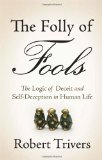
This book received a “Kirkus starred review”:
The Folly of Fools: The Logic of Deceit and Self-Deception in Human Life by Robert Trivers (Basic Books, 2011).
(kindle ed.), (amazon.co.uk – ‘Deceit and Self-Deception: Fooling Yourself the Better to Fool Others’)
Product description from the publisher:
Whether it’s in a cockpit at takeoff or the planning of an offensive war, a romantic relationship or a dispute at the office, there are many opportunities to lie and self-deceive—but deceit and self-deception carry the costs of being alienated from reality and can lead to disaster. So why does deception play such a prominent role in our everyday lives? In short, why do we deceive?
In his bold new work, prominent biological theorist Robert Trivers unflinchingly argues that self-deception evolved in the service of deceit—the better to fool others. We do it for biological reasons—in order to help us survive and procreate. From viruses mimicking host behavior to humans misremembering (sometimes intentionally) the details of a quarrel, science has proven that the deceptive one can always outwit the masses. But we undertake this deception at our own peril.
Trivers has written an ambitious investigation into the evolutionary logic of lying and the costs of leaving it unchecked.
See also: Book website, RSA audio archive (4 Oct 2011)
Google books preview:
Comments (0)
- new books,psychology
October 12, 2011
A Case for Irony (Tanner Lectures on Human Values) by Jonathan Lear (Harvard University Press, 2011)
(amazon.co.uk – 11 Nov)
Product description from the publisher:
In 2001, Vanity Fair declared that the Age of Irony was over. Joan Didion has lamented that the United States in the era of Barack Obama has become an “irony-free zone.” Jonathan Lear in his 2006 book Radical Hope looked into America’s heart to ask how might we dispose ourselves if we came to feel our way of life was coming to an end. Here, he mobilizes a squad of philosophers and a psychoanalyst to once again forge a radical way forward, by arguing that no genuinely human life is possible without irony.
Becoming human should not be taken for granted, Lear writes. It is something we accomplish, something we get the hang of, and like Kierkegaard and Plato, Lear claims that irony is one of the essential tools we use to do this. For Lear and the participants in his Socratic dialogue, irony is not about being cool and detached like a player in a Woody Allen film. That, as Johannes Climacus, one of Kierkegaard’s pseudonymous authors, puts it, “is something only assistant professors assume.” Instead, it is a renewed commitment to living seriously, to experiencing every disruption that shakes us out of our habitual ways of tuning out of life, with all its vicissitudes. While many over the centuries have argued differently, Lear claims that our feelings and desires tend toward order, a structure that irony shakes us into seeing. Lear’s exchanges with his interlocutors strengthen his claims, while his experiences as a practicing psychoanalyst bring an emotionally gripping dimension to what is at stake—the psychic costs and benefits of living with irony.
Google Books preview:
Comments (0)
- new books,psychology