Infants have a lot to make sense of in the world: Why does the sun shine and night fall; why do some objects move in response to words, while others won’t budge; who is it that looks over them and cares for them? How the developing brain grapples with these and other questions leads children, across cultures, to naturally develop a belief in a divine power of remarkably consistent traits––a god that is a powerful creator, knowing, immortal, and good—explains noted developmental psychologist and anthropologist Justin L. Barrett in this enlightening and provocative book. In short, we are all born believers.
Belief begins in the brain. Under the sway of powerful internal and external influences, children understand their environments by imagining at least one creative and intelligent agent, a grand creator and controller that brings order and purpose to the world. Further, these beliefs in unseen super beings help organize children’s intuitions about morality and surprising life events, making life meaningful. Summarizing scientific experiments conducted with children across the globe, Professor Barrett illustrates the ways human beings have come to develop complex belief systems about God’s omniscience, the afterlife, and the immortality of deities. He shows how the science of childhood religiosity reveals, across humanity, a “natural religion,” the organization of those beliefs that humans gravitate to organically, and how it underlies all of the world’s major religions, uniting them under one common source.
For believers and nonbelievers alike, Barrett offers a compelling argument for the human instinct for religion, as he guides all parents in how to effectively encourage children in developing a healthy constellation of beliefs about the world around them.
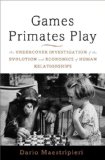
Most humans don’t realize that when they exchange emails with someone, anyone, they are actually exhibiting certain unspoken rules about dominance and hierarchy. The same rules regulate the exchange of grooming behavior in rhesus macaques or chimpanzees. Interestingly, some of the major aspects of human nature have profound commonalities with our ape ancestors: the violence of war, the intensity of love, the need to live together.
While we often assume that our behavior in everyday situations reflects our unique personalities, the choices we freely make, or the influences of our environment, we rarely consider that others behave in these situations in almost the exact the same way as we do. In Games Primates Play, primatologist Dario Maestripieri examines the curious unspoken customs that govern our behavior. These patterns and customs appear to be motivated by free will, yet they are so similar from person to person, and across species, that they reveal much more than our selected choices.
Games Primates Play uncovers our evolutionary legacy: the subtle codes that govern our behavior are the result of millions of years of evolution, predating the emergence of modern humans. To understand the rules that govern primate games and our social interactions, Maestripieri arms readers with knowledge of the scientific principles that ethologists, psychologists, economists, and other behavioral scientists have discovered in their quest to unravel the complexities of behavior. As he realizes, everything from how we write emails to how we make love is determined by the legacy of our primate roots and the conditions that existed so long ago.
An idiosyncratic and witty approach to our deep and complex origins, Games Primates Play reveals the ways in which our primate nature drives so much of our lives.
Did you know that the most creative companies have centralized bathrooms? That brainstorming meetings are a terrible idea? That the color blue can help you double your creative output?
From the New York Times best-selling author of How We Decide comes a sparkling and revelatory look at the new science of creativity. Shattering the myth of muses, higher powers, even creative “types,” Jonah Lehrer demonstrates that creativity is not a single gift possessed by the lucky few. It’s a variety of distinct thought processes that we can all learn to use more effectively.
Lehrer reveals the importance of embracing the rut, thinking like a child, daydreaming productively, and adopting an outsider’s perspective (travel helps). He unveils the optimal mix of old and new partners in any creative collaboration, and explains why criticism is essential to the process. Then he zooms out to show how we can make our neighborhoods more vibrant, our companies more productive, and our schools more effective.
You’ll learn about Bob Dylan’s writing habits and the drug addictions of poets. You’ll meet a Manhattan bartender who thinks like a chemist, and an autistic surfer who invented an entirely new surfing move. You’ll see why Elizabethan England experienced a creative explosion, and how Pixar’s office space is designed to spark the next big leap in animation.
Collapsing the layers separating the neuron from the finished symphony, Imagine reveals the deep inventiveness of the human mind, and its essential role in our increasingly complex world.
Buddhism asserts that we each have the potential to free ourselves from the prison of our problems. As practiced for more than twenty-six hundred years, the process involves working with, rather than against, our depression, anxiety, and compulsions. We do this by recognizing the habitual ways our minds perceive and react — the way they mislead. The lively exercises and inspiring real-world examples Cayton provides can help you transform intractable problems and neutralize suffering by cultivating a radically liberating self-understanding.
Why can’t our political leaders work together as threats loom and problems mount? Why do people so readily assume the worst about the motives of their fellow citizens? In The Righteous Mind, social psychologist Jonathan Haidt explores the origins of our divisions and points the way forward to mutual understanding.
His starting point is moral intuition—the nearly instantaneous perceptions we all have about other people and the things they do. These intuitions feel like self-evident truths, making us righteously certain that those who see things differently are wrong. Haidt shows us how these intuitions differ across cultures, including the cultures of the political left and right. He blends his own research findings with those of anthropologists, historians, and other psychologists to draw a map of the moral domain, and he explains why conservatives can navigate that map more skillfully than can liberals. He then examines the origins of morality, overturning the view that evolution made us fundamentally selfish creatures. But rather than arguing that we are innately altruistic, he makes a more subtle claim—that we are fundamentally groupish. It is our groupishness, he explains, that leads to our greatest joys, our religious divisions, and our political affiliations. In a stunning final chapter on ideology and civility, Haidt shows what each side is right about, and why we need the insights of liberals, conservatives, and libertarians to flourish as a nation.