September 5, 2008
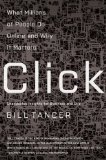
Click: What Millions of People Are Doing Online and Why it Matters by Bill Tancer (Hyperion, 2008). Tancer is the General Manager of Global Research at Hitwise.
Book Description
What time of year do teenage girls search for prom dresses online? How does the quick adoption of technology affect business success (and how is that related to corn farmers in Iowa)? How do time and money affect the gender of visitors to online dating sites? And how is the Internet itself affecting the way we experience the world? In Click, Bill Tancer takes us behind the scenes into the massive database of online intelligence to reveal the naked truth about how we use the Web, navigate to sites, and search for information–and what all of that says about who we are.
As online directories replace the yellow pages, search engines replace traditional research, and news sites replace newsprint, we are in an age in which we’ve come to rely tremendously on the Internet–leaving behind a trail of information about ourselves as a culture and the direction in which we are headed. With surprising and practical insight, Tancer demonstrates how the Internet is changing the way we absorb information and how understanding that change can be used to our advantage in business and in life. Click analyzes the new generation of consumerism in a way no other book has before, showing how we use the Internet, and how those trends provide a wealth of market research nearly as vast as the Internet itself. Understanding how we change is integral to our success. After all, we are what we click.
First chapter available here
Author’s blog
Comments (0)
- culture,new books
September 4, 2008
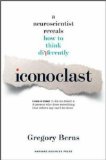
Iconoclast: A Neuroscientist Reveals How to Think Differently by Gregory Burns (Harvard Business Press, 2008) is indicated as “In Stock” at Amazon even though the publication date is listed for later this month. Amazon has “Search Inside” for this book so an excerpt is available. There is also a preview available through the publisher’s website.
Product Description
No organization can survive without iconoclasts — innovators who single-handedly upturn conventional wisdom and manage to achieve what so many others deem impossible.
Though indispensable, true iconoclasts are few and far between. In Iconoclast, neuroscientist Gregory Berns explains why. He explores the constraints the human brain places on innovative thinking, including fear of failure, the urge to conform, and the tendency to interpret sensory information in familiar ways.
Through vivid accounts of successful innovators ranging from glass artist Dale Chihuly to physicist Richard Feynman to country/rock trio the Dixie Chicks, Berns reveals the inner workings of the iconoclast’s mind with remarkable clarity. Each engaging chapter goes on to describe practical actions we can each take to understand and unleash our own potential to think differently — such as seeking out new environments, novel experiences, and first-time acquaintances.
Packed with engaging stories, science-based insights, potent practices, and examples from a startling array of disciplines, this engaging book will help you understand how iconoclasts think and equip you to begin thinking more like an iconoclast yourself.
Comments (0)
- cognitive science,new books
September 2, 2008
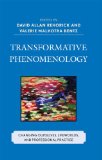
Transformative Phenomenology: Changing Ourselves, Lifeworlds, and Professional Practice edited by David Allan Rehorick and Valerie Malhotra Bentz (Lexington Books, 2008) … and it has gotten some good reviews too.
Product Description
The fourteen authors in this collection used phenomenology (the study of consciousness) and hermeneutics (the interpretation of meaning) to conduct deep inquiry into perplexing and wondrous events in their work and personal lives. These seasoned scholar-practitioners gained remarkable insight into areas such as health care and illness, organ donation, intercultural communications, high-performance teams, artistic production, jazz improvisation, and the integration of Tai Chi into education. All authors were transformed by phenomenology’s expanded ways of seeing and being.
I also found the table of contents:
Coming to phenomenology : saying why and showing how — Transformative phenomenology : a scholarly scaffold for practitioners / Valerie Malhotra Bentz and David Rehorick — Male experiences of pregnancy : bridging phenomenological and empirical insights / David Allan Rehorick and Linda Nugent — Experiencing phenomenology as mindful transformation : an autobiographical account / Sandra K. Simpson — Lessons from illness and personal trauma : pathways to individual change — Trial by fire : the transformational journey of an adult male cancer survivor / Dudley O. Tower — My body the traitor : fearing a recurrence of breast cancer / Roanne Thomas-MacLean — Take my kidney please : an organ donor’s experience / Jeffrey L. Nonemaker — Empowerment in workworlds : self-other transformations in corporate environments — The lifeworld of high performance teams : an experiential account / Lucy Dinwiddie — Personal power : realizing self in doing and being / Bernie Novokowsky — Bodymindfulness and energetic presence in intercultural communication / Adair Linn Nagata — Experiencing transcendence : personal transformation as collaborative accomplishment — Finding voice and reclaiming identity : embodied wisdom in the lived experience of Norteñas de nuevo méjico / Gloria L. Córdova — A breath of fresh air : phenomenological sociology and Tai Chi / Marc J. LaFountain — Intentionality in action : teaching artists phenomenology / David B. Haddad — Chasing transcendence : experiencing magic moments in jazz improvisation / Steven C. Jeddeloh
The publisher’s webpage also links to a sample chapter.
Comments (19)
- consciousness,new books
August 26, 2008
Reviewed in The Telegraph: “The Pages is a nicely written, wonderfully entertaining novel with optional depths about the discoveries of an Australian who devotes his adult life to an introspective search for truth.”

The Pages is coming next month in the US (Sept. 28).
Comments (0)
- fiction,new books
August 21, 2008
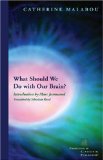
Too bad we’ll have to wait until October to find out What Should We Do with Our Brain? by Catherine Malabou.
Product description:
Recent neuroscience, in replacing the old model of the brain as a single centralized locus of control, has emphasized a feature of the brain called plasticity, whereby our brain develops and changes throughout an entire lifetime. Through this plasticity, our brain exists as a historical product; it develops in interaction with the environment, through human experience. Hence there is a thin frontier between the organization of the nervous system and the political and social organization conditioning and conditioned by that experience. The new way of speaking about the brain is a mirror image of the capitalist world in which we now live. “Plasticity,” in connection with such an image, can have two meanings. In its neo-liberal meaning, “plasticity” amounts to “flexibility” — in economics and management theory, “flexible” has become a buzzword. The plastic brain might thus represent just another style of power which, although less centralized, is still a means of control. But in this book, Catherine Malabou proposes a more radical meaning for plasticity, one that not only adapts itself to existing circumstances, but forms a margin of freedom to intervene, to change the circumstances. Such an understanding of this concept opens up a transformative aspect of the neurosciences, opposed to their aspect of domination and control. In insisting on this proximity between the neurosciences and the social sciences, Malabou applies to the brain Marx’s well-known phrase about history: people make their own brain, but they do not know it. This book is a call to such knowledge.
Comments (0)
- cognitive science,new books