October 1, 2008
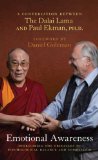
Emotional Awareness: Overcoming the Obstacles to Psychological Balance and Compassion by the Dalai Lama and Paul Ekman (Times Books, 2008) seems quite similar to the Mind and Life Institute series of books but it doesn’t appear on their list of publications.
Product Description
Two leading thinkers engage in a landmark conversation about human emotions and the pursuit of psychological fulfillment
At their first meeting, a remarkable bond was sparked between His Holiness the Dalai Lama, one of the world’s most revered spiritual leaders, and the psychologist Paul Ekman, whose groundbreaking work helped to define the science of emotions. Now these two luminaries share their thinking about science and spirituality, the bonds between East and West, and the nature and quality of our emotional lives.
In this unparalleled series of conversations, the Dalai Lama and Ekman prod and push toward answers to the central questions of emotional experience. What are the sources of hate and compassion? Should a person extend her compassion to a torturer—and would that even be biologically possible? What does science reveal about the benefits of Buddhist meditation, and can Buddhism improve through engagement with the scientific method? As they come to grips with these issues, they invite us to join them in an unfiltered view of two great traditions and two great minds.
Accompanied by commentaries on the findings of emotion research and the teachings of Buddhism, their interplay—amusing, challenging, eye-opening, and moving—guides us on a transformative journey in the understanding of emotions.
Comments (0)
- meditation,mind,new books
September 30, 2008
Andy Clark‘s new book Supersizing the Mind: Embodiment, Action, and Cognitive Extension (Philosophy of the Mind), mentioned as a forthcoming title last March in David Chalmers’s blog, is now available. The foreword by Chalmers is online.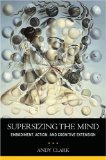
Product Description
When historian Charles Weiner found pages of Nobel Prize-winning physicist Richard Feynman’s notes, he saw it as a “record” of Feynman’s work. Feynman himself, however, insisted that the notes were not a record but the work itself. In Supersizing the Mind, Andy Clark argues that our thinking doesn’t happen only in our heads but that “certain forms of human cognizing include inextricable tangles of feedback, feed-forward and feed-around loops: loops that promiscuously criss-cross the boundaries of brain, body and world.” The pen and paper of Feynman’s thought are just such feedback loops, physical machinery that shape the flow of thought and enlarge the boundaries of mind. Drawing upon recent work in psychology, linguistics, neuroscience, artificial intelligence, robotics, human-computer systems, and beyond, Supersizing the Mind offers both a tour of the emerging cognitive landscape and a sustained argument in favor of a conception of mind that is extended rather than “brain-bound.” The importance of this new perspective is profound. If our minds themselves can include aspects of our social and physical environments, then the kinds of social and physical environments we create can reconfigure our minds and our capacity for thought and reason.
Oxford University Press has the Table of Contents.
It’s unclear how this book relates to Clark’s earlier Natural Born Cyborgs, but it appears to be a more academic/philosophical treatment of the extended-mind concept.
Comments (1)
- cognitive science,new books,philosophy of mind
September 26, 2008
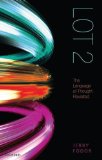
LOT 2: The Language of Thought Revisited is a new book by philosopher Jerry Fodor, though right now it is listed as “out of stock” at both Amazon and publisher Oxford University Press. A preview is available online through Amazon’s “Look Inside the Book.”
Product Description
Jerry Fodor presents a new development of his famous Language of Thought hypothesis, which has since the 1970s been at the centre of interdisciplinary debate about how the mind works. Fodor defends and extends the groundbreaking idea that thinking is couched in a symbolic system realized in the brain. This idea is central to the representational theory of mind which Fodor has established as a key reference point in modern philosophy, psychology, and cognitive science. The foundation stone of our present cognitive science is Turing’s suggestion that cognitive processes are not associations but computations; and computation requires a language of thought.
So the latest on the Language of Thought hypothesis, from its progenitor, promises to be a landmark in the study of the mind. LOT 2 offers a more cogent presentation and a fuller explication of Fodor’s distinctive account of the mind, with various intriguing new features. The central role of compositionality in the representational theory of mind is revealed: most of what we know about concepts follows from the compositionality of thoughts. Fodor shows the necessity of a referentialist account of the content of intentional states, and of an atomistic account of the individuation of concepts. Not least among the new developments is Fodor’s identification and persecution of pragmatism as the leading source of error in the study of the mind today.
LOT 2 sees Fodor advance undaunted towards the ultimate goal of a theory of the cognitive mind, and in particular a theory of the intentionality of cognition. No one who works on the mind can ignore Fodor’s views, expressed in the coruscating and provocative style which has delighted and disconcerted countless readers over the years.
See also: “Language of thought” at Wikipedia
Comments (0)
- new books,philosophy of mind
September 24, 2008
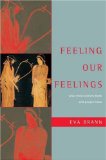
Feeling Our Feelings: What Philosophers Think and People Know by Eva Brann (Paul Dry Books, 2008) has a publication date of Oct 1 according to Amazon.
Product Description
In Feeling Our Feelings, Eva Brann considers what the great philosophers on the passions and feelings have thought and written about them. She examines the relevant work of Plato, Aristotle, the Stoics, Aquinas, Descartes, Spinoza, Adam Smith, Hume, Kierkegaard, and Heidegger, and also includes a chapter on contemporary studies on the brain. Feeling Our Feelings provides a comprehensive look at this pervasive and elusive topic.
The publisher also offers an excerpt:
“Feeling our feelings” comes from the words a little boy called Zeke said to me some thirty years ago when he was four. I was swinging him in a park in Cambridge, Massachusetts, and not doing it right. “Swing me higher,” he said, “I want to feel my feelings.” The phrase stuck with me; you might say it festered in my mind; it agitated questions: Why do we all want to feel our feelings, so generally that people “not in touch” with them are thought to be in need of therapy? What feeling was swinging high inducing? Was it an exultation of the body or an exhilaration of the soul? When he wanted to be feeling his feelings, was there a difference between the general feeling, the mere consciousness of being affected, and his particular feelings, the distinguishable affects?—as, when you sing a song, there is a difference between the singing done and the song sung—or is there? —Eva Brann, from her Preface
Comments (1)
- new books,philosophy of mind
September 22, 2008
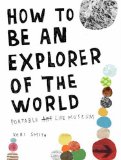
How to Be an Explorer of the World: Portable Life Museum by Keri Smith is coming in early October from Perigee.
Product Description
From the author of Wreck This Journal, an interactive guide for exploring and documenting the art and science of everyday life.
Artists and scientists analyze the world around them in surprisingly similar ways, by observing, collecting, documenting, analyzing, and comparing. In this captivating guided journal, readers are encouraged to explore their world as both artists and scientists.
The mission Smith proposes? “To document and observe the world around you. As if you’ve never seen it before. Take notes. Collect things you find on your travels. Document findings. Notice patterns. Copy. Trace. Focus on one thing at a time. Record what you are drawn to.”
With a series of interactive prompts and a beautifully hand-illustrated two-color package, readers will enjoy exploring and discovering the world through this gorgeous book.
The Wish Jar is Keri Smith’s blog, also fun to look at.
Here’s a related Amazon “Listmania” for books on “Journaling & Altered Book Techniques“
Comments (1)
- new books