[ View menu ]

Archive for 'new books'

coming soon: ‘The Art Instinct’ by Denis Dutton

December 21, 2008

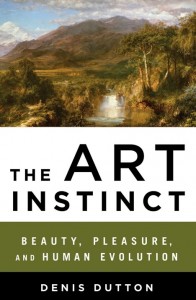
The Art Instinct

The Art Instinct: Beauty, Pleasure, and Human Evolution by Denis Dutton (Bloomsbury, 2008) is due out on Dec. 23, maybe just in time for Christmas if your local bookstore has it, or perhaps something to keep in mind if you have gift certificates to use after the holidays.

Here is the product description:

In a groundbreaking new book that does for art what Stephen Pinker’s The Language Instinct did for linguistics, Denis Dutton overturns a century of art theory and criticism and revolutionizes our understanding of the arts.
The Art Instinct combines two fascinating and contentious disciplines—art and evolutionary science—in a provocative new work that will change forever the way we think about the arts, from painting to literature to movies to pottery. Human tastes in the arts, Dutton argues, are evolutionary traits, shaped by Darwinian selection. They are not, as the past century of art criticism and academic theory would have it, just “socially constructed.”
Our love of beauty is inborn, and many aesthetic tastes are shared across remote cultures—just one example is the widespread preference for landscapes with water and distant trees, like the savannas where we evolved. Using forceful logic and hard evidence, Dutton shows that we must premise art criticism on an understanding of evolution, not on abstract “theory.” He restores the place of beauty, pleasure, and skill as artistic values.
Sure to provoke discussion in scientific circles and uproar in the art world, The Art Instinct offers radical new insights into both the nature of art and the workings of the human mind.

The book has a website, though not a lot is there yet. See also: author’s website. According to Wikipedia, Dutton is a co-founder of the website Arts & Letters Daily Review, which I have often visited and enjoyed.

Comments (0) - culture,new books

‘Born to Be Good: The Science of a Meaningful Life’ – coming in January

December 17, 2008

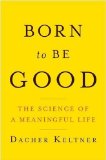
Born to Be Good
Born to Be Good: The Science of a Meaningful Life by Dacher Keltner (W.W. Norton & Co., 2009) is due out on Jan. 12.

Product Description

A new examination of the surprising origins of human goodness. In Born to Be Good, Dacher Keltner demonstrates that humans are not hardwired to lead lives that are “nasty, brutish, and short”—we are in fact born to be good. He investigates an old mystery of human evolution: why have we evolved positive emotions like gratitude, amusement, awe, and compassion that promote ethical action and are the fabric of cooperative societies?

By combining stories of scientific discovery, personal narrative, and Eastern philosophy, Keltner illustrates his discussions with more than fifty photographs of human emotions. Born to Be Good is a profound study of how emotion is the key to living the good life and how the path to happiness goes through human emotions that connect people to one another.

Keltner is a professor in the UC Berkeley Psychology Department.

YouTube has a video of Keltner discussing Born to Be Good:

Comments (0) - happiness,new books

‘How We Decide’ by Jonah Lehrer – coming in February

December 14, 2008

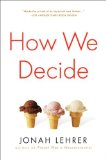
How We Decide
How We Decide by Jonah Lehrer (Proust Was a Neuroscientist, The Frontal Cortex) is already a popular pre-order at Amazon, though not due out until next February.

Product Description:

From the acclaimed author of Proust Was a Neuroscientist, a fascinating look at the new science
of decision-making—and how it can help us make better choices.
Since Plato, philosophers have described the decisionmaking process as either rational or emotional: we carefully deliberate or we “blink” and go with our gut. But as scientists break open the mind’s black box with the latest tools of neuroscience, they’re discovering that this is not how the mind works. Our best decisions are a finely tuned blend of both feeling and reason—and the precise mix depends on the situation. When buying a house, for example, it’s best to let our unconscious mull over the many variables. But when we’re picking a stock, intuition often leads us astray. The trick is to determine when to lean on which part of the brain, and to do this, we need to think harder (and smarter) about how we think.
Jonah Lehrer arms us with the tools we need, drawing on cutting-edge research by Daniel Kahneman, Colin Camerer, and others, as well as the real-world experiences of a wide range of “deciders”—from airplane pilots and hedge fund investors to serial killers and poker players. Lehrer shows how people are taking advantage of the new science to make better television shows, win more football games, and improve military intelligence. His goal is to answer two questions that are of interest to just about anyone, from CEOs to firefighters: How does the human mind make decisions? And how can we make those decisions better?

Comments (0) - new books,psychology

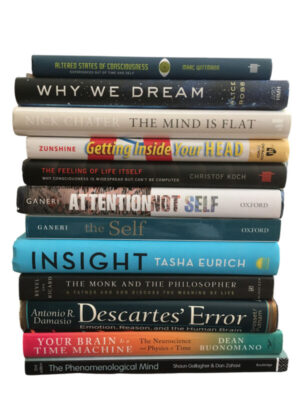
philosophy of mind books 2008-2009

December 8, 2008

Here are some of the recent books in philosophy of mind and some coming next year, based on a search of WorldCat.

The Achilles of rationalist psychology by Thomas M Lennon; Robert Stainton; (Dordrecht; London: Springer, 2008).

Being reduced : new essays on reduction, explanation, and causation ed. by Jakob Hohwy; Jesper Kallestrup; (Oxford; New York: Oxford University Press, 2008).

Brainstorming Views and Interviews on the Mind.  by Shaun Gallagher (Imprint Academic, 2008).

The case for qualia ed. by Edmond Leo Wright; (Cambridge, Mass.: MIT Press, 2008).

Descartes and the passionate mind by Deborah J Brown (Cambridge: Cambridge University Press, 2008).

The epicurean theory of mind, meaning, and knowledge by David Swift (Newcastle, UK: Cambridge Scholars Pub., 2008).

Folk psychological narratives : the sociocultural basis of understanding reasons by Daniel D Hutto (Cambridge, Mass.: MIT Press, 2008).

The Innate Mind: Foundations and the Future, Volume 3 ed. by Peter Carruthers; Stephen Laurence; Stephen P Stich; (New York; Oxford: Oxford University Press, 2008).

The Kingdom of Infinite Space: An Encounter with Your Head by Raymond Tallis (New Haven: Yale University Press, 2008).

The mechanical mind in history ed. by Philip Husbands; Owen Holland; Michael Wheeler (Cambridge, Mass.: MIT Press, 2008).

Mental causation: a nonreductive approach by Neil Campbell (New York: Peter Lang, 2008).

Mental causation : the mind-body problem by Anthony Dardis (New York: Columbia University Press, 2008).

Mind and common sense: philosophical essays on commonsense psychology ed. by Radu J Bogdan; (Cambridge: Cambridge University Press, 2008).

The mind in nature by C.B. Martin (Oxford: Clarendon Press; New York: Oxford University Press, 2008).

On the philosophy of mind by Barbara Montero (Belmont, CA: Wadsworth, Cengage Learning, 2008)

The subject’s point of view by Katalin Farkas (Oxford: New York: Oxford University Press, 2008).

Supersizing the mind : embodiment, action, and cognitive extension by Andy Clark (Oxford; New York: Oxford University Press, 2008).

Symbolic worlds: art, science, language, ritual by Israel Scheffler (Cambridge, [England]: Cambridge University Press, 2008).

Symbols and embodiment: debates on meaning and cognition ed. by Manuel de Vega; Arthur M Glenberg; Arthur C Graesser; (Oxford; New York: Oxford University Press, 2008).

Theory of mind: how children understand others’ thoughts and feelings by Martin J Doherty (Hove; New York: Psychology Press, 2008).

Tropes, universals and the philosophy of mind : essays at the boundary of ontology and philosophical psychology ed. by Simone Gozzano; Francesco Orilia; (Frankfurt [Germany]: Ontos Verlag; Piscataway, NJ: [Distributed in] North and South America by Transaction Books, Rutgers University, 2008).

What should we do with our brain? by Catherine Malabou (New York: Fordham University Press, 2008).

The wisdom of donkeys: finding tranquility in a chaotic world by Andy Merrifield (New York: Walker: Distributed to the trade by Macmillan, 2008).

2009

Against theory of mind ed. by Ivan Leudar; Alan Costall; (Basingstoke: Palgrave Macmillan, 2009). (May 2009)

Anti-externalism by Joseph Mendola (Oxford; New York: Oxford University Press, 2009). (Jan 2009)

Descartes’s changing mind by Peter K Machamer; J E McGuire (Princeton: Princeton University Press, 2009). (July 2009)

Embodied minds in action Robert Hanna; Michelle Maiese (New York: Oxford University Press, 2009). (March 2009)

Emotions and understanding: Wittgensteinian perspectives ed. by Ylva Gustafsson; Camilla Kronqvist; Michael McEachrane; (New York: Palgrave Macmillan, 2009). (April 2009)

Mind’s world : imagination and subjectivity from Descartes to Romanticism by Alexander M Schlutz (Seattle, WA: University of Washington Press, 2009). (Feb 2009)

The Oxford handbook of philosophy of mind ed. by Brian P McLaughlin; Ansgar Beckermann; Sven Walter; (Oxford; New York: Oxford University Press, 2009). (March 2009)

The philosophy of mind: the metaphysics of consciousness by Dale Jacquette (London; New York: Continuum, 2009). (June 2009)

Understanding people : normativity and rationalizing explanation by Alan Millar (Oxford : Oxford University Press, 2009). (Jan. 2009)
Comments (6) - new books,philosophy of mind

coming soon: ‘The Origin of Consciousness in the Social World’

December 1, 2008

The Origin of Consciousness in the Social World

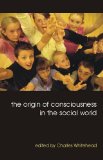
The Origin of Consciousness in the Social World (which should be added to the list of books on consciousness), ed. by Charles Whitehead (Imprint Academic, 2008). Amazon has “Search Inside the Book” for this title, so the Table of Contents and an excerpt are available, though the book is still a preorder in the US. (It is in stock at Amazon UK.)

Publisher’s description:

Western individualism has delayed scientific recognition of the essentially social nature of consciousness – or at least of the human mind and brain. Milestone publications (in ethology, primatology and cognitive science), dealing with theory of mind, Machiavellian intelligence, the social brain and mirror neurones, demonstrate that the origin of consciousness needs to be understood in a social context. This is reinforced by classic theorists in social psychology and cultural and social anthropology, like Dilthey, Baldwin, Cooley, Mead and Goffman.

The contributors to this volume, including Chris Frith, Robert Turner, Nalini Ambady, Corrado Sinigaglia, Chris Knight, Colwyn Trevarthen, Vasudevi Reddy, Maya Gratier, Michael Apter, Joan Chiao and Andreas Roepstorff , introduce some of these anthropological themes into consciousness studies.

Comments (0) - consciousness,new books