[ View menu ]

Archive for 'new books'

recent release: ‘Self, Logic, and Figurative Thinking’

January 10, 2009
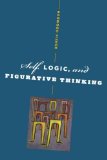
Self, Logic and Figurative Thinking

Self, Logic, and Figurative Thinking by Harwood Fisher (Columbia University Press, 2008).

Product Description

Harwood Fisher argues against neuroscientific and cognitive scientific explanations of mental states, for they fail to account for the gaps between actions in the brain, cognitive operations, linguistic mapping, and an individual’s account of experience. Fisher probes a rich array of thought from the primitive and the dream to the artistic figure of speech, and extending to the scientific metaphor. He draws on first-person methodologies to restore the conscious self to a primary function in the generation of figurative thinking.

How does the individual originate and organize terms and ideas? How can we differentiate between different types of thought and account for their origins? Fisher depicts the self as mediator between trope and logical form. Conversely, he explicates the creation and articulation of the self through interplay between logic and icon. Fisher explains how the “I” can step out of scripted roles. The self is neither a discursive agent of postmodern linguistics nor a socially determined entity. Rather, it is a historically situated, dynamically constituted place at the crossroads of conscious agency and unconscious actions and evolving contextual logics and figures.

Fisher is a professor emeritus of City College of New York; an earlier book of his is The Subjective Self: A Portrait inside Logical Space (University of Nebraska Press, 2001) (reviewed at Metapsychology)
Comments (0) - new books,self

Cognitive science books coming in 2009

January 4, 2009

For “browsing into the future,” here is a list of cognitive science books coming in 2009, including related subject terms “cognition” and “cognitive psychology,” based on a search of WorldCat:


Cognitive archaeology and human evolution
ed. by Sophie A de Beaune; Frederick L Coolidge; Thomas Wynn (Cambridge; New York: Cambridge University Press, 2009). June 2009

Cognitive biology : evolutionary and developmental perspectives on mind, brain, and behavior ed. by Luca Tommasi; Mary A Peterson; Lynn Nadel (Cambridge, MA: MIT Press, 2009). July 2009

Computation, cognition, and Pylyshyn ed. by Don Dedrick; Lana Trick (Cambridge, MA : MIT Press, 2009). July 2009

Emotion and the psychodynamics of the cerebellum: a neuro-psychoanalytical analysis and synthesis by Fred Levin (London: Karnac, 2009). March 2009

Foundations in evolutionary cognitive neuroscience : introduction to the discipline ed. by Steven M Platek; Todd K Shackelford (Cambridge; New York: Cambridge University Press, 2009). March 2009

Ignorance : on the wider implications of deficient knowledge by Nicholas Rescher (Pittsburgh, Pa.: University of Pittsburgh Press, 2009. Feb 2009 (Amazon has this marked as a 2nd ed. but I couldn’t turn up an earlier edition.)

In two minds: dual processes and beyond ed. by Jonathan Evans; Keith Frankish (Oxford; New York: Oxford University Press, 2009). Sept 2009

Memory and the computational brain : why cognitive science will transform neuroscience by C R Gallistel; Adam Philip King (Chichester, West Sussex, UK; Malden, MA: Wiley-Blackwell, 2009). May 2009

On the Origins of Cognitive Science: the mechanization of mind by Jean-Pierre Dupuy (Cambridge, MA: MIT Press, 2009). April 2009

Perception and cognition : essays in the philosophy of psychology Gary C Hatfield (Oxford : Oxford University Press, 2009). Aug 2009

The philosophical baby : what children’s minds tell us about truth, love, and the meaning of life by Alison Gopnik (New York: Farrar, Straus and Giroux, 2009). Aug 2009


The rise of homo sapiens : the evolution of modern thinking
by Frederick L Coolidge; Thomas Wynn (Oxford: Wiley-Blackwell, 2009). April 2009

The sapient mind: archaeology meets neuroscience ed. by Colin Renfrew; Christopher D Frith; Lambros Malafouris (Oxford: Oxford University Press, 2009). Sept 2009

Supernatural agents: why we believe in souls, gods and buddhas by Ilkka Pyysiäinen (New York: Oxford University Press, 2009). May 2009

Wednesday is indigo blue: discovering the brain of synesthesia by Richard E Cytowic; David Eagleman (Cambridge, MA : MIT Press, 2009). April 2009

Comments (2) - cognitive science,new books

books and sites for New Year’s resolutions (or plain old goals)

January 3, 2009

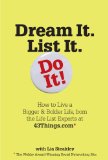
Dream It. List It. Do It!
This post was prompted when I saw that the website 43Things has put out a new book: Dream It. List It. Do It!: How to Live a Bigger & Bolder Life, from the Life List Experts at 43Things.com. (More about the book at 43Things)

For example at 43Things, “10,016 people want to read more books”!

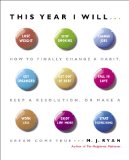
Another book to check out for help in following through on goals and resolutions is This Year I Will…: How to Finally Change a Habit, Keep a Resolution, or Make a Dream Come True by M.J. Ryan (Broadway, 2006). This Year I Will...

From the author’s website:

Why do people find it so hard to change? The secret is that everyone has their own formula for making changes that stick, but most people don’t know what theirs is. They think there is one way to lose five pounds, and another way to stay on top of their email, but they don’t realize that for all changes, there is one system that works best for each individual. This Year I Will helps you lock on to your unique formula for planning, implementing, and seeing a life change through, so you can use it again and again to tackle anything else you’d like to do.

Joe’s Goals, a free online habit tracker, is one of the sites featured in Lifehacker’s tips on how to “Set and track New Year’s Resolutions with free software.”

Comments (0) - new books,psychology

coming soon: ‘A Dialogue on Consciousness’

December 28, 2008

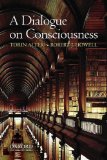
A Dialogue on Consciousness by Torin Alter and Robert J. Howell (Oxford University Press, 2009) is expected to be available on Jan. 13, 2009.
A Dialogue on Consciousness

Product Description
In recent years, the problem of consciousness has developed into one of the most important and hotly contested areas in the philosophy of mind. Many philosophers regard consciousness as an entirely physical phenomenon, yet it seems to elude scientific explanation. On the other hand, viewing consciousness as a nonphysical phenomenon brings up even larger issues. If consciousness is not physical, how can it be explained?
Concise, up-to-date, and engaging, A Dialogue on Consciousness explores these issues in depth. It features two main characters, Tollens and Ponens–unemployed graduate students who secretly live in a university library–who bring the debate alive. Tollens and Ponens examine the most significant theories and arguments in the field, quoting key passages from both classic and contemporary texts. Their discussion encompasses an expansive and diverse range of ideas, from those that originated in the Enlightenment up to today’s most current perspectives. The dialogue concludes with a consideration of the pros and cons of modern physicalist views and nonphysicalist alternatives. An extensive annotated list of suggested readings directs readers to the most relevant and helpful primary sources.
An accessible and entertaining introduction to this complex issue, Dialogue on Consciousness ideal for courses in philosophy of mind and consciousness. It also serves as an excellent supplement to introductory philosophy courses.

Comments (0) - consciousness,new books

new book: ‘Embracing the Wide Sky: A Tour Across the Horizons of the Mind’ by Daniel Tammet

December 24, 2008

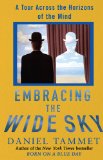
Embracing the Wide Sky: A Tour Across the Horizons of the Mind by Daniel Tammet (Free Press, 2009).
Embracing the Wide Sky
Tammet’s previous book is Born On A Blue Day: Inside the Extraordinary Mind of an Autistic Savant.

Here is the product description for Embracing the Wide Sky:

Owner of “the most remarkable mind on the planet,” (according to Entertainment Weekly) Daniel Tammet captivated readers and won worldwide critical acclaim with the 2007 New York Times bestselling memoir, Born On A Blue Day, and its vivid depiction of a life with autistic savant syndrome. In his fascinating new book, he writes with characteristic clarity and personal awareness as he sheds light on the mysteries of savants’ incredible mental abilities, and our own.

Tammet explains that the differences between savant and non-savant minds have been exaggerated; his astonishing capacities in memory, math and language are neither due to a cerebral supercomputer nor any genetic quirk, but are rather the results of a highly rich and complex associative form of thinking and imagination. Autistic thought, he argues, is an extreme variation of a kind that we all do, from daydreaming to the use of puns and metaphors.

Embracing the Wide Sky combines meticulous scientific research with Tammet’s detailed descriptions of how his mind works to demonstrate the immense potential within us all. He explains how our natural intuitions can help us to learn a foreign language, why his memories are like symphonies, and what numbers and giraffes have in common. We also discover why there is more to intelligence than IQ, how optical illusions fool our brains, and why too much information can make you dumb.

Many readers will be particularly intrigued by Tammet’s original ideas concerning the genesis of genius and exceptional creativity. He illustrates his arguments with examples as diverse as the private languages of twins, the compositions of poets with autism, and the breakthroughs, and breakdowns, of some of history’s greatest minds. Embracing the Wide Sky is a unique and brilliantly imaginative portrait of how we think, learn, remember and create, brimming with personal insights and anecdotes, and explanations of the most up-to-date, mind-bending discoveries from fields ranging from neuroscience to psychology and linguistics. This is a profound and provocative book that will transform our understanding and respect for every kind of mind.

Tammet’s blog has book excerpts and links to a great video for the book that I’m embedding here:

Comments (1) - mind,new books,psychology