February 2, 2009
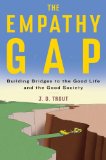 The Empathy Gap: Building Bridges to the Good Life and the Good Society by J.D. Trout (Viking, 2009) has a publication date of Feb. 5.
Publisher’s description:
A road map to a better society linking the cognitive psychology of individual and social decision making
Drawing on his sweeping and innovative research, philosopher and cognitive scientist J. D. Trout recruits the latest findings in psychology, behavioral economics, and neuroscience to answer the question: How can we make better personal decisions and design social policies that improve the lives of everyone?
Empathy prompts us to roll up our sleeves. Empathy for the risk and suffering of our fellow citizens can lead to moral outrage, more decent laws, and fairer policies. But new research on judgment and decision making has revealed that the human mind makes decisions that undermine the best interests of the individual and society alike. Empathy is an admirable impulse, but alone it is unreliable. It needs to be balanced by rationality if we are to develop a responsible social approach to decent and democratic policy making.
With penetrating insight into our cognitive and empathic limitations, Trout offers pragmatic political solutions to vault these crippling psychological barriers and outlines the best way to use our brains and our policies to improve society and the life of every individual.
See also: Author’s website
Comments (1)
- cognitive science,culture,new books
January 22, 2009
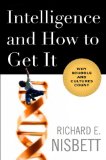
Intelligence and How to Get It: Why Schools and Cultures Count by Richard E. Nisbett (Norton, 2009).
Product Description
A bold refutation of the belief that genes determine intelligence. Who are smarter, Asians or Westerners? Are there genetic explanations for racial differences in test scores? What makes some nationalities excel in engineering and others in music? Will math and science remain a largely male preserve. From the damning research of The Bell Curve to the more recent controversy surrounding geneticist James Watson’s statements, one factor has been consistently left out of the equation: culture. In the tradition of The Mismeasure of Man by Stephen Jay Gould, world-class social psychologist Richard E. Nisbett takes on the idea of intelligence as something that is biologically determined and impervious to culture–with vast implications for the role of education as it relates to social and economic development. Intelligence and How to Get It asserts that intellect is not primarily genetic but is principally determined by societal influences. Nisbett’s commanding argument, superb marshaling of evidence, and fearless discussions of the controversial carve out new and exciting terrain in this hotly debated field.
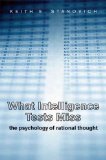
What Intelligence Tests Miss: The Psychology of Rational Thought by Keith Stanovich (Yale University Press, 2009).
Product Description
Critics of intelligence tests—writers such as Robert Sternberg, Howard Gardner, and Daniel Goleman—have argued in recent years that these tests neglect important qualities such as emotion, empathy, and interpersonal skills. However, such critiques imply that though intelligence tests may miss certain key noncognitive areas, they encompass most of what is important in the cognitive domain. In this book, Keith E. Stanovich challenges this widely held assumption.
Stanovich shows that IQ tests (or their proxies, such as the SAT) are radically incomplete as measures of cognitive functioning. They fail to assess traits that most people associate with “good thinking,” skills such as judgment and decision making. Such cognitive skills are crucial to real-world behavior, affecting the way we plan, evaluate critical evidence, judge risks and probabilities, and make effective decisions. IQ tests fail to assess these skills of rational thought, even though they are measurable cognitive processes. Rational thought is just as important as intelligence, Stanovich argues, and it should be valued as highly as the abilities currently measured on intelligence tests.
Coming later this year: Intelligence 101 by Jonathan Plucker (Springer, August 2009).
Comments (0)
- cognitive science,culture,new books
January 18, 2009
The 10,000 Year Explosion: How Civilization Accelerated Human Evolution by Gregory Cochran and Henry Harpending is new or coming soon from Basic Books, with a publication date listed as Jan. 26; as of today (Jan. 18) Amazon doesn’t have it as a pre-order or in stock, but “ships within 7 to 11 days.”
Product Description
Resistance to malaria. Blue eyes. Lactose tolerance. What do all of these traits have in common? Every one of them has emerged in the last 10,000 years.
Scientists have long believed that the “great leap forward” that occurred some 40,000 to 50,000 years ago in Europe marked end of significant biological evolution in humans. In this stunningly original account of our evolutionary history, top scholars Gregory Cochran and Henry Harpending reject this conventional wisdom and reveal that the human species has undergone a storm of genetic change much more recently. Human evolution in fact accelerated after civilization arose, they contend, and these ongoing changes have played a pivotal role in human history. They argue that biology explains the expansion of the Indo-Europeans, the European conquest of the Americas, and European Jews’ rise to intellectual prominence. In each of these cases, the key was recent genetic change: adult milk tolerance in the early Indo-Europeans that allowed for a new way of life, increased disease resistance among the Europeans settling America, and new versions of neurological genes among European Jews.
Ranging across subjects as diverse as human domestication, Neanderthal hybridization, and IQ tests, Cochran and Harpending’s analysis demonstrates convincingly that human genetics have changed and can continue to change much more rapidly than scientists have previously believed. A provocative and fascinating new look at human evolution that turns conventional wisdom on its head, The 10,000 Year Explosion reveals the ongoing interplay between culture and biology in the making of the human race.
The book has a website with chapter summaries and related information.
Comments (0)
- culture,human evolution,new books
January 14, 2009
Perception and Basic Beliefs: Zombies, Modules and the Problem of the External World by Jack Lyons, coming Jan. 20 from Oxford University Press (with zombies in the title! But the index shows just about eight zombie references in the text.)
Amazon has “Search Inside” for this title, so a preview is available.
Product Description
Perception is our main source of epistemic access to the outside world. Perception and Basic Beliefs addresses two central questions in epistemology: which beliefs are epistemologically basic (i.e., noninferentially justified) and where does perception end and inferential cognition begin. Jack Lyons offers a highly externalist theory, arguing that what makes a belief a basic belief or a perceptual belief is determined by the nature of the cognitive system, or module, that produced the beliefs. On this view, the sensory experiences that typically accompany perceptual beliefs play no indispensable role in the justification of these beliefs, and one can have perceptual beliefs–justified perceptual beliefs–even in the absence of any sensory experiences whatsoever. Lyons develops a general theory of basic beliefs and argues that perceptual beliefs are a species of basic beliefs. This results from the fact that perceptual modules are a special type of basic belief-producing modules. Importantly, some beliefs are not the outputs of this class of cognitive module; these beliefs are therefore non-basic, thus requiring inferential support from other beliefs for their justification. This last point is used to defend a reliabilist epistemology against an important class of traditional objections (where the agent uses a reliable process that she doesn’t know to be reliable).
Perception and Basic Beliefs brings together an important treatment of these major epistemological topics and provides a positive solution to the traditional problem of the external world.
The author’s homepage includes links to some of his recent papers.
Comments (0)
- new books,philosophy of mind
January 11, 2009
 The Element: How Finding Your Passion Changes Everything by Sir Ken Robinson (found via TED Blog) is published by Viking.
Product Description
From one of the world’s leading thinkers and speakers on creativity and self-fulfillment, a breakthrough book about talent, passion, and achievement
The element is the point at which natural talent meets personal passion. When people arrive at the element, they feel most themselves and most inspired and achieve at their highest levels. The Element draws on the stories of a wide range of people, from ex-Beatle Paul McCartney to Matt Groening, creator of The Simpsons; from Meg Ryan to Gillian Lynne, who choreographed the Broadway productions of Cats and The Phantom of the Opera; and from writer Arianna Huffington to renowned physicist Richard Feynman and others, including business leaders and athletes. It explores the components of this new paradigm: The diversity of intelligence, the power of imagination and creativity, and the importance of commitment to our own capabilities.
With a wry sense of humor, Ken Robinson looks at the conditions that enable us to find ourselves in the element and those that stifle that possibility. He shows that age and occupation are no barrier, and that once we have found our path we can help others to do so as well. The Element shows the vital need to enhance creativity and innovation by thinking differently about human resources and imagination. It is also an essential strategy for transforming education, business, and communities to meet the challenges of living and succeeding in the twenty-first century.
See also: website for The Element
An earlier book by Ken Robinson is Out of Our Minds: Learning to be Creative
Comments (0)
- new books