March 22, 2009

Effective Intentions: The Power of Conscious Will by Alfred Mele (Oxford University Press, 2009) with a “Look Inside” preview available from Amazon.
(If the cover looks familiar it has the same photo as another recent Oxford Press book; however, the Oxford website shows a different cover.)
Product description – from the publisher:
Each of the following claims has been defended in the scientific literature on free will and consciousness: your brain routinely decides what you will do before you become conscious of its decision; there is only a 100 millisecond window of opportunity for free will, and all it can do is veto conscious decisions, intentions, or urges; intentions never play a role in producing corresponding actions; and free will is an illusion.
In Effective Intentions Alfred Mele shows that the evidence offered to support these claims is sorely deficient. He also shows that there is strong empirical support for the thesis that some conscious decisions and intentions have a genuine place in causal explanations of corresponding actions. In short, there is weighty evidence of the existence of effective conscious intentions or the power of conscious will. Mele examines the accuracy of subjects’ reports about when they first became aware of decisions or intentions in laboratory settings and develops some implications of warranted skepticism about the accuracy of these reports. In addition, he explores such questions as whether we must be conscious of all of our intentions and why scientists disagree about this. Mele’s final chapter closes with a discussion of imaginary scientific findings that would warrant bold claims about free will and consciousness of the sort he examines in this book.
Comments (0)
- new books,philosophy of mind
March 18, 2009
Perception, Hallucination, and Illusion by William Fish (Oxford University Press, 2009) has a “Look Inside” preview at Amazon.
Product Description
The idea of a disjunctive theory of visual experiences first found expression in J.M. Hinton’s pioneering 1973 book Experiences. In the first monograph in this exciting area since then, William Fish develops a comprehensive disjunctive theory, incorporating detailed accounts of the three core kinds of visual experience–perception, hallucination, and illusion–and an explanation of how perception and hallucination could be indiscriminable from one another without having anything in common. In the veridical case, Fish contends that the perception of a particular state of affairs involves the subject’s being acquainted with that state of affairs, and that it is the subject’s standing in this acquaintance relation that makes the experience possess a phenomenal character. Fish argues that when we hallucinate, we are having an experience that, while lacking phenomenal character, is mistakenly supposed by the subject to possess it. Fish then shows how this approach to visual experience is compatible with empirical research into the workings of the brain and concludes by extending this treatment to cover the many different types of illusion that we can be subject to.
Comments (0)
- new books,philosophy of mind
March 16, 2009
Subjects of the World: Darwin’s Rhetoric and the Study of Agency in Nature by Paul Sheldon Davies (U of Chicago Press, 2009).
Synopsis from the publisher:
Being human while trying to scientifically study human nature confronts us with our most vexing problem. Efforts to explicate the human mind are thwarted by our cultural biases and entrenched infirmities; our first-person experiences as practical agents convince us that we have capacities beyond the reach of scientific explanation. What we need to move forward in our understanding of human agency, Paul Sheldon Davies argues, is a reform in the way we study ourselves and a long overdue break with traditional humanist thinking.
Davies locates a model for change in the rhetorical strategies employed by Charles Darwin in On the Origin of Species. Darwin worked hard to anticipate and diminish the anxieties and biases that his radically historical view of life was bound to provoke. Likewise, Davies draws from the history of science and contemporary psychology and neuroscience to build a framework for the study of human agency that identifies and diminishes outdated and limiting biases. The result is a heady, philosophically wide-ranging argument in favor of recognizing that humans are, like everything else, subjects of the natural world—an acknowledgement that may free us to see the world the way it actually is.
Comments (0)
- new books,philosophy of mind,self
March 12, 2009
The Oxford Handbook of Philosophy of Mind (Oxford University Press, 2009) is available, with “Look Inside” at Amazon for a preview of the Table of Contents and part of Jaegwon Kim’s article on “Mental Causation.”
Information from the publisher:
Product Description
The study of the mind has always been one of the main preoccupations of philosophers, and has been a booming area of research in recent decades, with remarkable advances in psychology and neuroscience. Oxford University Press now presents the most authoritative and comprehensive guide ever published to the philosophy of mind.
An outstanding international team of contributors offer 45 specially written critical surveys of a wide range of topics relating to the mind. The first two sections cover the place of the mind in the natural world: its ontological status, how it fits into the causal fabric of the universe, and the nature of consciousness. The third section focuses on the much-debated subjects of content and intentionality. The fourth section examines a variety of mental capacities, including memory, imagination, and emotion. The fifth section looks at epistemic issues, in particular regarding knowledge of one’s own and other minds. The volume concludes with a section on self, personhood, and agency.
The Oxford Handbook of Philosophy of Mind will be an invaluable resource for advanced students and scholars of philosophy, and also for researchers in neighboring disciplines seeking a high-level survey of the state of the art in this flourishing field.
Comments (2)
- new books,philosophy of mind
March 8, 2009
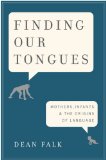
Finding Our Tongues: Mothers, Infants, and the Origins of Language by Dean Falk (Basic Books, 2009).
from the publisher:
Description
Scientists have long theorized that abstract, symbolic thinking evolved to help humans negotiate such classically male activities as hunting, tool making, and warfare, and eventually developed into spoken language. In Finding Our Tongues, Dean Falk overturns this established idea, offering a daring new theory that springs from a simple observation: parents all over the world, in all cultures, talk to infants by using baby talk or “Motherese.” Falk shows how Motherese developed as a way of reassuring babies when mothers had to put them down in order to do work. The melodic vocalizations of early Motherese not only provided the basis of language but also contributed to the growth of music and art. Combining cutting-edge neuroscience with classic anthropology, Falk offers a potent challenge to conventional wisdom about the emergence of human language.
Comments (0)
- culture,language,mind,new books