May 5, 2009
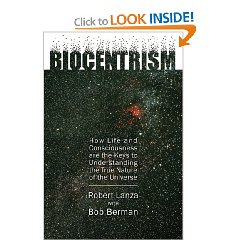 by Robert Lanza and Bob Berman (Benbella Books, 2009)
Biocentrism: How Life and Consciousness Are the Keys to Understanding the True Nature of the Universe
Every now and then, a simple yet radical idea shakes the very foundations of knowledge. The startling discovery that the world was not flat challenged and ultimately changed the way people perceived themselves and their relationships with the world. For most humans of the 15th century, the notion of Earth as ball of rock was nonsense. The whole of Western natural philosophy is undergoing a sea change again, forced upon us by the experimental findings of quantum theory. At the same time, these findings have increased our doubt and uncertainty about traditional physical explanations of the universe’s genesis and structure.
Biocentrism completes this shift in worldview, turning the planet upside down again with the revolutionary view that life creates the universe instead of the other way around. In this new paradigm, life is not just an accidental byproduct of the laws of physics.
Biocentrism takes the reader on a seemingly improbable but ultimately inescapable journey through a foreign universe–our own–from the viewpoints of an acclaimed biologist and a leading astronomer. Switching perspective from physics to biology unlocks the cages in which Western science has unwittingly managed to confine itself. Biocentrism shatters the reader’s ideas of life, time and space, and even death. At the same time, it releases us from the dull worldview that life is merely the activity of an admixture of carbon and a few other elements; it suggests the exhilarating possibility that life is fundamentally immortal.
Biocentrism awakens in readers a new sense of possibility and is full of so many shocking new perspectives that the reader will never see reality the same way again.
See also: excerpt in May 2009 Discover Magazine
Author Robert Lanza’s website
Comments (0)
- consciousness,new books,reality
May 2, 2009

How We Get Along by David Velleman (Columbia University Press, 2009)
In How We Get Along, philosopher David Velleman compares our social interactions to the interactions among improvisational actors on stage. He argues that we play ourselves-not artificially but authentically, by doing what would make sense coming from us as we really are. And like improvisational actors, we deal with one another in dual capacities: both as characters within the social drama and as players contributing to the shared performance. In this conception of social intercourse, Velleman finds rational grounds for morality, though not a rational guarantee. He maps a middle course between skepticism and rationalism, arguing that practical reasoning is “pro-moral’ without requiring moral action. The result is what he calls a “Kinda Kantian metaethics”. Written in an accessible and engaging style, How We Get Along is the summation of Velleman’s thinking to date, incorporating and unifying previous work on agency, the self, the emotions, narrative, and Kantian moral theory.
A preview is available at the publisher’s website.
Author’s home page has links to some online papers.
Comments (0)
- culture,new books,self
April 30, 2009
Why Music Moves Us by Jeanette Bicknell (Palgrave MacMillan, 2009)
Product information from the publisher:
Surely you’ve experienced it before: you’re listening to a piece of music and all of a sudden you find a lump in your throat, a tear in your eye, or a chill down your spine. Whether it’s Beethoven’s Choral Symphony or The Verve’s ‘Bittersweet Symphony’, a bit of blues or a bit of baroque, music has the power to move us. It’s a language which we all speak. But why does it have this effect on us? What is going on, emotionally, physically and cognitively when listeners have strong emotional responses to music? What, if anything, do such responses mean? Can they tell us anything about ourselves? Jeanette Bicknell uses research in philosophy, psychology, neuroscience, and anthropology to address these questions, ultimately showing us that the reason why some music tends to arouse powerful experiences in listeners is inseparable from the reason why any music matters at all. Musical experience is a social one, and that is fundamental to its attractions and power over us.
The author’s website has a chapter-by-chapter synopsis.
Comments (0)
- culture,new books,philosophy of mind,psychology
April 28, 2009
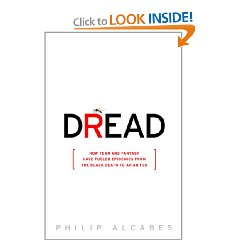
Dread: How Fear and Fantasy have Fueled Epidemics from the Black Death to the Avian Flu by Philip Alcabes (PublicAffairs, April 13, 2009) appeared shortly before the current swine flu outbreak. (& it has a Kindle edition)
Product description from the publisher:
The average individual is far more likely to die in a car accident than from a communicable disease…yet we are still much more fearful of the epidemic. Even at our most level-headed, the thought of an epidemic can inspire terror. As Philip Alcabes persuasively argues in Dread, our anxieties about epidemics are created not so much by the germ or microbe in question—or the actual risks of contagion—but by the unknown, the undesirable, and the misunderstood.
Alcabes examines epidemics through history to show how they reflect the particular social and cultural anxieties of their times. From Typhoid Mary to bioterrorism, as new outbreaks are unleashed or imagined, new fears surface, new enemies are born, and new behaviors emerge. Dread dissects the fascinating story of the imagined epidemic: the one that we think is happening, or might happen; the one that disguises moral judgments and political agendas, the one that ultimately expresses our deepest fears.
See also: article at Smithsonian.com
Author’s website added 4/29
Comments (2)
- culture,happiness,new books
April 23, 2009
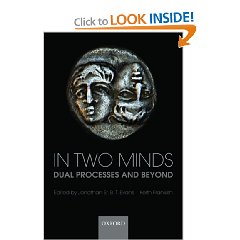
In Two Minds: Dual Processes and Beyond edited by Jonathan Evans and Keith Frankish (Oxford University Press, 2009)
(link for UK)
Product description from the publisher:
This book explores the idea that we have two minds – one that is automatic, unconscious, and fast, the other controlled, conscious, and slow. In recent years there has been great interest in so-called dual-process theories of reasoning and rationality. According to dual process theories, there are two distinct systems underlying human reasoning – an evolutionarily old system that is associative, automatic, unconscious, parallel, and fast, and a more recent, distinctively human system that is rule-based, controlled, conscious, serial, and slow. Within the former, processes are held to be innate and to use heuristics which evolved to solve specific adaptive problems. In the latter, processes are taken to be learned, flexible, and responsive to rational norms.
Despite the attention these theories are attracting, there is still poor communication between dual-process theorists themselves, and the substantial bodies of work on dual processes in cognitive psychology and social psychology remain isolated from each other. This book brings together leading researchers on dual-processes to summarize the state of the art, highlight key issues, present different perspectives, explore implications, and provide a stimulus to further work.
It includes new ideas about the human mind both by contemporary philosophers interested in broad theoretical questions about mental architecture and by psychologists specialising in traditionally distinct and isolated fields. For all those in the cognitive sciences, this is a book that will advance dual-process theorizing, promote interdisciplinary communication, and encourage further applications of dual-process approaches.
Comments (0)
- cognitive science,new books,philosophy of mind