June 2, 2009
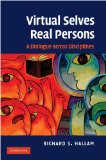
Virtual Selves, Real Persons: A Dialogue across Disciplines by Richard S. Hallam (Columbia University Press, 2009)
Product description from the publisher:
How do we know and understand who we really are as human beings? The concept of ‘the self’ is central to many strands of psychology and philosophy. This book tackles the problem of how to define persons and selves and discusses the ways in which different disciplines, such as biology, sociology and philosophy, have dealt with this topic. Richard S. Hallam examines the notion that the idea of the self as some sort of entity is a human construction and, in effect, a virtual reality. At the same time, this virtual self is intimately related to the reality of ourselves as biological organisms. Aiming to integrate a constructionist understanding of self with the universalizing assumptions that are needed in natural science approaches, this text is unique in its attempt to create a dialogue across academic disciplines, while retaining a consistent perspective on the problem of relating nature to culture.
An excerpt is available from the publisher’s website.
Comments (0)
- consciousness,new books,self
May 19, 2009
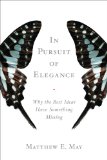
In Pursuit of Elegance: Why the Best Ideas Have Something Missing by Matthew May (Broadway Business, 2009)
Product description from the publisher:
What made the Sopranos finale one of the most-talked-about events in television history?
Why is sudoku so addictive and the iPhone so irresistible?
What do Jackson Pollock and Lance Armstrong have in common with theoretical physicists and Buddhist monks?
Elegance.
In this thought-provoking exploration of why certain events, products, and people capture our attention and imaginations, Matthew E. May examines the elusive element behind so many innovative breakthroughs in fields ranging from physics and marketing to design and popular culture. Combining unusual simplicity and surprising power, elegance is characterized by four key elements—seduction, subtraction, symmetry, and sustainability. In a compelling, story-driven narrative that sheds light on the need for elegance in design, engineering, art, urban planning, sports, and work, May offers surprising evidence that what’s “not there” often trumps what is.
In the bestselling tradition of The Tipping Point, Made to Stick, and The Black Swan, In Pursuit of Elegance will change the way you think about the world.
See also: book website
Comments (1)
- consciousness,culture,happiness,new books,psychology,self
May 17, 2009
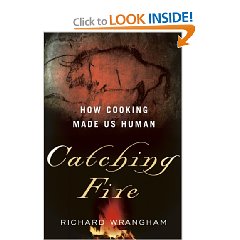
Catching Fire: How Cooking Made Us Human by Harvard primatologist Richard Wrangham (Basic Books, 2009) (which also has a Kindle edition)
Product Description from the publisher
Until two million years ago, our ancestors were apelike beings the size of chimpanzees. Then Homo erectus was born and we became human. What caused this extraordinary transformation?
In this stunningly original book, renowned primatologist Richard Wrangham argues that cooking created the human race. At the heart of Catching Fire lies an explosive new idea: The habit of eating cooked rather than raw food permitted the digestive tract to shrink and the human brain to grow, helped structure human society, and created the male-female division of labor. As our ancestors adapted to using fire, humans emerged as “the cooking apes.”
A groundbreaking new theory of evolution, Catching Fire offers a startlingly original argument about how we came to be the social, intelligent, and sexual species we are today.
See also: Scientific American interview – “Evolving bigger brains through cooking”
“The evolution of cooking” at Edge
Comments (0)
- culture,human evolution,new books
May 12, 2009
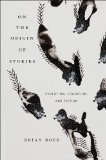
I just chanced across this book at Amazon: On the Origin of Stories: Evolution, Cognition, and Fiction by Brian Boyd (Belknap Press, 2009). I’d seen it mentioned over a year ago in an article by Boyd.
Product Description from the publisher
A century and a half after the publication of Origin of Species, evolutionary thinking has expanded beyond the field of biology to include virtually all human-related subjects—anthropology, archeology, psychology, economics, religion, morality, politics, culture, and art. Now a distinguished scholar offers the first comprehensive account of the evolutionary origins of art and storytelling. Brian Boyd explains why we tell stories, how our minds are shaped to understand them, and what difference an evolutionary understanding of human nature makes to stories we love.
Art is a specifically human adaptation, Boyd argues. It offers tangible advantages for human survival, and it derives from play, itself an adaptation widespread among more intelligent animals. More particularly, our fondness for storytelling has sharpened social cognition, encouraged cooperation, and fostered creativity.
After considering art as adaptation, Boyd examines Homer’s Odyssey and Dr. Seuss’s Horton Hears a Who! demonstrating how an evolutionary lens can offer new understanding and appreciation of specific works. What triggers our emotional engagement with these works? What patterns facilitate our responses? The need to hold an audience’s attention, Boyd underscores, is the fundamental problem facing all storytellers. Enduring artists arrive at solutions that appeal to cognitive universals: an insight out of step with contemporary criticism, which obscures both the individual and universal. Published for the bicentenary of Darwin’s birth and the 150th anniversary of the publication of Origin of Species, Boyd’s study embraces a Darwinian view of human nature and art, and offers a credo for a new humanism.
Comments (1)
- cognitive science,fiction,new books
May 10, 2009
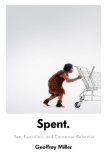
Spent: Sex, Evolution, and Consumer Behavior by evolutionary psychologist Geoffrey Miller is due out this Thurs. May 14 from Viking. (Here is the Kindle edition)
Product description from the publisher:
A leading evolutionary psychologist probes the hidden instincts behind our working, shopping, and spending
Evolutionary psychology—the compelling science of human nature—has clarified the prehistoric origins of human behavior and influenced many fields ranging from economics to personal relationships. In Spent Geoffrey Miller applies this revolutionary science’s principles to a new domain: the sensual wonderland of marketing and status seeking that we call American consumer culture. Starting with the basic notion that the goods and services we buy unconsciously advertise our biological potential as mates and friends, Miller examines the hidden factors that dictate our choices in everything from lipstick to cars, from the magazines we read to the music we listen to. With humor and insight, Miller analyzes an array of product choices and deciphers what our decisions say about ourselves, giving us access to a new way of understanding—and improving—our behaviors. Like Freakonomics or The Tipping Point, Spent is a bold and revelatory book that illuminates the unseen logic behind the chaos of consumerism and suggests new ways we can become happier consumers and more responsible citizens.
Miller’s previous book was The Mating Mind: How Sexual Choice Shaped the Evolution of Human Nature.
Comments (0)
- new books,psychology