[ View menu ]

Archive for 'new books'

new book on human navigation – ‘You Are Here’

July 8, 2009
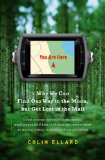
You Are Here

You Are Here: Why We Can Find Our Way to the Moon, but Get Lost in the Mall (or “Where Am I?” in Canada) by Collin Ellard (Doubleday, 2009)

Product description from the publisher:

A fascinating exploration of human navigation, both feat and foible, in the age of GPS and GoogleEarth.

We live in a world crowded by street signs and arrows. With the click of a computer mouse we can find exact directions to just about anywhere on earth, and with a handheld GPS we can find our precise latitude and longitude, even in the remotest of places. But despite all our advancements, we still get lost in the mall, can’t follow directions to a friend’s house and, on camping expeditions, take wrong turns that can mean the difference between life and death.

Many other species, however, have an innate sense of direction. Ants display surprisingly sophisticated behavior, traveling great distances without wasting a step. Monarch butterflies and migrating songbirds pilot even greater expanses, thousands of kilometers in some instances, to targets that they might never even have seen before. A homing pigeon can be driven halfway across a continent in a lightproof box and then, on release, find its way—unerringly—back to its loft. What is truly amazing, though, is that humans, the only animal that has come close to understanding how some of these magnificent navigational feats are performed, are rendered helpless by dense bush or even an unexpected turn in a maze of cubicles.

In You Are Here, psychologist Colin Ellard explains how, over centuries of innovation, we have lost our instinctive ability to find our way, as we traverse vast distances in mere hours in luxurious comfort. Some cultures, such as the Inuit, retain the ability to navigate huge expanses of seemingly empty space, as their survival depends on it, but the rest of us have been so conditioned by our built-up world that we don’t really know how to get from point A to point B.

Drawing on his exhaustive research, Ellard illuminates this disconnect from our world with great clarity and explains what it means, not just for our forays into the wilderness but for how we construct our cities, our workplaces, and even our homes and virtual worlds. Architects and city planners, he suggests, need to consider human behavior when designing human environments, and we all need to recognize that we are part of, not isolated from, the space around us.

See also: author’s website
Comments (0) - cognitive science,new books

‘Free’ by Chris Anderson

July 7, 2009

FREE (full book) by Chris Anderson

A free unabridged audiobook is also available. See the author’s blog for more information.

Comments (0) - culture,new books

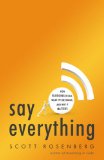
new book on blogging – ‘Say Everything’

Say Everything: How Blogging Began, What It’s Becoming, and Why It Matters by Scott Rosenberg (Crown, 2009)

Say Everything

Product description from the publisher:

Blogs are everywhere. They have exposed truths and spread rumors. Made and lost fortunes. Brought couples together and torn them apart. Toppled cabinet members and sparked grassroots movements. Immediate, intimate, and influential, they have put the power of personal publishing into everyone’s hands. Regularly dismissed as trivial and ephemeral, they have proved that they are here to stay.

In Say Everything, Scott Rosenberg chronicles blogging’s unplanned rise and improbable triumph, tracing its impact on politics, business, the media, and our personal lives. He offers close-ups of innovators such as Blogger founder Evan Williams, investigative journalist Josh Marshall, exhibitionist diarist Justin Hall, software visionary Dave Winer, “mommyblogger” Heather Armstrong, and many others.

These blogging pioneers were the first to face new dilemmas that have become common in the era of Google and Facebook, and their stories offer vital insights and warnings as we navigate the future. How much of our lives should we reveal on the Web? Is anonymity a boon or a curse? Which voices can we trust? What does authenticity look like on a stage where millions are fighting for attention, yet most only write for a handful? And what happens to our culture now that everyone can say everything?

Before blogs, it was easy to believe that the Web would grow up to be a clickable TV–slick, passive, mass-market. Instead, blogging brought the Web’s native character into focus–convivial, expressive, democratic. Far from being pajama-clad loners, bloggers have become the curators of our collective experience, testing out their ideas in front of a crowd and linking people in ways that broadcasts can’t match. Blogs have created a new kind of public sphere–one in which we can think out loud together. And now that we have begun, Rosenberg writes, it is impossible to imagine us stopping.

In his first book, Dreaming in Code, Scott Rosenberg brilliantly explored the art of creating software (“the first true successor to The Soul of a New Machine,” wrote James Fallows in The Atlantic). In Say Everything, Rosenberg brings the same perceptive eye to the blogosphere, capturing as no one else has the birth of a new medium.

The website for the book has excerpts, endnotes with links, and more.

Comments (1) - culture,new books

new book – ‘Psychology: Pythagoras to Present’

June 27, 2009

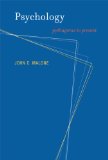
New from MIT Press: Psychology: Pythagoras to Present (Bradford Books) by John C. Malone, Professor of Psychology at the University of Tennessee, Knoxville.

Psychology: Pythagoras to Present

Product description from the publisher:

Certain ideas have preoccupied thinkers since ancient times: the nature of mind, the sources of knowledge and belief, the nature of the self, ethics and the best way to lead our lives, the question of free will. In this book, John Malone examines these ideas in the writings of thinkers from antiquity to the present day and argues for their importance not just as precursors of modern views but as ideas that are frequently better than current ones. We can get good advice, he writes, from the writings of the best thinkers of the past. Pythagoras, Thales, Plato, Protagoras, Aristotle, Diogenes, and Epictetus all offer tried and tested ideas on how we should lead our lives and on the treatment of psychopathology—as do Berkeley, Hume, John Stuart Mill, Johann Friedrich Herbart, Wilhelm Wundt, William James, Sigmund Freud, and B. F. Skinner.

Malone begins with the naturalistic and mystical strains of early Greek thought, moves on to Platonism and the world of Forms (and considers parallels between the thought of Plato and Freud), and discusses “Ancient Self-Help Therapies” (including Epicureanism). He investigates the psychological insights of Enlightenment thinkers including Francis Bacon and Galileo, Locke’s and Kant’s theories of experience, and Darwin’s evolutionary thinking. He charts the rise of modern psychology and the beginning of “biological psychology.” He examines the work of Wundt, Titchener, Freud, Peirce, and James, among others, and describes the ideas of behaviorism, Gestalt psychology, and cognitive science.

Malone’s history offers both breadth and depth, an engaging style and rigorous scholarship, demonstrating vividly the relevance of the great historical psychological thinkers.

A preview is available at the publisher’s website.

Comments (0) - new books,psychology

new book – ‘The Vision Revolution’

June 22, 2009

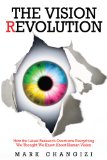
The Vision Revolution

The Vision Revolution: How the Latest Research Overturns Everything We Thought We Knew About Human Vision by Mark Changizi (BenBella Books, 2009)

Product description from the publisher:

Primates evolved binocular vision (both eyes facing forward) so that they can see in three dimensions, critical as they jumped from branch to branch. Higher primates developed color vision to better hunt out ripe fruit. Optical illusions succeed because they exploit the limitations of our visual processing. Wrong!

All of these beliefs are false, as groundbreaking research by evolutionary scientist and neurobiologist Mark Changizi now reveals. Changizi’s research centers on the “why” of human vision. Why do we have binocular vision? Why do we see in color the way we do? Why do optical illusions work? And why are we able to absorb information by reading?a very new invention from an evolutionary perspective?more readily than by hearing, which we’ve evolved to do over hundreds of thousands of years?

The Vision Revolution answers these questions, and proves, with the detailed results of Changizi’s fieldwork, that the answers are very different than traditionally believed. A radically new perspective of human vision is now emerging. The Vision Revolution is upon us.

See also: book excerpt from the Wall Street Journal

Author’s website

“The Vision Revolution” at Scientific Blogging

Comments (0) - cognitive science,new books