[ View menu ]

Archive for 'new books'

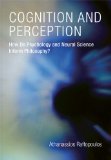
new book – ‘Cognition and Perception: How Do Psychology and Neural Science Inform Philosophy?

August 21, 2009

Cognition and Perception: How Do Psychology and Neural Science Inform Philosophy? (Bradford Books) by Athanassios Raftopoulos (MIT Press, 2009)Cognition and Perception
(link for UK)

Product description from the publisher:

In Cognition and Perception, Athanassios Raftopoulos discusses the cognitive penetrability of perception and claims that there is a part of visual processes (which he calls “perception”) that results in representational states with nonconceptual content; that is, a part that retrieves information from visual scenes in conceptually unmediated, “bottom-up,” theory-neutral ways. Raftopoulos applies this insight to problems in philosophy of science, philosophy of mind, and epistemology, and examines how we access the external world through our perception as well as what we can know of that world.

To show that there is a theory-neutral part of existence, Raftopoulos turns to cognitive science and argues that there is substantial scientific evidence. He then claims that perception induces representational states with nonconceptual content and examines the nature of the nonconceptual content. The nonconceptual information retrieved, he argues, does not allow the identification or recognition of an object but only its individuation as a discrete persistent object with certain spatiotemporal properties and other features. Object individuation, however, suffices to determine the referents of perceptual demonstratives. Raftopoulos defends his account in the context of current discussions on the issue of the theory-ladenness of perception (namely the Fodor-Churchland debate), and then discusses the repercussions of his thesis for problems in the philosophy of science. Finally, Raftopoulos claims that there is a minimal form of realism that is defensible. This minimal realism holds that objects, their spatiotemporal properties, and such features as shape, orientation, and motion are real, mind-independent properties in the world.

Table of contents & sample chapters available at MIT Press

Comments (0) - cognitive science,new books,philosophy of mind
‘Narrative and Folk Psychology’ – Journal of Consciousness Studies special issue

August 15, 2009

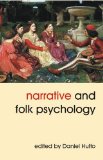
Narrative and Folk Psychology

Narrative and Folk Psychology, ed. by Daniel Hutto (Imprint Academic, 2009) is a special issue of the Journal of Consciousness Studies (v.16, no. 6-8, June-August 2009) available in book form.

The journal website has full text of the editor’s introduction, plus abstracts of the articles.

Here is the abstract of the introduction:

Abstract: There has been a long-standing interest in the putative roles that various so-called ‘theory of mind’ abilities might play in enabling us to understand and enjoy narratives. Of late, as our understanding of the complexity and diversity of everyday psychological capacities has become more nuanced and variegated, new possibilities have been articulated: (i) that our capacity for a sophisticated, everyday understanding of actions in terms of reason (our folk psychology) may itself be best characterized as a kind of narrative practice and (ii) that acquiring the capacity for supplying and digesting reasons explanations might (at least normally) depend upon having a special training with narratives. This introductory paper to the volume situates the claims of those who support the narrative approach to folk psychology against the backdrop of some traditional and new thinking about intersubjectivity, social cognition and ‘theory of mind’ abilities. Special emphasis is laid on the different reasons for being interested in these claims about narrative practice and folk psychology in light of various empirical and philosophical agendas.

Editor Daniel D. Hutto is the author of Folk Psychological Narratives: The Sociocultural Basis of Understanding Reasons (Bradford Books) (MIT Press, 2008)

Comments (0) - new books,psychology

new book – ‘Consequential Strangers’

August 8, 2009

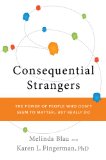
Consequential Strangers

Consequential Strangers: The Power of People Who Don’t Seem to Matter. . . But Really Do by Melinda Blau and Karen L. Fingerman (W.W. Norton & Co., 2009)

Product description from the publisher:

Our barista, our mechanic, our coworker—they populate our days, but we often take them for granted. Yet these are the people who bring novelty and information into our lives, allow us to exercise different parts of ourselves, and open us up to new opportunities. In their unprecedented examination of people on the periphery, psychologist Karen Fingerman, who coined the term “consequential strangers,” collaborates with journalist Melinda Blau to expand on and make her own groundbreaking research come alive. Drawing as well from Blau’s more than two hundred interviews with specialists in psychology, sociology, marketing, and communication, the book presents compelling stories of individuals and institutions, past and present. A rich portrait of our social landscape—on and off the Internet—it presents the science of casual connection and chronicles the surprising impact that consequential strangers have on business, creativity, the work environment, our physical and mental health, and the strength of our communities.

See also: Website for the book

Comments (0) - culture,new books

new book – ‘Pleasures of the Brain’

August 6, 2009

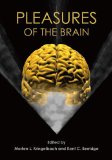
Pleasures of the Brain

Pleasures of the Brain (Series in Affective Science) ed. by Morten L. Kringelbach and Kent C. Berridge (Oxford University Press, 2009)

Product description from the publisher:

Pleasure is fundamental to well-being and the quality of life, but until recently, was barely explored by science. Current research on pleasure has brought about ground-breaking developments on several fronts, and new data on pleasure and the brain have begun to converge from many disparate fields. The time is ripe to present these important findings in a single volume, and so Morten Kringelbach and Kent Berridge have brought together the leading researchers to provides a comprehensive review of our current scientific understanding of pleasure. The authors present their latest neuroscientific research into pleasure, describing studies on the brain’s role in pleasure and reward in animals and humans, including brain mechanisms, neuroimaging data, and psychological analyses, as well as how their findings have been applied to clinical problems, such as depression and other disorders of hedonic well-being. To clarify the differences between their views, the researchers also provide short answers to a set of fundamental questions about pleasure and its relation to the brain. This book is intended to serve as both a starting point for readers new to the field, and as a reference for more experienced graduate students and scientists from fields such as neuroscience, psychology, psychiatry, neurology, and neurosurgery.

See also: Morten Kringelbach’s website

Kent Berridge’s website at U of Michigan

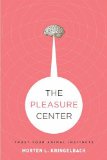
Morten Kringelback’s previous book: The Pleasure Center: Trust Your Animal Instincts (Oxford University Press, 2008)

The Pleasure Center

Product description from the publisher:

Many people believe that pleasure and desire are obstacles to reasonable and intelligent behavior. In The Pleasure Center, Morten Kringelbach reveals that what we desire, what pleases us–in fact, our most base, animalistic tendencies–are actually very important sources of information. They motivate us for a good reason. And understanding that reason, taking that reason into account, and harnessing and directing that reason, can make us much more rational and effective people. In exploring the many facets of pleasure, desire and emotion, Kringelbach takes us through the whole spectrum of human experience, such as how emotion fuels our interest in things, allowing us to pay attention and learn. He investigates the reward systems of the brain and sheds light on some of the most interesting new discoveries about pleasure and desire. Kringelbach concludes that if we understand and accept how pleasure and desire arise in the complex interaction between the brain’s activity and our own experiences, we can discover what helps us enjoy life, enabling us to make better decisions and, ultimately, lead happier lives.

Comments (0) - new books,psychology

new book – ‘The Liar in Your Life’ by Robert Feldman

August 5, 2009

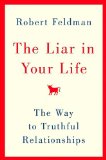
While waiting for new episodes of Lie to Me (returning 9/28/09), fans of that show might be interested in The Liar in Your Life: The Way to Truthful Relationships by Robert Feldman (Twelve, Aug 3, 2009). [“Look Inside the Book” available at Amazon.]

The Liar in Your Life

Product description from the publisher:

Product Description
In The Liar in Your Life, psychology professor Robert Feldman, one of the world’s leading authorities on deception, draws on his immense body of knowledge to give fresh insights into how and why we lie, how our culture has become increasingly tolerant of deception, the cost it exacts on us, and what to do about it. His work is at once surprising and sobering, full of corrections for common myths and explanations of pervasive oversimplifications.

Feldman examines marital infidelity, little white lies, career-driven resumé lies, and how we teach children to lie. Along the way, he reveals-despite our beliefs to the contrary- how it is nearly impossible to spot a liar (studies have shown no relationship between nervousness, lack of eye contact, or a trembling voice, and acts of deception). He also provides startling evidence of just how integral lying is to our culture; indeed, his research shows that two people, meeting for the first time, will lie to each other an average of three times in the first ten minutes of a conversation.

Feldman uses this discussion of deception to explore ways we can cope with infidelity, betrayal, and mistrust, in our friends and family. He also describes the lies we tell ourselves: Sometimes, the liar in your life is the person you see in the mirror. With incisive clarity and wry wit, Feldman has written a truthful book for anyone who whose life has been touched by deception.

For more information:

An excerpt is available at ABC News.

Author interview at NPR

Author’s website

Related reading: The Philosophy of Deception ed. by Clancy Martin (Oxford University Press, July 10, 2009).

Product description from the publisher:

Product Description
This volume gathers together new essays on deception and self-deception by leading thinkers on the subject. The contributors discuss topics including the nature and the definition of deception; whether deception is morally blameworthy or not; attacks against and defenses of self-deception; and the most famous philosophical account of lying by Immanuel Kant. Deception of others and self-deception share many more interconnections than is normally recognized, and these essays reveal the benefits of considering them together.
The Philosophy of Deception will be of interest to philosophers across the spectrum including those interested in philosophy of mind, philosophy of psychology, and metaphysics.

Comments (0) - new books,psychology