[ View menu ]

Archive for 'new books'

recent book – ‘The Master and His Emissary: The Divided Brain and the Making of the Western World’

January 4, 2010

The Master and His Emissary

The Master and His Emissary: The Divided Brain and the Making of the Western World by Iain McGilchrist (Yale University Press, 2009)
(link for UK)

Product description from the publisher:

Why is the brain divided? The difference between right and left hemispheres has been puzzled over for centuries. In a book of unprecedented scope, Iain McGilchrist draws on a vast body of recent brain research, illustrated with case histories, to reveal that the difference is profound—not just this or that function, but two whole, coherent, but incompatible ways of experiencing the world. The left hemisphere is detail oriented, prefers mechanisms to living things, and is inclined to self-interest, where the right hemisphere has greater breadth, flexibility, and generosity. This division helps explain the origins of music and language, and casts new light on the history of philosophy, as well as on some mental illnesses.

In the second part of the book, McGilchrist takes the reader on a journey through the history of Western culture, illustrating the tension between these two worlds as revealed in the thought and belief of thinkers and artists, from Aeschylus to Magritte. He argues that, despite its inferior grasp of reality, the left hemisphere is increasingly taking precedence in the modern world, with potentially disastrous consequences. This is truly a tour de force that should excite interest in a wide readership.

See also: Author’s website, including a pdf of the introduction

Comments (0) - cognitive science,culture,new books

Cognitive science books coming in 2010

January 2, 2010

Based on a search of Worldcat, here are some of the books on cognitive science, cognitive psychology, or cognition coming in 2010, with expected month of publication in the US & links to Amazon.com & Amazon.co.uk:


The Architect’s Brain: Neuroscience, Creativity, and Architecture
by Harry Francis Mallgrave (Chichester, West Sussex, U.K.; Malden, MA: Wiley-Blackwell, 2010). [published Dec 2009 but copyright 2010] (link for UK)
Brain and the Meaning of Life

The Brain and the Meaning of Life by Paul Thagard (Princeton, N.J.: Princeton University Press, 2010). [March 2010] (link for UK)

Cognition and Conditionals: Probability and Logic in Human Thinking by M Oaksford; Nick Chater (Oxford; New York: Oxford University Press, 2010). [April 2010] (link for UK)

Cognitive Pragmatics: The Mental Processes of Communication by Bruno G Bara (Cambridge, MA: The MIT Press, 2010). [June 2010] (link for UK)

Cognitive Psychology Perspectives (Psychology Research Progress) by Giacomo Salvati; Valeria Rabuano (Hauppauge, N.Y.: Nova Science ; Lancaster: Gazelle [distributor], 2010). [April 2010] (link for UK)

The Extended Mind (Life and Mind: Philosophical Issues in Biology and Psychology) ed. by Richard Menary (Cambridge, Mass.: MIT Press, 2010). [June 2010] (link for UK)

Gaming and Cognition: Theories and Practice from the Learning Sciences by Richard Van Eck (Hershey, PA: Information Science Reference, 2010). [March 2010] (link for UK)

How the Mind Uses the Brain: To Move the Body and Image the Universe by Ralph D Ellis; Natika Newton (Chicago, Ill.: Open Court, 2010). [June 2010] (link for UK)

Introduction to Cognitive Cultural Studies ed. by Lisa Zunshine (Baltimore: Johns Hopkins University Press, 2010). [June 2010] (link for UK)

The Making of Human Concepts ed. by Denis Mareschal; Paul C Quinn; S E G Lea (New York: Oxford University Press, 2010). [May 2010] (link for UK)

Natural Reflections: Human Cognition at the Nexus of Science and Religion (The Terry Lectures Series) by Barbara Herrnstein Smith (New Haven, Conn.; London: Yale University Press, 2010). [Jan 2010 – in print]

The Neurocognition of Dance: Mind, Movement and Motor Skills ed. by Bettina Bläsing; Martin Puttke; Thomas Schack (Hove: Psychology, 2010). [April 2010] (link for UK)

Psychology Around Us by Ronald J Comer; Elizabeth Gould (Hoboken, N.J.: Wiley; Chichester: John Wiley [distributor], 2010). [Jan. 2010 – textbook] (link for UK)

Religious Narrative, Cognition and Culture: Image and Word in the Mind of Narrative (Religion, Cognition, and Culture) ed. by Armin W Geertz; Jeppe Sinding Jensen (London; Oakville, CT: Equinox Pub. Ltd., 2010). [Aug. 2010] (link for UK)

The Science of Social Vision ed. by Reginald B Adams; et al (New York: Oxford University Press, 2010). [March 2010]

Structured Worlds: The Archaeology of Hunter-Gatherer Thought and Action (Approaches to Anthropological Archaeology) by Aubrey Cannon (Oakville, CT: Equinox Pub., 2010). [March 2010] (link for UK)

Thinking Visually by Stephen K Reed (New York: Psychology Press, 2010). [Jan. 2010] (link for UK)

Toward a Cognitive Theory of Narrative Acts ed. by Frederick Luis Aldama (Austin: University of Texas Press, 2010). [June 2010] (link for UK)

Toward an Anthropology of the Will ed. by Keith M Murphy; C Jason Throop (Stanford, Calif.: Stanford University Press, 2010). [Feb. 2010] (link for UK)

Trust Theory: A Socio-Cognitive and Computational Model (Wiley Series in Agent Technology) by Cristiano Castelfranchi; Rino Falcone
(Chichester : John Wiley & Sons, 2010). [May 2010] (link for UK)
Comments (8) - cognitive science,new books

two new books – ‘Happiness Project’ and ‘Drive’

December 29, 2009

The Happiness Project

Gretchen Rubin has winningly chronicled her “happiness project” at her blog and now the book is out: The Happiness Project: Or, Why I Spent a Year Trying to Sing in the Morning, Clean My Closets, Fight Right, Read Aristotle, and Generally Have More Fun (Harper, 2009)

(link for UK)

Product description from the publisher:

Gretchen Rubin had an epiphany one rainy afternoon in the unlikeliest of places: a city bus. “The days are long, but the years are short,” she realized. “Time is passing, and I’m not focusing enough on the things that really matter.” In that moment, she decided to dedicate a year to her happiness project.

In this lively and compelling account of that year, Rubin carves out her place alongside the authors of bestselling memoirs such as Julie and Julia, The Year of Living Biblically, and Eat, Pray, Love. With humor and insight, she chronicles her adventures during the twelve months she spent test-driving the wisdom of the ages, current scientific research, and lessons from popular culture about how to be happier.

Rubin didn’t have the option to uproot herself, nor did she really want to; instead she focused on improving her life as it was. Each month she tackled a new set of resolutions: give proofs of love, ask for help, find more fun, keep a gratitude notebook, forget about results. She immersed herself in principles set forth by all manner of experts, from Epicurus to Thoreau to Oprah to Martin Seligman to the Dalai Lama to see what worked for her—and what didn’t.

Her conclusions are sometimes surprising—she finds that money can buy happiness, when spent wisely; that novelty and challenge are powerful sources of happiness; that “treating” yourself can make you feel worse; that venting bad feelings doesn’t relieve them; that the very smallest of changes can make the biggest difference—and they range from the practical to the profound.

Written with charm and wit, The Happiness Project is illuminating yet entertaining, thought-provoking yet compulsively readable. Gretchen Rubin’s passion for her subject jumps off the page, and reading just a few chapters of this book will inspire you to start your own happiness project.

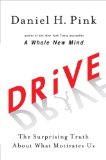
Drive

A few years ago I enjoyed A Whole New Mind, whose author has this new book out: Drive: The Surprising Truth About What Motivates Us by Daniel H Pink (Riverhead, 2009)

(link for UK)

Product description from the publisher:

Forget everything you thought you knew about how to motivate people–at work, at school, at home. It’s wrong. As Daniel H. Pink explains in his new and paradigm-shattering book Drive: The Surprising Truth About What Motivates Us, the secret to high performance and satisfaction in today’s world is the deeply human need to direct our own lives, to learn and create new things, and to do better by ourselves and our world.

Drawing on four decades of scientific research on human motivation, Pink exposes the mismatch between what science knows and what business does–and how that affects every aspect of our lives. He demonstrates that while the old-fashioned carrot-and-stick approach worked successfully in the 20th century, it’s precisely the wrong way to motivate people for today’s challenges. In Drive, he reveals the three elements of true motivation:

*Autonomy– the desire to direct our own lives
*Mastery– the urge to get better and better at something that matters
*Purpose– the yearning to do what we do in the service of something larger than ourselves

Along the way, he takes us to companies that are enlisting new approaches to motivation and introduces us to the scientists and entrepreneurs who are pointing a bold way forward.

Drive is bursting with big ideas– the rare book that will change how you think and transform how you live.

See also: Drive excerpt, author’s website

Comments (0) - happiness,new books,psychology

new John Searle book – ‘Making the Social World’

December 27, 2009

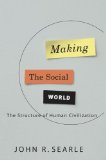
Making the Social World

Something more to celebrate this holiday season — a new book by the eminent philosopher John Searle, Making the Social World: The Structure of Human Civilization (Oxford University Press, 2010)

(link for UK)

Product information from the publisher:

There are few more important philosophers at work today than John Searle, a creative and contentious thinker who has shaped the way we think about mind and language. Now he offers a profound understanding of how we create a social reality–a reality of money, property, governments, marriages, stock markets and cocktail parties.
The paradox he addresses in Making the Social World is that these facts only exist because we think they exist and yet they have an objective existence. Continuing a line of investigation begun in his earlier book The Construction of Social Reality, Searle identifies the precise role of language in the creation of all “institutional facts.” His aim is to show how mind, language and civilization are natural products of the basic facts of the physical world described by physics, chemistry and biology. Searle explains how a single linguistic operation, repeated over and over, is used to create and maintain the elaborate structures of human social institutions. These institutions serve to create and distribute power relations that are pervasive and often invisible. These power relations motivate human actions in a way that provides the glue that holds human civilization together.
Searle then applies the account to show how it relates to human rationality, the freedom of the will, the nature of political power and the existence of universal human rights. In the course of his explication, he asks whether robots can have institutions, why the threat of force so often lies behind institutions, and he denies that there can be such a thing as a “state of nature” for language-using human beings.

Dr Searle’s Fall 2009 lectures on the philosophy of society are available as podcasts from UC Berkeley.

Comments (4) - culture,new books

new book – ‘The Perfect Swarm: The Science of Complexity in Everyday Life’

December 13, 2009

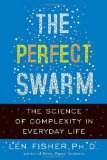
The Perfect Swarm: The Science of Complexity in Everyday Life by Len Fisher (Basic Books, 2009)

(link for UK)

The Perfect Swarm

One of the greatest discoveries of recent times is that the complex patterns we find in life are often produced when all of the individuals in a group follow the same simple rule. This process of “self-organization” reveals itself in the inanimate worlds of crystals and seashells, but as Len Fisher shows, it is also evident in living organisms, from fish to ants to human beings. The coordinated movements of fish in shoals, for example, arise from the simple rule: “Follow the fish in front.” Traffic flow arises from simple rules: “Keep your distance” and “Keep to the right.”

Now, in his new book, Fisher shows how we can manage our complex social lives in an ever more chaotic world. His investigation encompasses topics ranging from “swarm intelligence” to the science of parties and the best ways to start a fad. Finally, Fisher sheds light on the beauty and utility of complexity theory. An entertaining journey into the science of everyday life, The Perfect Swarm will delight anyone who wants to understand the complex situations in which we so often find ourselves.

See also: Author’s website

Comments (1) - new books