coming Aug 1
Landscape of the Mind: Human Evolution and the Archaeology of Thought by John F. Hoffecker (Columbia University Press, 2010)
(link for amazon.co.uk)
Product description from the publisher:
John F. Hoffecker explores the origin and growth of the mind, drawing on information from the human fossil record, archaeology, and history. Hoffecker argues that, as an indirect result of bipedal locomotion, early humans developed a feedback relationship among their hands, brains, and tools, evolving the capacity to externalize thoughts in the form of shaped stone objects. When anatomically modern humans evolved a parallel capacity to externalize thought as symbolic language, individual brains within social groups were integrated into a neocortical internet, or super-brain, thus giving birth to the mind. Noting that archaeological traces of symbolism coincide with evidence for the ability to generate novel technology, Hoffecker contends that human creativity, as well as higher-order consciousness, is a product of the collective super-brain.
Hoffecker equates the subsequent growth of the mind with human history, which began in Africa more than 50,000 years ago. As anatomically modern humans spread across the globe, adapting to a variety of climates and habitats, they redesigned themselves technologically and developed alternative realities via toolmaking, tool use, and artistic expression. Hoffecker connects the rise of civilization to a hierarchical reorganization of the super-brain, triggered by explosive population growth. According to him, subsequent history reflects the varying degrees to which rigid hierarchies of states and empires suppressed the creative powers of the mind, constraining the further accumulation of knowledge. The modern world emerged from the fragments of a collapsed empire after 1200 AD. In the final chapter, Hoffecker speculates on the possibility of artificial intelligence and a mind without biology.
Aug 5
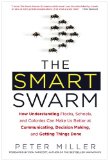
The Smart Swarm: How Understanding Flocks, Schools, and Colonies Can Make Us Better at Communicating, Decision Making, and Getting Things Done by Peter Miller (Avery, 2010)
(link for amazon.co.uk)
Product description from the publisher:
What ants, bees, fish, and smart swarms can teach us about communication, organization, and decision-making
The modern world may be obsessed with speed and productivity, but twenty-first-century humans actually have much to learn from the ancient instincts of swarms. A fascinating new take on the concept of collective intelligence and its colorful manifestations in some of our most complex problems, The Smart Swarm introduces a compelling new understanding of the real experts on solving our own complex problems relating to such topics as business, politics, and technology.
Based on extensive globe-trotting research, this lively tour from National Geographic reporter Peter Miller introduces thriving throngs of ant colonies, which have inspired computer programs for streamlining factory processes, telephone networks, and truck routes; termites, used in recent studies for climate-control solutions; schools of fish, on which the U.S. military modeled a team of robots; and many other examples of the wisdom to be gleaned about the behavior of crowds-among critters and corporations alike.
In the tradition of James Surowiecki’s The Wisdom of Crowds and the innovative works of Malcolm Gladwell, The Smart Swarm is an entertaining yet enlightening look at small-scale phenomena with big implications for us all.
Aug 13
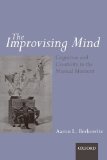
The improvising mind: Cognition and creativity in the musical moment by Aaron Berkowitz (Oxford University Press, 2010)
(link for amazon.co.uk)
Product description from the publisher:
The ability to improvise represents one of the highest levels of musical achievement. An improviser must master a musical language to such a degree as to be able to spontaneously invent stylistically idiomatic compositions on the spot. This feat is one of the pinnacles of human creativity, and yet its cognitive basis is poorly understood. What musical knowledge is required for improvisation? How does a musician learn to improvise? What are the neural correlates of improvised performance?
In The Improvising Mind, these questions are explored through an interdisciplinary approach that draws on cognitive neuroscience, study of historical pedagogical treatises on improvisation, interviews with improvisers, and musical analysis of improvised performances. Findings from these treatises and interviews are discussed from the perspective of cognitive psychological theories of learning, memory, and expertise. Musical improvisation has often been compared to ‘speaking a musical language.’ While past research has focussed on comparisons of music and language perception, few have dealt with this comparison in the performance domain. In this book, learning to improvise is compared with language acquisition, and improvised performance is compared with spontaneous speech from both theoretical and neurobiological perspectives.
Tackling a topic that has hitherto received little attention, The Improvising Mind will be a valuable addition to the literature in music cognition. This is a book that will make fascinating reading for musicologists, music theorists, cognitive neuroscientists and psychologists, musicians, music educators, and anyone with an interest in creativity.
Aug 24
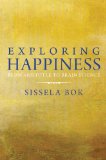
Exploring Happiness: From Aristotle to Brain Science by Sissela Bok (Yale University Press, 2010)
(link for amazon.co.uk)
Product description from the publisher:
In this smart and timely book, the distinguished moral philosopher Sissela Bok ponders the nature of happiness and its place in philosophical thinking and writing throughout the ages. With nuance and elegance, Bok explores notions of happiness – from Greek philosophers to Desmond Tutu, Charles Darwin, Iris Murdoch, and the Dalai Lama – as well as the latest theories advanced by psychologists, economists, geneticists, and neuroscientists. Eschewing abstract theorizing, Bok weaves in a wealth of firsthand observations about happiness from ordinary people as well as renowned figures. This may well be the most complete picture of happiness yet. This book is also a clarion call to think clearly and sensitively about happiness. Bringing together very different disciplines provides Bok with a unique opportunity to consider the role of happiness in wider questions of how we should lead our lives and treat one another – concerns that don’t often figure in today’s happiness equation. How should we pursue, weigh, value, or limit our own happiness, or that of others, now and in the future? Compelling and perceptive, “Exploring Happiness” shines a welcome new light on the heart of the human condition.
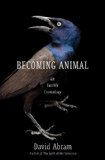
Becoming Animal: An Earthly Cosmology by David Abram (Pantheon, 2010)
(link for amazon.co.uk)
David Abram’s first book, The Spell of the Sensuous—hailed as “revolutionary” by the Los Angeles Times, as “daring and truly original” by Science—has become a classic of environmental literature. Now Abram returns with a startling exploration of our human entanglement with the rest of nature.
As the climate veers toward catastrophe, the innumerable losses cascading through the biosphere make vividly evident the need for a metamorphosis in our relation to the living land. For too long we’ve inured ourselves to the wild intelligence of our muscled flesh, taking our primary truths from technologies that hold the living world at a distance. This book subverts that distance, drawing readers ever deeper into their animal senses in order to explore, from within, the elemental kinship between the body and the breathing Earth.
The shapeshifting of ravens, the erotic nature of gravity, the eloquence of thunder, the pleasures of being edible: all have their place in Abram’s investigation. He shows that from the awakened perspective of the human animal, awareness (or mind) is not an exclusive possession of our species but a lucid quality of the biosphere itself—a quality in which we, along with the oaks and the spiders, steadily participate.
With the audacity of its vision and the luminosity of its prose, Becoming Animal sets a new benchmark for the human appraisal of our place in the whole.