[ View menu ]

Archive for 'new books'

social perception in ‘God Soul Mind Brain: A Neuroscientist’s Reflections on the Spirit World’

August 22, 2010
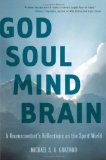
God Soul Mind Brain

Despite the title, God Soul Mind Brain: A Neuroscientist’s Reflections on the Spirit World (link for amazon.co.uk) is not primarily about religion or the spirit world from a neuroscientific perspective. Instead, gods and spirits figure as examples of a more general process of social perception that is the real focus of the work.

In a clear, reader-friendly manner, author Michael Graziano describes social perception as a mechanism for constructing simplified models of mental states and intentions. Because we are social animals we developed this capacity for constructing models of other minds. As with perception of objects, social perception is subject to illusions, such as the illusion that a ventriloquist’s dummy is a separate person.

Simplified models of intentionality consist of “point agents” assigned to spatial locations. Such mind-models are the source of concepts of spirits and souls. In this approach, for example, the God of monotheism represents “the perception of a single unified mind behind every otherwise inexplicable event.”

Graziano argues that consciousness can also be understood as a social perceptual model applied inwardly. The account of consciousness seemed to be the real core of the book, an original approach to the problem with potential applications from AI to multiple personality disorder.

Also included is a discussion of the brain circuitry involved in social perception, primarily the superior temporal polysensory (STP) area and the temporo-parietal junction (TPJ).

Graziano also discusses social imitation and memes as the source of human culture. What is missing is an account of the role of culture in affecting what kinds of entities (gods, spirits, souls, etc.) are modeled by the social perceptual system.

[Thanks to Leapfrog Press for allowing me to view an advance copy via NetGalley].

Product description from the publisher:

Written for the general public, God Soul Mind Brain explores the controversial relationship between science and religion by first dismissing the “science versus religion” debate as outdated and unnecessary. The cutting-edge field of social neuroscience explains how our perceptions of our own consciousness, of other people’s minds, and of spirits and gods depend on machinery in the brain that evolved to make us socially intelligent animals. In clear prose without technical jargon, Graziano discusses his and others’ findings in this 20-year-old field of study, and the implications for human spirituality and religion. By addressing head-on the fundamental issues of human consciousness, religion, and God, and how these elements relate to the science of the brain, Graziano presents an entirely new view of religion and science.

See also: “Why We See Spirits and Souls”, Graziano’s article at “Big Questions Online,” with lots of comments; author’s website

Comments (0) - cognitive science,consciousness,culture,new books
new book – ‘Matter and Mind’ by Mario Bunge

August 15, 2010

An interesting-looking though pricey book from philosopher-physicist Mario Bunge — may be something to check for at your library or through interlibrary loan…

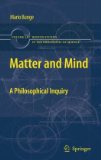
Matter and Mind

Matter and Mind: A Philosophical Inquiry (Boston Studies in the Philosophy of Science) (Springer, 2010)

(link for amazon.co.uk)

This book discusses two of the oldest and hardest problems in both science and philosophy: What is matter?, and What is mind? A reason for tackling both problems in a single book is that two of the most influential views in modern philosophy are that the universe is mental (idealism), and that the everything real is material (materialism). Most of the thinkers who espouse a materialist view of mind have obsolete ideas about matter, whereas those who claim that science supports idealism have not explained how the universe could have existed before humans emerged. Besides, both groups tend to ignore the other levels of existence—chemical, biological, social, and technological. If such levels and the concomitant emergence processes are ignored, the physicalism/spiritualism dilemma remains unsolved, whereas if they are included, the alleged mysteries are shown to be problems that science is treating successfully.

See also: Publisher’s webpage for the book

Comments (0) - consciousness,new books,philosophy of mind

new book – ‘Just Another Ape?’

August 14, 2010

Just Another Ape?

Just Another Ape? by Helene Guldberg (Imprint Academic, 2010)

(link for amazon.co.uk)

Product description from the publisher:

Today, the belief that human beings are special is distinctly out of fashion. Almost every day we are presented with new revelations about how animals are so much more like us than we ever imagined. The argument is at its most powerful when it comes to our closest living relatives – the great apes. This book argues that whatever first impressions might tell us, apes are really not ‘just like us’. Science has provided strong evidence that the boundaries between us and other species are vast. Unless we hold on to the belief in our exceptional abilities we will never be able to envision or build a better future – in which case, we might as well be monkeys.

See also: Author’s website

Comments (1) - mind,new books

Philosophy Bites – book, podcast, contest!

August 11, 2010

The wonderful Philosophy Bites podcast series has become a book, featuring 25 of the best interviews from over 100 available at philosophybites.com. The book is available now in the UK and will be in the US by the end of August. Apparently a sequel, Philosophy Bites Back, is already in the works. Tweet your answer to ‘What is philosophy?’ in 100 characters or less to enter the competition.

Philosophy Bites

Philosophy Bites by David Edmonds & Nigel Warburton (Oxford University Press, 2010)

(link for amazon.co.uk)

Product description from the publisher:

What does Anthony Grayling think about atheism? Adrian Moore about infinity? For the last three years, some of the world’s leading philosophers have held forth on their favorite topics on the immensely popular website philosophybites.com. The site now features more than one hundred short conversations, has had some 7 million downloads to date, and is listened to all over the globe.

Philosophy Bites brings together the twenty-five best interviews from this hugely successful website. Leading philosophers–including Simon Blackburn, Alain de Botton, Will Kymlicka, Alexander Nehamas, and more than twenty others–discuss a wide range of philosophical issues in a surprisingly lively, informal, and personal way. For instance, Peter Singer, arguably the world’s leading animal rights philosopher, states that for people living in the western world, vegetarianism is the only moral choice, but he allows that this would not be the case for an Inuit who lives by killing fish–causing an animal to suffer must be balanced against the necessity to survive. Julian Savulescu talks about the “yuk factor”–the natural revulsion that keeps us from practicing incest or cannibalism–attacking its use as an argument against gay rights and abortion. Anthony Appiah discusses cosmopolitanism, the idea that emphasizes that people around the world have much in common, and that we have to be able to live with people despite our differences. And Stephen Law shows why it is unreasonable to believe in an all-powerful, all-good deity.

Time, infinity, evil, friendship, animals, wine, sport, tragedy–all of human life is here. And as these bite-sized interviews reveal, often the most brilliant philosophers are eager and able to convey their thoughts, simply and clearly, on the great ideas of philosophy.

See also: philosophy bites website, past interviews

Philosophy Bites & Waterstones twitter competition details

#philbitescomp on twitter

My definition of philosophy…

Comments (0) - new books

new book – ‘Delusions of Gender: How Our Minds, Society, and Neurosexism Create Difference’ by Cordelia Fine

August 8, 2010

Delusions of Gender

Delusions of Gender: How Our Minds, Society, and Neurosexism Create Difference by Cordelia Fine (W.W. Norton & Co, 2010)

(link for amazon.co.uk – available Sep 2)

Product description from the publisher:

A brilliantly researched and wickedly funny rebuttal of the pseudo-scientific claim that men are from Mars and women are from Venus. It’s the twenty-first century, and although we tried to rear unisex children—boys who play with dolls and girls who like trucks—we failed. Even though the glass ceiling is cracked, most women stay comfortably beneath it. And everywhere we hear about vitally important “hardwired” differences between male and female brains. The neuroscience that we read about in magazines, newspaper articles, books, and sometimes even scientific journals increasingly tells a tale of two brains, and the result is more often than not a validation of the status quo. Women, it seems, are just too intuitive for math; men too focused for housework.

Drawing on the latest research in neuroscience and psychology, Cordelia Fine debunks the myth of hardwired differences between men’s and women’s brains, unraveling the evidence behind such claims as men’s brains aren’t wired for empathy and women’s brains aren’t made to fix cars. She then goes one step further, offering a very different explanation of the dissimilarities between men’s and women’s behavior. Instead of a “male brain” and a “female brain,” Fine gives us a glimpse of plastic, mutable minds that are continuously influenced by cultural assumptions about gender.

Passionately argued and unfailingly astute, Delusions of Gender provides us with a much-needed corrective to the belief that men’s and women’s brains are intrinsically different—a belief that, as Fine shows with insight and humor, all too often works to the detriment of ourselves and our society.

See also: Author’s website, Publishers Weekly starred review, USA Today review

Comments (0) - cognitive science,culture,new books