May 15, 2011
The Compass of Pleasure: How Our Brains Make Fatty Foods, Orgasm, Exercise, Marijuana, Generosity, Vodka, Learning, and Gambling Feel So Good by David J. Linden (Viking, 2011)
(Kindle ed.), (amazon.co.uk)
Product description from the publisher:
A leading brain scientist’s look at the neurobiology of pleasure-and how pleasures can become addictions.
Whether eating, taking drugs, engaging in sex, or doing good deeds, the pursuit of pleasure is a central drive of the human animal. In The Compass of Pleasure Johns Hopkins neuroscientist David J. Linden explains how pleasure affects us at the most fundamental level: in our brain.
As he did in his award-winning book, The Accidental Mind, Linden combines cutting-edge science with entertaining anecdotes to illuminate the source of the behaviors that can lead us to ecstasy but that can easily become compulsive. Why are drugs like nicotine and heroin addictive while LSD is not? Why has the search for safe appetite suppressants been such a disappointment? The Compass of Pleasure concludes with a provocative consideration of pleasure in the future, when it may be possible to activate our pleasure circuits at will and in entirely novel patterns.
See also: Author interview at Salon.com
Book website & blog
Comments (0)
- cognitive science,new books
May 8, 2011
The Formation of Reason by David Bakhurst (Wiley-Blackwell, 2011)
(amazon.co.uk)
Product description from the publisher:
In The Formation of Reason, philosophy professor David Bakhurst utilizes ideas from philosopher John McDowell to develop and defend a socio-historical account of the human mind.
* Provides the first detailed examination of the relevance of John McDowell’s work to the Philosophy of Education
* Draws on a wide-range of philosophical sources, including the work of ‘analytic’ philosophers Donald Davidson, Ian Hacking, Peter Strawson, David Wiggins, and Ludwig Wittgenstein
* Considers non-traditional ideas from Russian philosophy and psychology, represented by Ilyenkov and Vygotsky
* Discusses foundational philosophical ideas in a way that reveals their relevance to educational theory and practice
See also: Life in the Space of Reasons: Mood, Music, Education, and the Philosophy of John McDowell (pdf) by David Bakhurst
Comments (0)
- new books,philosophy of mind
May 6, 2011
The Organisation of Mind by Tim Shallice and Richard P. Cooper (Oxford University Press, 2011)
(amazon.co.uk)
Product description from the publisher:
Brain imaging has been immensely valuable in showing us how the mind works. However, many of our ideas about how the mind works come from disciplines like experimental psychology, artificial intelligence and linguistics, which in their modern form date back to the computer revolution of the 1940s, and are not strongly linked to the subdisciplines of biomedicine. Cognitive science and neuroscience thus have very separate intellectual roots, and very different styles. Unfortunately, these two areas of knowledge have not been well integrated as far as higher mental processes are concerned. So how can these two be reconciled in order to develop a full understanding of the mind and brain?
This is the focus of this landmark book from leaders in the field. Coming more than two decades after Shallice’s classic ‘From neuropsychology to mental structure’, ‘The Organisation of Mind’ establishes a strong historical, empirical, and theoretical basis for cognitive neuroscience.
The book starts by reviewing the history and intellectual roots of the field, looking at some of the researchers who guided and influenced it. The basic principles – theoretical and empirical and the inferential relation between them – are then considered with particular emphasis being placed on inferences to the organisation of the cognitive system from two empirical methodologies – neuropsychology and functional imaging. The core skeleton of the cognitive system is then analysed for the areas most critical for understanding rational thought. In the third section the components of simple cognitive acts are described, namely semantic processing, working memory, and cognitive operations. In the final section, more complex higher-level modulating processes are considered, including, supervisory processing, episodic memory, consciousness and problem-solving.
This will be a seminal publication in the brain sciences – one that all students and researchers will have to read.
Comments (0)
- cognitive science,mind,new books
April 29, 2011
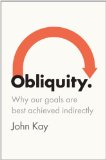
Recently published in the US: Obliquity: Why Our Goals Are Best Achieved Indirectly by economist John Kay (Penguin, 2011)
(kindle ed.), (amazon.co.uk)
Product description from the publisher:
A leading economist charts the indirect road to happiness and wealth.
Using dozens of practical examples from the worlds of business, politics, science, sports, literature, even parenting, esteemed economist John Kay proves a notion that feels at once paradoxical and deeply commonsensical: The best way to achieve any complex or broadly defined goal-from happiness to wealth to profit to preventing forest fires-is the indirect way. As Kay points out, we rarely know enough about the intricacies of important problems to tackle them head-on. And our unpredictable interactions with other people and the world at large mean that the path to our goals-and sometimes the goals themselves-will inevitably change. We can learn about our objectives and how to achieve them only through a gradual process of risk taking and discovery-what Kay calls obliquity.
Kay traces this pathway to satisfaction as it manifests itself in nearly every aspect of life. The wealthiest people-from Andrew Carnegie to Bill Gates-achieved their riches through a passion for their work, not because they set materialistic goals. Research has shown that companies whose goal (as declared in mission statements) is excellent products or service are more profitable than companies whose stated goal is increasing profits. In the personal realm, a large body of evidence shows that parenthood is on a daily basis far more frustrating than happy- making. Yet parents are statistically happier than nonparents. Though their short-term pleasure is often thwarted by the demands of childrearing, the subtle-oblique-rewards of parenthood ultimately make them happier.
Once he establishes the ubiquity of obliquity, Kay offers a wealth of practical guidance for avoiding the traps laid by the direct approach to complex problems. Directness blinds us to new information that contradicts our presumptions, fools us into confusing logic with truth, cuts us off from our intuition (which is the subconscious expression of our experience), shunts us away from alternative solutions that may be better than the one we’re set on, and more. Kay also shows us how to acknowledge our limitations, redefine our goals to fit our skills, open our minds to new data and solutions, and otherwise live life with obliquity.
This bracing manifesto will convince readers-or confirm their conviction-that the best route to satisfaction and success does not run through the bottom line.
See also: Author’s website
Comments (0)
- happiness,new books,psychology
April 27, 2011
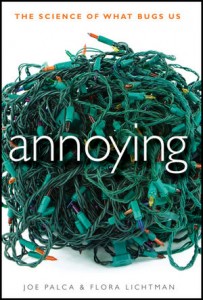
Annoying: The Science of What Bugs Us by Joe Palca and Flora Lichtman (Wiley, 2011)
(kindle ed.), (amazon.co.uk)
Product description from the publisher:
Two crackerjack science journalists from NPR look at why some things (and some people!) drive us crazy
It happens everywhere – offices, schools, even your own backyard. Plus, seemingly anything can trigger it: cell phones, sirens, bad music, constant distractions, your boss, or even your spouse. We all know certain things get under our skin. Can science explain why? Palca and Lichtman take you on a scientific quest through psychology, evolutionary biology, anthropology, and other disciplines to uncover the truth about being annoyed. What is the recipe for annoyance? For starters, it should be temporary, unpleasant, and unpredictable, like a boring meeting or mosquito bites
* Gives fascinating, surprising explanations for why people react the way they do to everything from chili peppers to fingernails on a blackboard
* Explains why irrational behavior (like tearing your hair out in traffic) is connected to worthwhile behavior (like staying on task)
* Includes tips for identifying your own irritating habits!
How often can you say you’re happily reading a really Annoying book? The insights are fascinating, the exploration is fun, and the knowledge you gain, if you act like you know everything, can be really annoying.
See also: New York Times review
Comments (0)
- cognitive science,new books,psychology