March 14, 2008
This seems like an appropriately numerical title in celebration of Pi Day (3.14)…
42: Deep Thought on Life by Mark Vernon sounds like some Monty Python joke, but 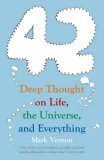 here is the book description:
Mark Vernon takes his inspiration from 42 of the funniest, wisest, and quirkiest quotations about the big questions in life, and uses these as starting points for his brilliant observations. In each chapter he explains what the greatest thinkers of all time have had to say on subjects such as eternal life, work, love and sex, and the nature of happiness; he draws his own conclusions, and will provoke you to think deeply yourself!
BBC article by Vernon on ’42’ in Douglas Adams’ Hitchhiker’s Guide – (This may be an excerpt from Vernon’s book?); also the publisher’s site has a sample chapter.
I like this Author’s blog!
Comments (0)
- new books
March 9, 2008
Guilty Robots, Happy Dogs: The Question of Alien Minds by David McFarland (Oxford University Press, 2008).
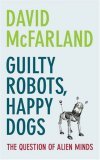
from the book description:
When we interact with animals, we intuitively read thoughts and feelings into their expressions and actions. …
But is our natural tendency to humanize other beings philosophically or scientifically justifiable? Can we ever know what non-human minds are really like? How different are human minds from the minds of animals or robots? In Guilty Robots and Happy Dogs , David McFarland offers an accessible exploration of these and many other intriguing questions, questions that illuminate our understanding the human mind and its limits in knowing and imagining other minds. In exploring these issues, McFarland looks not only at philosophy, but also examines new evidence from the science of animal behavior, plus the latest developments in robotics and artificial intelligence, to show how many different–and often quite surprising–conclusions we can draw about the nature of minds “alien” to our own. Can robots ever feel guilty? Can dogs feel happy? Answering these questions is not simply an abstract exercise but has real implications for such increasingly relevant topics as animal welfare, artificial intelligence, and cybernetics.
Link to Times Online review
Comments (0)
- mind,new books,philosophy of mind
March 4, 2008
Accident: A Philosophical and Literary History by Ross Hamilton (University of Chicago Press, 2008)
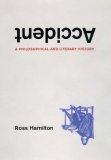
From the book description:
Accident tells an original history of Western thought from the perspective of Aristotle’s remarkably durable categories of accident and substance. Throughout antiquity and the Middle Ages, Aristotle’s distinction underwrote an insistence on order and subordination of the inessential. In a groundbreaking innovation, Hamilton argues that after the Reformation, the concept of accident began to change places with that of substance: accident became a life-transforming event and effectively a person’s essence. For moderns, it is the accidental, seemingly trivial moments of consciousness that, like Wordsworth’s “spots of time,” create constellations of meaning in our lives. Touching on a broad array of images and texts—Augustine, Dante, the frescoes of Raphael, Descartes, Jane Austen, the work of the surrealists, and twentieth-century cinema—Hamilton provides a new way to map the mutations of personal identity and subjectivity.
Comments (0)
- new books