April 1, 2008
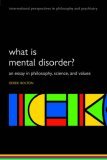 What is Mental Disorder?: An essay in philosophy, science, and values (International Perspectives in Philosophy and Psychiatry) by Derek Bolton (Oxford University Press)
From the book description:
This new book by Derek Bolton tackles the problems involved in the definition and boundaries of mental disorder. It addresses two main questions regarding mental illness. Firstly, what is the basis of the standards or norms by which we judge that a person has a mental disorder – that the person’s mind is not working as it should, that their mental functioning is abnormal? Controversies about these questions have been dominated by the contrast between norms that are medical, scientific or natural, on the one hand, and social norms on the other. The norms that define mental disorder seem to belong to psychiatry, to be medical and scientific, but are they really social norms, hijacked and disguised by the medical profession?
Secondly, what is the validity of the distinction between mental disorder and order, between abnormal and normal mental functioning? To what extent, notwithstanding appearances, does mental disorder involve meaningful reactions and problem-solving? These responses may be to normal problems of living, or to not so normal problems – to severe psycho-social challenges. Is there after all order in mental disorder?
Comments (0)
- new books,philosophy of mind,psychology
March 25, 2008

The Limits of Dream: A Scientific Exploration of the Mind/Brain Interface by J.F. Pagel (Academic Press, 2008).
From the book description:
The Limits of Dream focuses on what we currently know of the human central nervous system (CNS), examining the basic sciences of neurochemisty, neuroanatomy, and CNS electrophysiology as these sciences apply to dream, then reaching beyond basic science to examine the cognitive science of dreaming including the processes of memory, the perceptual interface, and visual imagery. Building on what is known of intrapersonal CNS processing, the book steps outside the physical body to explore artificially created dreams and their use in filmmaking, art and story, as well as the role of dreaming in creative process and creative madness. The limits of our scientific knowledge of dream frame this window that can be used to explore the border between body and mind. What is known scientifically of the cognitive process of dreaming will lead the neuroscientist, the student of cognitive science, and the general reader down different paths than expected into an exploration of the fuzzy and complex horizon between mind and brain.
Comments (0)
- cognitive science,mind,new books
March 22, 2008
 I’m familiar with Clay Shirky as the author of “Ontology Is Overrated” a great essay on folksonomy, so I’m interested in his new book Here Comes Everybody: The Power of Organizing Without Organizations, which also has a related blog.
“Wikiphobia and Web 2.0” in the Telegraph (22/03/2008) calls Shirky’s book “as crisply argued and as enlightening a book about the internet as has been written.”
3/31/08 New York Times: “We Want It, and Waiting Is Not an Option”
Comments (1)
- culture,new books
March 19, 2008
Multiplicity: The New Science of Personality, Identity, and the Self is a new book by Rita Carter that I picked up at the bookstore recently.
From the book description:
MULTIPLICITY presents an entirely new view of our selves. Instead of seeing each person as a single personality, Carter argues that we all consist of multiple characters, each one with its own viewpoint, emotions and ambitions. The mother who feeds breakfast to her children, for example, has quite different concerns and opinions from the woman taking part in a boardroom discussion two hours later, and from the woman she will be with her husband that night. Yet all three may share the same body, and none is any more “authentic” than another.
Personality changes in a person are conventionally frowned upon, but Carter shows that in today’s world our ability to switch from one personality to another according to what is demanded of us is a huge strength, providing one’s personalities work together as a team rather than against each other. In addition to its groundbreaking scientific thesis, MULTIPLICITY contains extensive exercises designed to help readers achieve this harmony.
Carter’s previous books include Mapping the Mind and Exploring Consciousness.
Comments (0)
- new books,self
March 17, 2008
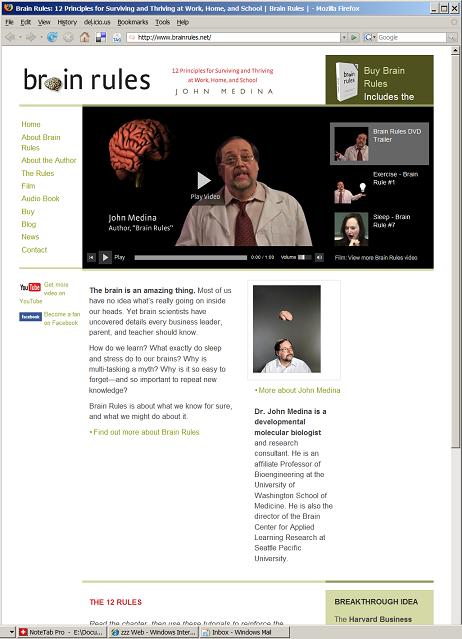
Brain Rules: 12 Principles for Surviving and Thriving at Work, Home, and School by John Medina is a new book with a nice website/blog.
He has boiled it all down to 12 rules dealing with exercise, survival, wiring, attention, short-term memory, long-term memory, sleep, stress, sensory integration, vision, gender and exploration.
3/31/08: Seattle Times article
Comments (0)
- cognitive science,new books