[ View menu ]

Archive for 'new books'

‘The Wisdom of Donkeys’ at The Times Online

May 5, 2008

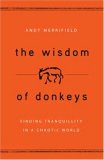
The Wisdom of Donkeys

A donkey doesn’t so much accept its cruel fate as bears it, lets it pass over them. They’re the most philosophical of all animals, much more philosophical about their fate than human beings. And it’s an instinctive philosophy, a stoic acceptance, a kind of beautiful strength, passive rather than aggressive, not an ugly violent power. Needless to say, their philosophy isn’t academic, isn’t read in books or taught in a privileged classroom: it’s everyday, a simple disposition that’s lived out and practised, in an open field. We might say, if we used philosophical-speak, that a donkey’s philosophy is ontological, that it’s all about Being, the philosophy of permanent reverie, of daydreaming in the open air.

That’s a snippet from a longish book excerpt included in The Times article on The Wisdom of Donkeys: Finding Tranquility in a Chaotic World by Andy Merrifield (Walker and Co., 2008).

See also “Donkeys and wisdom” at hermit’s thatch.

Comments (0) - happiness,meditation,new books

new book: How Infants Know Minds

April 25, 2008

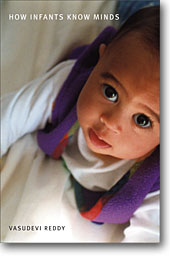
How Infants Know Minds by Vasudevi Reddy (Harvard University Press, 2008)
Reddy-How Infants Know Minds

from the product description:

Most psychologists claim that we begin to develop a “theory of mind”—some basic ideas about other people’s minds—at age two or three, by inference, deduction, and logical reasoning.

But does this mean that small babies are unaware of minds? That they see other people simply as another (rather dynamic and noisy) kind of object? This is a common view in developmental psychology. Yet, as this book explains, there is compelling evidence that babies in the first year of life can tease, pretend, feel self-conscious, and joke with people. Using observations from infants’ everyday interactions with their families, Vasudevi Reddy argues that such early emotional engagements show infants’ growing awareness of other people’s attention, expectations, and intentions.

The publisher’s website has more information, including a 13-page excerpt.

Comments (0) - mind,new books

recent books on consciousness

April 23, 2008

These are books on consciousness published in 2008, selected from WorldCat, which means they are in some library’s collection:
The Achilles of Rationalist Psychology (Studies in the History of Philosophy of Mind) ed. by Thomas M. Lennon and Robert J. Stainton (Springer, 2008)

In his Second Paralogism of the Critique of Pure Reason, Kant described what he called the “Achilles of all dialectical inferences in the pure doctrine of the soul.” This argument, which he took to be powerful yet fatally flawed, purports to establish the simplicity of the human mind, or soul, on the basis of the unity of consciousness. In Kants illustration, the unity had by our perception of a verse cannot be accounted for if the words of the verse are distributed among parts thought to compose the mind. The argument, or at least the unity of consciousness that underpins it, has a history extending from Plato to the present. Moreover, many philosophers have extended the argument, some of them using to argue such views as immortality.

It is the aim of this volume to treat the major figures who have advanced the argument, or who have held views importantly bearing on it. Original essays by scholars with expertise on the relevant authors treat Plato, Aristotle, the Neoplatonists, the medievals, Descartes, Locke, Cudworth, Bayle, Clarke, Spinoza, Leibniz. Hume, Mendelsohn, Kant, Lotze, James, as well as those working in contemporary cognitive science on what is called the binding problem of how the human brain can unify the elements of experience into a single representation.

Consciousness Transitions: Phylogenetic, Ontogenetic and Physiological Aspects ed. by Hans Liljenström and Peter Århem (Elsevier Science, 2008)

It was not long ago when the consciousness was not considered a problem for science. However, this has now changed and the problem of consciousness is considered the greatest challenge to science. In the last decade, a great number of books and articles have been published in the field, but very few have focused on the how consciousness evolves and develops, and what characterizes the transitions between different conscious states, in animals and humans. This book addresses these questions. Renowned researchers from different fields of science (including neurobiology, evolutionary biology, ethology, cognitive science, computational neuroscience and philosophy) contribute with their results and theories in this book, making it a unique collection of the state-of-the-art of this young field of consciousness studies.

Developmental Perspectives on Embodiment and Consciousness (Jean Piaget Symposia Series) ed. by Willis F. Overton, Ulrich Müller, and Judith L. Newman (Lawrence Erlbaum, 2008)

This latest volume in the Jean Piaget Society Symposia Series illustrates different ways in which the concept of embodiment can be used in developmental psychology and related disciplines. It explores the role of the body in the development of meaning, consciousness, and psychological functioning. The overall goal is to demonstrate how the concept of embodiment can deepen our understanding of developmental psychology by suggesting new possibilities of integrating biological, psychological, and socio-cultural approaches….

MindReal: How the Mind Creates its Own Virtual Reality by Robert Ornstein (Malor Books, 2008)

This is a book that shows, in simple detail, one of the most startling findings of modern science: We don’t experience the world as it is, but as virtual reality. And while much of the latest scientific work demonstrates this, as do many of the classical psychological illusions, it is an important meeting point for students of the mind, brain, philosophy and religion because, as we can now see in light of this book, all these disciplines begin at the same place.

This is not an abstruse treatise, but part graphic novel and part direct address. It allows the reader a breakthrough understanding of the mind which is not available anywhere else. It is, in part, a summa of Dr. Ornstein’s research and writing of the past 35 years (with pieces and references to many of his works) as well as a seminal introduction to new readers.

The Reflexive Nature of Consciousness (Advances in Consciousness Research) by Greg Janzen (John Benjamins Publishing Co., 2008)

Combining phenomenological insights from Brentano and Sartre, but also drawing on recent work on consciousness by analytic philosophers, this book defends the view that conscious states are reflexive, and necessarily so, i.e., that they have a built-in, “implicit” awareness of their own occurrence, such that the subject of a conscious state has an immediate, non-objectual acquaintance with it. As part of this investigation, the book also explores the relationship between reflexivity and the phenomenal, or “what-it-is-like,” dimension of conscious experience, defending the innovative thesis that phenomenal character is constituted by the implicit self-awareness built into every conscious state. This account stands in marked contrast to most influential extant theories of phenomenal character, including qualia theories, according to which phenomenal character is a matter of having phenomenal sensations, and representationalism, according to which phenomenal character is constituted by representational content.
Comments (1) - consciousness,new books

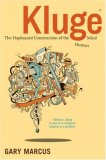
new book: ‘Kluge’ by Gary Marcus

April 20, 2008

I’m not sure how I missed posting about Kluge: The Haphazard Construction of the Human Mind by Gary Marcus before this, but there’s probably a good explanation in the book!
Kluge
Product description:

Are we noble in reason? Perfect, in God’s image? Far from it, says New York University psychologist Gary Marcus. In this lucid and revealing book, Marcus argues that the mind is not an elegantly designed organ but rather a “kluge,” a clumsy, cobbled-together contraption. He unveils a fundamentally new way of looking at the human mind — think duct tape, not supercomputer — that sheds light on some of the most mysterious aspects of human nature.

Taking us on a tour of the fundamental areas of human experience — memory, belief, decision-making, language, and happiness — Marcus reveals the myriad ways our minds fall short. He examines why people often vote against their own interests, why money can’t buy happiness, why leaders often stick to bad decisions, and why a sentence like “people people left left” ties us in knots even though it’s only four words long.

Marcus also offers surprisingly effective ways to outwit our inner kluge, for the betterment of ourselves and society. Throughout, he shows how only evolution — haphazard and undirected — could have produced the minds we humans have, while making a brilliant case for the power and usefulness of imperfection.

Marcus was on bloggingheads.tv with Carl Zimmer last week.

Comments (0) - mind,new books

new book: ‘Ontology of Consciousness’ for cross-cultural perspective

April 16, 2008

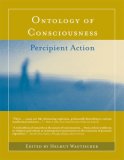
Ontology of Consciousness: Percipient Action (MIT Press) spent a long time as a “forthcoming” book but has finally made its own crucial ontological shift to “published.”

To me, the title doesn’t convey that the book is looking at consciousness from a wide range of disciplinary and cultural perspectives, which I think is needed to throw into perspective the assumptions made by one’s own culture and discipline. Ontology of Consciousness

Here is the product description:

The “hard problem” of today’s consciousness studies is subjective experience: understanding why some brain processing is accompanied by an experienced inner life. Recent scientific advances offer insights for understanding the physiological and chemical phenomenology of consciousness. But by leaving aside the internal experiential nature of consciousness in favor of mapping neural activity, such science leaves many questions unanswered. In Ontology of Consciousness, scholars from a range of disciplines–from neurophysiology to parapsychology, from mathematics to anthropology and indigenous non-Western modes of thought–go beyond these limits of current neuroscience research to explore insights offered by other intellectual approaches to consciousness.

These scholars focus their attention on such philosophical approaches to consciousness as Tibetan Tantric Buddhism, North American Indian insights, pre-Columbian Mesoamerican civilization, and the Byzantine Empire. Some draw on artifacts and ethnographic data to make their point. Others translate cultural concepts of consciousness into modern scientific language using models and mathematical mappings. Many consider individual experiences of sentience and existence, as seen in African communalism, Hindi psychology, Zen Buddhism, Indian vibhuti phenomena, existentialism, philosophical realism, and modern psychiatry. Some reveal current views and conundrums in neurobiology to comprehend sentient intellection.

MIT Press’s site includes the Table of Contents plus full text of the Foreword by Robert Thurman, the Preface by Helmut Wautischer, and the Introduction by Stanley Krippner.

Comments (0) - consciousness,culture,new books