May 18, 2008
This was the featured book for today at Powell’s Daily Dose (selected reader review):
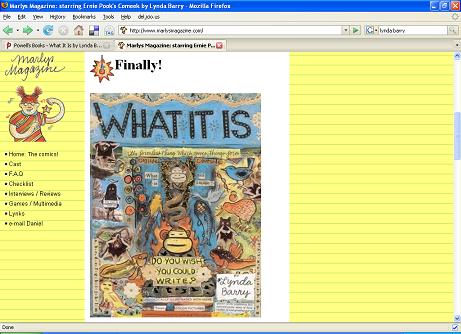
from the product description:
How do objects summon memories? What do real images feel like? For decades, these types of questions have permeated the pages of Lynda Barry’s compositions, with words attracting pictures and conjuring places through a pen that first and foremost keeps on moving. What It Is demonstrates a tried-and-true creative method that is playful, powerful, and accessible to anyone with an inquisitive wish to write or to remember. Composed of completely new material, each page of Barry’s first Drawn & Quarterly book is a full-color collage that is not only a gentle guide to this process but an invigorating example of exactly what it is: “The ordinary is extraordinary.”
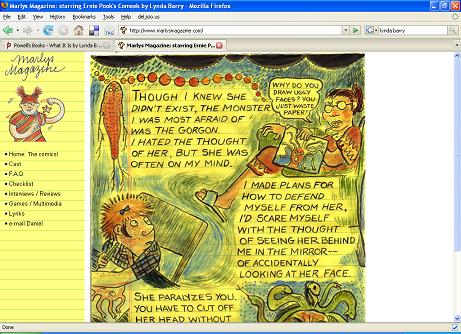
Marlys Magazine website also has some sample pages:
Comments (0)
- new books
May 16, 2008
I’ve noticed a number of new books coming out on the subject of memory; here’s a short list: 
The Woman Who Can’t Forget: The Extraordinary Story of Living with the Most Remarkable Memory Known to Science–A Memoir by Jill Price with Bart Davis (Free Press, 2008)
Can’t Remember What I Forgot: The Good News from the Front Lines of Memory Research by Sue Halpern (Harmony, 2008) author’s blog
Memory: From Mind to Molecules by Larry Squire and Eric Kandel (Roberts and Co, 2nd ed., coming in July 2008)
The Metaphysics of Memory (Philosophical Studies Series) by Sven Bernecker (Springer, 2008)
……………..
And this:
A bibliography and resource list on the interdisciplinary study of memory, updated in Nov. 2007, by John Sutton, Philosophy Dept., Macquarie University
Comments (0)
- mind,new books
May 12, 2008
Brainstorming: Views and Interviews on the Mind by Shaun Gallagher (Imprint Academic, 2008).  According to Amazon, this book is due out on June 1.
From the publisher:
Shaun Gallagher is a philosopher of mind who has made it his business to study and meet with leading neuroscientists, including Michael Gazzaniga, Marc Jeannerod and Chris Frith.
The result is this unique introduction to the study of the mind, with topics ranging over consciousness, emotion, language, movement, free will and moral responsibility. The discussion throughout is illustrated by lengthy extracts from the author’s many interviews with his scientist colleagues on the relation between the mind and the brain.
Shaun Gallagher is Professor of Philosophy and Cognitive Sciences at the University of Central Florida and the University of Hertfordshire.
Shaun Gallagher at Wikipedia
Comments (0)
- mind,new books,philosophy of mind
May 10, 2008
Mirroring People: The New Science of How We Connect with Others by Marco Iacoboni (Farrar, Straus and Giroux, 2008).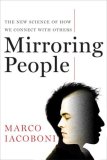 Amazon still has this listed as a pre-order, with a publication date of May 13, but I saw this book on the shelves at my local bookstore yesterday.
From the product description:
What accounts for the remarkable ability to get inside another person’s head—to know what they’re thinking and feeling? “Mind reading” is the very heart of what it means to be human, creating a bridge between self and others that is fundamental to the development of culture and society. But until recently, scientists didn’t understand what in the brain makes it possible. This has all changed in the last decade. Marco Iacoboni, a leading neuroscientist whose work has been covered in The New York Times, the Los Angeles Times, and The Wall Street Journal, explains the groundbreaking research into mirror neurons, the “smart cells” in our brain that allow us to understand others. From imitation to morality, from learning to addiction, from political affiliations to consumer choices, mirror neurons seem to have properties that are relevant to all these aspects of social cognition. As The New York Times reports: “The discovery is shaking up numerous scientific disciplines, shifting the understanding of culture, empathy, philosophy, language, imitation, autism and psychotherapy.” Mirroring People is the first book for the general reader on this revolutionary new science.
Comments (0)
- cognitive science,new books
May 7, 2008
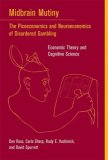
Midbrain Mutiny: The Picoeconomics and Neuroeconomics of Disordered Gambling: Economic Theory and Cognitive Science (Bradford Books) by Don Ross, Carla Sharp, Rudy E. Vuchenich and David Spurrett (MIT Press, 2008)
from the product description:
The explanatory power of economic theory is tested by the phenomenon of irrational consumption, examples of which include such addictive behaviors as disordered and pathological gambling. Midbrain Mutiny examines different economic models of disordered gambling, using the frameworks of neuroeconomics (which analyzes decision making in the brain) and picoeconomics (which analyzes patterns of consumption behavior), and drawing on empirical evidence about behavior and the brain. The authors argue that pathological gambling is a true addiction and that addictive gambling is the basic form of addiction, revealing the core character of all addiction.
The book describes addiction in neuroeconomic terms as chronic disruption of the balance between the midbrain dopamine system and the prefrontal and frontal serotonergic system, and reviews recent evidence from trials testing the effectiveness of antiaddiction drugs. The authors argue that the best way to understand disordered and addictive gambling is with a hybrid picoeconomic-neuroeconomic model, and their demonstration of this framework’s applicability to gambling provides a concrete case study for the more abstract description of picoeconomic-neuroeconomic complementarity in Don Ross’s earlier book Economic Theory and Cognitive Science: Microexplanation (MIT Press, 2005).
MIT Press information, including sample chapters
More on “picoeconomics” (micro-micro-economics)
newspaper article: “UAB researchers find gambling addiction’s wild card” (Birmingham News, May 6, 2008)
Dr. Don Ross’s webpage at UAB
Comments (0)
- cognitive science,new books