[ View menu ]

Archive for 'new books'

Cognitive science books 2008

June 1, 2008

Following is a list of cognitive science books new/forthcoming in 2008, to be added to the list in the sidebar. This selection is based on a search of WorldCat, so they are titles that have been chosen by libraries. [6/13 – just updated a few titles that have since been released]

Applied Attention Theory by Christopher D Wickens and Jason S McCarley (Boca Raton: CRC Press, 2008)

Applying Cognitive Science to Education: Thinking and Learning in Scientific and Other Complex Domains (Bradford Books) by F Reif (Cambridge, Mass.; London: MIT, 2008) forthcoming

Better Than Conscious?: Decision Making, the Human Mind, and Implications for Institutions ed. by Christoph Engel and Wolf Singer (Cambridge, Mass.: MIT Press, 2008)

Beyond Happiness: Deepening the Dialogue Between Buddhism, Psychotherapy and the Mind Sciences by Gay Watson (London: Karnac Books, 2008)

The Bounds of Cognition by Frederick Adams and Kenneth Aizawa (Malden, Mass.; Oxford : Blackwell Pub., 2008)

The Cambridge Handbook of Computational Psychology (Cambridge Handbook Of…)ed. by Ron Sun (Cambridge; New York: Cambridge University Press, 2008)

Cognitive Economics by Bernard Walliser (Berlin: Springer, 2008)

Cognitive Science (SAGE Benchmarks in Psychology Series) ed. by Koen Lamberts (Los Angeles; London: SAGE, 2008). 6 vols.

Cognitive Science Compendium ed. by Miao-Kun Sun (New York: Nova Science Publishers, 2008) forthcoming

Cognitive Sciences Research Progress ed. by Miao-Kun Sun (New York: Nova Science Publishers, Inc., 2008) forthcoming

Creative Model Construction in Scientists and Students: The Role of Imagery, Analogy, and Mental Simulation by John J Clement (Dordrecht; London: Springer, 2008) forthcoming

History of Cognitive Neuroscience by M.R. Bennett and P.M.S. Hacker (Malden, Mass.: Wiley-Blackwell, 2008) forthcoming

Human Reasoning and Cognitive Science (Bradford Books) by Keith Stenning and Michiel van Lambalgen (Cambridge, Mass.: MIT Press, 2008) forthcoming

I-Language: An Introduction to Linguistics as Cognitive Science by Daniela Isac and Charles Reiss (Oxford : Oxford University Press, 2008) (textbook)

The Innate Mind: Vol. 3, Foundations and the Future (Evolution and Cognition)ed. by Peter Carruthers; Stephen Laurence; Stephen P Stich (New York; Oxford: Oxford University Press, 2008)

Midbrain Mutiny: The Picoeconomics and Neuroeconomics of Disordered Gambling: Economic Theory and Cognitive Science (Bradford Books) by Don Ross; et al (Cambridge, Mass.: MIT Press, 2008)

Mind and Cognition: An Anthology, 3rd ed. (Blackwell Philosophy Anthologies) ed. by William G Lycan and Jesse J Prinz (Malden, Mass.; Oxford: Blackwell Pub. Ltd, 2008)

Mind, Brain and the Elusive Soul: Human Systems of Cognitive Science and Religion by Mark Graves (Aldershot, England ; Burlington, Vermont: Ashgate, 2008)

Models of Brain and Mind: Physical, Computational and Psychological Approaches (Progress in Brain Research, Vol. 168) ed. by Rahul Banerjee; B K Chakrabarti (Amsterdam; London: Elsevier, 2008)

Neuroeconomics: A Guide to the New Science of Making Choices by Peter E Politser (Oxford; New York: Oxford University Press, 2008)

Novel Approaches in Cognitive Informatics and Natural Intelligence ed. by Yingxu Wang (Hershey, Pa. : Information Science Reference, 2009) forthcoming

The Probabilistic Mind: Prospects for Bayesian Cognitive Science by Nick Chater and M Oaksford (Oxford; New York: Oxford University Press, 2008)

Strange Concepts and the Stories They Make Possible: Cognition, Culture, Narrative by Lisa Zunshine (Baltimore : Johns Hopkins University Press, 2008) forthcoming

Truly Understood by Christopher Peacocke (Oxford: Oxford University Press, 2008)

Comments (3) - cognitive science,new books

new book: ‘The Probabilistic Mind: Prospects for Bayesian Cognitive Science’

May 31, 2008

The new book The Probabilistic Mind: Prospects for Bayesian Cognitive Science by Nick Chater and Mike Oaksford (Oxford, 2008) [Search Inside the Book available at Amazon] appears to be unrelated to the New Scientist article on Bayesian statistics and brain functions discussed today at Mind Hacks.


From the product description for The Probabilistic Mind:

The rational analysis method, first proposed by John R. Anderson, has been enormously influential in helping us understand high-level cognitive processes.

The Probabilistic Mind is a follow-up to the influential and highly cited ‘Rational Models of Cognition’ (OUP, 1998). It brings together developments in understanding how, and how far, high-level cognitive processes can be understood in rational terms, and particularly using probabilistic Bayesian methods. It synthesizes and evaluates the progress in the past decade, taking into account developments in Bayesian statistics, statistical analysis of the cognitive ‘environment’ and a variety of theoretical and experimental lines of research. The scope of the book is broad, covering important recent work in reasoning, decision making, categorization, and memory. Including chapters from many of the leading figures in this field,
The Probabilistic Mind will be valuable for psychologists and philosophers interested in cognition.

Comments (0) - cognitive science,new books

new book: ‘Snoop: What Your Stuff Says About You’

May 26, 2008

I saw this at the bookstore today, started reading and was already jotting things down within the first few pages, a sure sign of a good book:

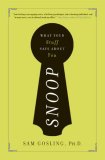
Snoop: What Your Stuff Says About You by Sam Gosling (Basic Books, 2008)

From the product description:

Does what’s on your desk reveal what’s on your mind? Do those pictures on your walls tell true tales about you? And is your favorite outfit about to give you away? For the last ten years psychologist Sam Gosling has been studying how people project (and protect) their inner selves. By exploring our private worlds (desks, bedrooms, even our clothes and our cars), he shows not only how we showcase our personalities in unexpected—and unplanned—ways, but also how we create personality in the first place, communicate it others, and interpret the world around us. Gosling, one of the field’s most innovative researchers, dispatches teams of scientific snoops to poke around dorm rooms and offices, to see what can be learned about people simply from looking at their stuff. What he has discovered is astonishing: when it comes to the most essential components of our personalities—from friendliness to flexibility—the things we own and the way we arrange them often say more about us than even our most intimate conversations. If you know what to look for, you can figure out how reliable a new boyfriend is by peeking into his medicine cabinet or whether an employee is committed to her job by analyzing her cubicle. Bottom line: The insights we gain can boost our understanding of ourselves and sharpen our perceptions of others. Packed with original research and fascinating stories, Snoop is a captivating guidebook to our not-so-secret lives.

Website for the book

Comments (1) - new books,psychology,self

recent book: ‘Beyond Revenge: The Evolution of the Forgiveness Instinct’ by

May 25, 2008

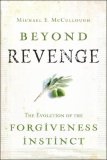
Beyond Revenge: The Evolution of the Forgiveness Instinct by Michael McCullough (Jossey-Bass, 2008)
From the product description:

Why is revenge such a pervasive and destructive problem? How can we create a future in which revenge is less common and forgiveness is more common? Psychologist Michael McCullough argues that the key to a more forgiving, less vengeful world is to understand the evolutionary forces that gave rise to these intimately human instincts and the social forces that activate them in human minds today. Drawing on exciting breakthroughs from the social and biological sciences, McCullough dispenses surprising and practical advice for making the world a more forgiving place.


Website for the book

Comments (0) - culture,new books

new book: ‘Better Than Conscious?’

May 20, 2008

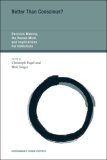
Better Than Conscious?: Decision Making, the Human Mind, and Implications For Institutions (Strüngmann Forum Reports) ed. by Christoph Engel and Wolf Singer (MIT Press, 2008)

Better Than Conscious?
From the product description:

Conscious control enables human decision makers to override routines, to exercise willpower, to find innovative solutions, to learn by instruction, to decide collectively, and to justify their choices. These and many more advantages, however, come at a price: the ability to process information consciously is severely limited and conscious decision makers are liable to hundreds of biases. Measured against the norms of rational choice theory, conscious decision makers perform poorly. But if people forgo conscious control, in appropriate tasks, they perform surprisingly better: they handle vast amounts of information; they update prior information; they find appropriate solutions to ill-defined problems.

This inaugural Strüngmann Forum Report explores the human ability to make decisions, consciously as well as without conscious control. It explores decision-making strategies, including deliberate and intuitive; explicit and implicit; processing information serially and in parallel, with a general-purpose apparatus, or with task-specific neural subsystems. The analysis is at four levels–neural, psychological, evolutionary, and institutional–and the discussion is extended to the definition of social problems and the design of better institutional interventions. The results presented differ greatly from what could be expected under standard rational choice theory and deviate even more from the alternate behavioral view of institutions. New challenges emerge (for example, the issue of free will) and some purported social problems almost disappear if one adopts a more adequate model of human decision making.

Preprint of the Max Planck Institute for Research on Collective Goods (22 p. pdf by Engel and Singer)

Ernst Strüngmann Forum information

Comments (0) - cognitive science,consciousness,new books