These two recent titles seem to go together to describe my way of life these days. ‘Always On’ is a more scholarly examination by a professor of linguistics of the effects of new communication technologies on language, whereas ‘Distracted’ is a journalistic account of the effects of those technologies on attention.
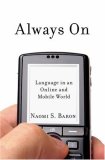
Always On: Language in an Online and Mobile World by Naomi S. Baron (Oxford University Press, 2008)
Product description:
In Always On, Naomi S. Baron reveals that online and mobile technologies–including instant messaging, cell phones, multitasking, Facebook, blogs, and wikis–are profoundly influencing how we read and write, speak and listen, but not in the ways we might suppose.
Baron draws on a decade of research to provide an eye-opening look at language in an online and mobile world. She reveals for instance that email, IM, and text messaging have had surprisingly little impact on student writing. Electronic media has magnified the laid-back “whatever” attitude toward formal writing that young people everywhere have embraced, but it is not a cause of it. A more troubling trend, according to Baron, is the myriad ways in which we block incoming IMs, camouflage ourselves on Facebook, and use ring tones or caller ID to screen incoming calls on our mobile phones. Our ability to decide who to talk to, she argues, is likely to be among the most lasting influences that information technology has upon the ways we communicate with one another. Moreover, as more and more people are “always on” one technology or another–whether communicating, working, or just surfing the web or playing games–we have to ask what kind of people do we become, as individuals and as family members or friends, if the relationships we form must increasingly compete for our attention with digital media?
Our 300-year-old written culture is on the verge of redefinition, Baron notes. It’s up to us to determine how and when we use language technologies, and to weigh the personal and social benefits–and costs–of being “always on.” This engaging and lucidly-crafted book gives us the tools for taking on these challenges.
Science Daily article on ‘Always On’
Author Naomi S. Baron’s webpage
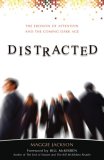
Distracted: The Erosion of Attention and the Coming Dark Age by Maggie Jackson, with a foreword by Bill McKibben (Prometheus Books, 2008)
Description from the publisher;
We have oceans of information at our fingertips, yet we seek knowledge in Yahoo headlines glimpsed on the run. We are networked as never before, but we connect with friends and family via email and fleeting face-to-face moments that are rescheduled a dozen times.
Welcome to the land of distraction.
Despite our wondrous technologies and scientific advances, we are nurturing a culture of diffusion and detachment. Our attention is scattered among the beeps and pings of a push-button world. We are less and less able to pause, reflect, and deeply connect.
Distracted is a gripping exposé of this hyper-mobile, cyber-centric, attention-deficient life. Day by day, we are eroding our capacity for deep attention — the building block of intimacy, wisdom, and cultural progress. The implications for a healthy society are stark.
And yet we can recover our powers of focus through a renaissance of attention. Neuroscience is just now decoding the workings of attention, with its three pillars of focus, awareness, and judgment, and revealing how these skills can be shaped and taught. This is exciting news for all of us living in an age of overload.
In her sweeping quest to unravel the nature of attention and detail its losses, Maggie Jackson introduces us to scientists, cartographers, marketers, educators, wired teens, and even roboticists. She offers us a compelling wake-up call, an adventure story, and reasons for hope.
Pull over, hit the pause button, and prepare for an eye-opening journey. More than ever, we cannot afford to let distraction become the marker of our time.
Author Maggie Jackson’s blog
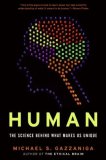 Human: The Science Behind What Makes Us Unique by neuroscientist Michael S. Gazzaniga (Ecco, 2008) has a June 24 release date according to Amazon. (This was one of the books mentioned in the Neuroanthropology post “David Brooks Bonus” on ‘Neural Buddhists.’)