[ View menu ]

Archive for 'new books'

coming soon: ‘Describing Ourselves: Wittgenstein and Autobiographical Consciousness’

July 4, 2008

Describing Ourselves: Wittgenstein and Autobiographical Consciousness by Garry Hagberg (Oxford University Press, 2008) (in stock at Amazon UK, coming July 15 in the US)

Product description:

The voluminous writings of Ludwig Wittgenstein contain some of the most profound reflections of recent times on the nature of the human subject and self-understanding – the human condition, philosophically speaking. Describing Ourselves mines those extensive writings for a conception of the self that stands in striking contrast to its predecessors as well as its more recent alternatives. More specifically, the book offers a detailed discussion of Wittgenstein’s later writings on language and mind as they hold special significance for the understanding and clarification of the distinctive character of self-descriptive or autobiographical language.
Garry L. Hagberg undertakes a ground-breaking philosophical investigation of selected autobiographical writings – among the best examples we have of human selves exploring themselves – as they cast new and special light on the critique of mind-body dualism and its undercurrents in particular and on the nature of autobiographical consciousness more generally. The chapters take up in turn the topics of self-consciousness, what Wittgenstein calls ‘the inner picture’, mental privacy and the picture of metaphysical seclusion, the very idea of our observation of the contents of consciousness, first-person expressive speech, reflexive or self-directed thought and competing pictures of introspection, the nuances of retrospective self-understanding, person-perception and the corollary issues of self-perception (itself an interestingly dangerous phrase), self-defining memory, and the therapeutic conception of philosophical progress as it applies to all of these issues.
The cast of characters interwoven throughout this rich discussion include, in addition to Wittgenstein centrally, Augustine, Goethe, Dostoevsky, Kierkegaard, Iris Murdoch, Donald Davidson, and Stanley Cavell, among others. Throughout, conceptual clarifications concerning mind and language are put to work in the investigation of issues relating to self-description and in novel philosophical readings of autobiographical texts.
Comments (0) - new books,self

coming soon: What Is Special About the Human Brain?

July 2, 2008

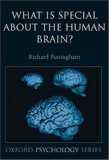
What Is Special About the Human Brain?

What is Special About the Human Brain? (Oxford Portraits in Science) by Richard Passingham has a prospective release date of July 15, 2008, according to Amazon, or July 4 according to Oxford University Press.

Product description:

It is plausible that evolution could have created the human skeleton, but it is hard to believe that it created the human mind. Yet, in six or seven million years evolution came up with Homo sapiens, a creature unlike anything the world had ever known. The mental gap between man and ape is immense, and yet evolution bridged that gap in so short a space of time. Since the brain is the organ of the mind, it is natural to assume that during the evolution of our hominid ancestors there were changes in the brain that can account for this gap. This book is a search for those changes.
It is not enough to understand the universe, the world, or the animal kingdom: we need to understand ourselves. Humans are unlike any other animal in dominating the earth and adapting to any environment. This book searches for specializations in the human brain that make this possible. As well as considering the anatomical differences, it examines the contribution of different areas of the brain – reviewing studies in which functional brain imaging has been used to study the brain mechanisms that are involved in perception, manual skill, language, planning, reasoning, and social cognition. It considers a range of skills unique to us – for example our ability to learn a language and pass on cultural traditions in this way, and become aware of our own thoughts through inner speech
Written in a lively style by a distinguished scientist who has made his own major contribution to our understanding of the mind, the book is a far-reaching and exciting quest to understand those things that make humans unique.

Comments (0) - cognitive science,human evolution,new books

new book: ‘Epistemic Dimensions of Personhood’

June 30, 2008

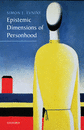
Epistemic Dimensions of Personhood by Simon Evnine (Oxford University Press, 2008)

Product description:Epistemic Dimensions of Personhood

Simon Evnine examines various epistemic aspects of what it is to be a person. Persons are defined as finite beings that have beliefs, including second-order beliefs about their own and others’ beliefs, and are agents, capable of making long-term plans. It is argued that for any being meeting these conditions, a number of epistemic consequences obtain. First, all such beings must have certain logical concepts and be able to use them in certain ways. Secondly, there are at least two principles governing belief that it is rational for persons to satisfy and are such that nothing can be a person at all unless it satisfies them to a large extent. These principles are that one believe the conjunction of one’s beliefs and that one treat one’s future beliefs as, by and large, better than one’s current beliefs. Thirdly, persons both occupy epistemic points of view on the world and show up within those views. This makes it impossible for them to be completely objective about their own beliefs. Ideals of rationality that require such objectivity, while not necessarily wrong, are intrinsically problematic for persons. This “aspectual dualism” is characteristic of treatments of persons in the Kantian tradition. In sum, these epistemic consequences support a traditional view of the nature of persons, one in opposition to much recent theorizing.

Comments (0) - new books,philosophy of mind,self

Telegraph’s “best new summer reading”

June 27, 2008

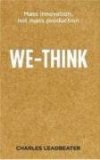
The list of “best new summer reading of 2008” at the Telegraph (UK) includes The Baby in the Mirror: A Child’s World from Birth to Three by Charles Fernyhough (“the most poetic popular science book of the year” though more of a fall read in the US) and We-think: The Power of Mass Creativity by Charles Leadbeater (“brilliantly comprehensive guide to the revolutionary new era of IT”).

Comments (0) - new books

new book: ‘The Case for Qualia’

June 26, 2008

The Case for Qualia (Bradford Books) edited by Edmond Wright (MIT Press, 2008)

Product description:

Many philosophers and cognitive scientists dismiss the notion of qualia, sensory experiences that are internal to the brain. Leading opponents of qualia (and of indirect realism, the philosophical position that has qualia as a central tenet) include Michael Tye, Daniel Dennett, Paul and Patricia Churchland, and even Frank Jackson, a former supporter. Qualiaphiles apparently face the difficulty of establishing philosophical contact with the real when their access to it is seen by qualiaphobes to be second-hand and, worse, hidden behind a “veil of sensation”–a position that would slide easily into relativism and solipsism, presenting an ethical dilemma. In The Case for Qualia, proponents of qualia defend the Indirect Realist position and mount detailed counterarguments against opposing views.

The book first presents philosophical defenses, with arguments propounding, variously, a new argument from illusion, a sense-datum theory, dualism, “qualia realism,” qualia as the “cement” of the experiential world, and “subjective physicalism.” Three scientific defenses follow, discussing color, heat, and the link between the external object and the internal representation. Finally, specific criticisms of opposing views include discussions of the Churchlands’ “neurophilosophy,” answers to Frank Jackson’s abandonment of qualia (one of which is titled, in a reference to Jackson’s famous thought experiment, “Why Frank Should Not Have Jilted Mary”), and refutations of transparency theory.

Contributors:
Torin Alter, Michel Bitbol, Harold I. Brown, Mark Crooks, George Graham, C. L. Hardin, Terence E. Horgan, Robert J. Howell, Amy Kind, E. J. Lowe, Riccardo Manzotti, Barry Maund, Martine Nida-Rümelin, John O’Dea, Isabelle Peschard, Matjaž Potr?, Diana Raffman, Howard Robinson, William S. Robinson, John Smythies, Edmond Wright.

MIT Press has the Table of Contents and samples

Qualia at Wikipedia

Comments (0) - new books,philosophy of mind