[ View menu ]

Archive for 'new books'

new book – Mothers and Others: The Evolutionary Origins of Mutual Understanding

April 2, 2009

Mothers and Others

Mothers and Others: The Evolutionary Origins of Mutual Understanding is a new book by anthropologist/primatologist Sarah Blaffer Hrdy (Belknap Press, 2009).

Product description from the publisher:

Somewhere in Africa, more than a million years ago, a line of apes began to rear their young differently than their Great Ape ancestors. From this new form of care came new ways of engaging and understanding each other. How such singular human capacities evolved, and how they have kept us alive for thousands of generations, is the mystery revealed in this bold and wide-ranging new vision of human emotional evolution.

Mothers and Others finds the key in the primatologically unique length of human childhood. If the young were to survive in a world of scarce food, they needed to be cared for, not only by their mothers but also by siblings, aunts, fathers, friends—and, with any luck, grandmothers. Out of this complicated and contingent form of childrearing, Sarah Hrdy argues, came the human capacity for understanding others. Mothers and others teach us who will care, and who will not.

From its opening vision of “apes on a plane”; to descriptions of baby care among marmosets, chimpanzees, wolves, and lions; to explanations about why men in hunter-gatherer societies hunt together (hint: it’s called the Showing-Off Hypothesis), Mothers and Others is compellingly readable. But it is also an intricately knit argument that ever since the Pleistocene, it has taken a village to raise children—and how that gave our ancient ancestors the first push on the path toward becoming emotionally modern human beings.

An excerpt is available through the publisher’s website.
Comments (0) - culture,human evolution,new books

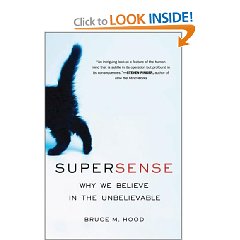
coming soon – ‘SuperSense: Why We Believe in the Unbelievable’

March 31, 2009

supersense

SuperSense: Why We Believe in the Unbelievable by cognitive scientist Bruce M. Hood (HarperOne, 2009) is due out on April 7. Amazon has a video introduction from the author, plus a pdf of the first chapter.

Product Description from the publisher:

The majority of the world’s population is religious or believes in supernatural phenomena. In the United States, nine out of every ten adults believe in God, and a recent Gallup poll found that about three out of four Americans believe in some form of telepathy, déjà vu, ghosts, or past lives. Where does such supernatural thinking come from? Are we indoctrinated by our parents, churches, and media, or do such beliefs originate somewhere else? In SuperSense, award-winning cognitive scientist Bruce M. Hood reveals the science behind our beliefs in the supernatural.

Superstitions are common. Many of us cross our fingers, knock on wood, step around black cats, and avoid walking under ladders. John McEnroe refused to step on the white lines of a tennis court between points. Wade Boggs insisted on eating a chicken dinner before every Boston Red Sox game. President Barack Obama played a game of basketball the morning of his victory in the Iowa primary and continued the tradition on every subsequent election day.

Supernatural thinking includes loftier beliefs as well, such as the sentimental value we place on photos of loved ones, wedding rings, and teddy bears. It also includes spiritual beliefs and the hope for an afterlife. But in this modern, scientific age, why do we hold on to these behaviors and beliefs?

It turns out that belief in things beyond what is rational or natural is common to humans and appears very early in childhood. In fact, according to Hood, this “super sense” is something we’re born with to develop and is essential to the way we learn to understand the world. We couldn’t live without it!

Our minds are designed from the very start to think there are unseen patterns, forces, and essences inhabiting the world, and it is unlikely that any effort to get rid of supernatural beliefs, or the superstitious behaviors that accompany them, will be successful. These common beliefs and sacred values are essential in binding us together as a society because they help us to see ourselves connected to each other at a deeper level.

See also: Author’s blog

Comments (1) - cognitive science,new books

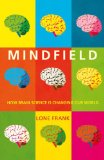
new book – Mindfield: How Brain Science Is Changing Our World

March 26, 2009

Mindfield

Mindfield: How Brain Science is Changing Our World by Lone Frank (Oneworld Publications, 2009), originally published in Danish in 2007, is now available in English translation.

Product description from the publisher:

Our world is about to be revolutionised. The way we see economics, health, and law enforcement will change. Our perception of happiness, advertising, and even morality will be turned upside down.

Reporting from the frontlines, award-winning writer Lone Frank tracks down the world’s top researchers in brain science and bravely volunteers herself in the name of discovery. As she enrols in a globe-spanning experiment on the moral nature of humanity, endures brain scans to learn the secrets of empathy, and dons a God Helmet to probe the neurological nature of religious experience, her adventures open the door to a plethora of shocking, mind-bending, and frequently comical revelations.

An insider’s guide to the outermost boundaries of brain science, Mindfield offers an uplifting vision of what it means to be human in the new age of the brain.

A sample chapter is available at the publisher’s website.

Comments (2) - mind,new books,Uncategorized

new book – ‘Adam’s Tongue: How Humans Made Language, How Language Made Humans’

March 24, 2009

Adam's Tongue

Adam’s Tongue: How Humans Made Language, How Language Made Humans by Derek Bickerton (Hill & Wang, 2009)

Product description from the publisher:

How language evolved has been called “the hardest problem in science.” In Adam’s Tongue, Derek Bickerton—long a leading authority in this field—shows how and why previous attempts to solve that problem have fallen short. Taking cues from topics as diverse as the foraging strategies of ants, the distribution of large prehistoric herbivores, and the construction of ecological niches, Bickerton produces a dazzling new alternative to the conventional wisdom. Language is unique to humans, but it isn’t the only thing that sets us apart from other species—our cognitive powers are qualitatively different. So could there be two separate discontinuities between humans and the rest of nature? No, says Bickerton; he shows how the mere possession of symbolic units—words—automatically opened a new and different cognitive universe, one that yielded novel innovations ranging from barbed arrowheads to the Apollo spacecraft. Written in Bickerton’s lucid and irreverent style, this book is the first that thoroughly integrates the story of how language evolved with the story of how humans evolved. Sure to be controversial, it will make indispensable reading both for experts in the field and for every reader who has ever wondered how a species as remarkable as ours could have come into existence.

See also: review at New Scientist

Comments (0) - cognitive science,culture,human evolution,language,new books

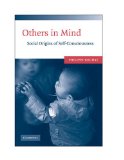
recent book – ‘Others in Mind: Social Origins of Self-Consciousness’

March 23, 2009

Others in Mind
This book slipped by and I forgot to feature it before now: Others in Mind: Social Origins of Self-Consciousness by Philippe Rochat (Cambridge University Press, 2009)

Product description from the publisher:

Why are we so prone to guilt and embarrassment? Why do we care so much about how others see us, about our reputation? What are the origins of such afflictions? It is because we are members of a species that evolved the unique propensity to reflect upon themselves as the object of thoughts, an object of thoughts that is potentially evaluated by others. But, Philippe Rochat’s argument goes, this propensity comes from a basic fear: the fear of rejection, of being socially “banned” and ostracized. Others in Mind is about self-consciousness, how it originates and how it shapes our lives. Self-consciousness is arguably the most important and revealing of all psychological problems.

More information from the publisher, including an excerpt.

Comments (0) - cognitive science,consciousness,culture,new books,self