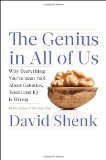
With irresistibly persuasive vigor, David Shenk debunks the long-standing notion of genetic “giftedness,” and presents dazzling new scientific research showing how greatness is in the reach of every individual.
DNA does not make us who we are. “Forget everything you think you know about genes, talent, and intelligence,” he writes. “In recent years, a mountain of scientific evidence has emerged suggesting a completely new paradigm: not talent scarcity, but latent talent abundance.”
Integrating cutting-edge research from a wide swath of disciplines—cognitive science, genetics, biology, child development—Shenk offers a highly optimistic new view of human potential. The problem isn’t our inadequate genetic assets, but our inability, so far, to tap into what we already have. IQ testing and widespread acceptance of “innate” abilities have created an unnecessarily pessimistic view of humanity—and fostered much misdirected public policy, especially in education.
The truth is much more exciting. Genes are not a “blueprint” that bless some with greatness and doom most of us to mediocrity or worse. Rather our individual destinies are a product of the complex interplay between genes and outside stimuli-a dynamic that we, as people and as parents, can influence.
This is a revolutionary and optimistic message. We are not prisoners of our DNA. We all have the potential for greatness.
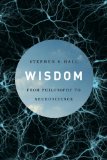
A compelling investigation into one of our most coveted and cherished ideals, and the efforts of modern science to penetrate the mysterious nature of this timeless virtue.
We all recognize wisdom, but defining it is more elusive. In this fascinating journey from philosophy to science, Stephen S. Hall gives us a dramatic history of wisdom, from its sudden emergence in four different locations (Greece, China, Israel, and India) in the fifth century B.C. to its modern manifestations in education, politics, and the workplace. We learn how wisdom became the provenance of philosophy and religion through its embodiment in individuals such as Buddha, Confucius, and Jesus; how it has consistently been a catalyst for social change; and how revelatory work in the last fifty years by psychologists, economists, and neuroscientists has begun to shed light on the biology of cognitive traits long associated with wisdom—and, in doing so, begun to suggest how we might cultivate it.
Hall explores the neural mechanisms for wise decision making; the conflict between the emotional and cognitive parts of the brain; the development of compassion, humility, and empathy; the effect of adversity and the impact of early-life stress on the development of wisdom; and how we can learn to optimize our future choices and future selves.
Hall’s bracing exploration of the science of wisdom allows us to see this ancient virtue with fresh eyes, yet also makes clear that despite modern science’s most powerful efforts, wisdom continues to elude easy understanding.
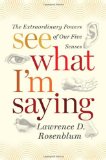
An in-depth look at the science that explains the hidden powers of the five senses and how to harness their potential. In this revealing romp through the mysteries of human perception, University of California psychologist and researcher Lawrence Rosenblum explores the astonishing abilities of the five senses–skills of which most of us are remarkably unaware. Drawing on groundbreaking insights into the brain’s plasticity and integrative powers, including findings from his own research, Rosenblum examines how our brains use the subtlest information to perceive the world. A blind person, for example, can “see” through batlike echolocation; a Master Sommelier can actually taste the grape variety, region, and vintage of an obscure wine; and pheromones can subliminally signal a lover’s compatibility.
To illustrate these implicit perceptual skills, Rosenblum takes us from the “beep” baseball fields where blind players swing at beeping balls, to a pitch-black restaurant where diners experience taste without the aid of sight. We accompany him on a visit to an Oscar-winning animator who explains how the public’s expertise in perceiving faces has made his job so difficult; and a visit with a supermodel to discuss why beautiful faces are irresistible.
New studies have shed light on the surprising power and reach of our senses. It turns out that our brains use entire forms of perceptual information of which we are largely unaware. We can hear things that don’t make sounds, feel things without touching them, see things with no form, and smell things that have no discernible odor. Throughout the book, Rosenblum not only illuminates the fascinating science behind our hidden perceptual powers, but demonstrates how increased awareness of these abilities can actually lead us to enhance how we use them.
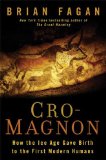
Cro-Magnons were the first fully modern Europeans—not only the creators of the stunning cave paintings at Lascaux and elsewhere, but the most adaptable and technologically inventive people that had yet lived on earth. The prolonged encounter between the Cro-Magnons and the archaic Neanderthals and between 45,000 and 30,000 years ago was one of the defining moments of history. The Neanderthals survived for some 15,000 years in the face of the newcomers, but were finally pushed aside by the Cro-Magnons’ vastly superior intellectual abilities and cutting-edge technologies, which allowed them to thrive in the intensely challenging climate of the Ice Age.
What do we know about this remarkable takeover? Who were the first modern Europeans and what were they like? How did they manage to thrive in such an extreme environment? And what legacy did they leave behind them after the cold millennia? The age of the Cro-Magnons lasted some 30,000 years—longer than all of recorded history. Cro-Magnon is the story of a little known, yet seminal, chapter of human experience.
An open call for new literary and other art forms to match the complexities of the twenty-first century.
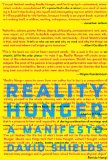
Reality TV dominates broadband. YouTube and Facebook dominate the web. In Reality Hunger: A Manifesto, his landmark new book, David Shields (author of the New York Times best seller The Thing About Life Is That One Day You’ll Be Dead) argues that our culture is obsessed with “reality” precisely because we experience hardly any.
Most artistic movements are attempts to figure out a way to smuggle more of what the artist thinks is reality into the work of art. So, too, every artistic movement or moment needs a credo, from Horace’s Ars Poetica to Lars von Trier’s “Vow of Chastity.” Shields has written the ars poetica for a burgeoning group of interrelated but unconnected artists in a variety of forms and media who, living in an unbearably manufactured and artificial world, are striving to stay open to the possibility of randomness, accident, serendipity, spontaneity; actively courting reader/listener/viewer participation, artistic risk, emotional urgency; breaking larger and larger chunks of “reality” into their work; and, above all, seeking to erase any distinction between fiction and nonfiction.
The questions Reality Hunger explores—the bending of form and genre, the lure and blur of the real—play out constantly all around us. Think of the now endless controversy surrounding the provenance and authenticity of the “real”: A Million Little Pieces, the Obama “Hope” poster, the sequel to The Catcher in the Rye, Robert Capa’s “The Falling Soldier” photograph, the boy who wasn’t in the balloon. Reality Hunger is a rigorous and radical attempt to reframe how we think about “truthiness,” literary license, quotation, appropriation.
Drawing on myriad sources, Shields takes an audacious stance on issues that are being fought over now and will be fought over far into the future. People will either love or hate this book. Its converts will see it as a rallying cry; its detractors will view it as an occasion for defending the status quo. It is certain to be one of the most controversial and talked-about books of the year.
There’s already lots of response to this book, so here is a link to the latest Google news search results.