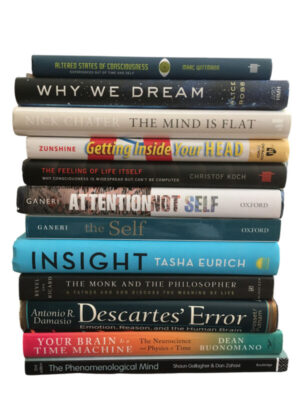
Amazon.com has removed some of the more specific categories from the New Releases and Browse Subjects sections. For example, we used to be able to drill down from “Nonfiction” to “Philosophy” to “Consciousness & Thought,” but now the selections stop at “Philosophy.” It is still possible to find the more specific categories through a Google search, such as: site:amazon.com new releases consciousness thought & subscribe to the feed provided at the bottom of the page at Amazon.com.
Here are links to the new releases in “Consciousness & Thought” and “Neuropsychology”:
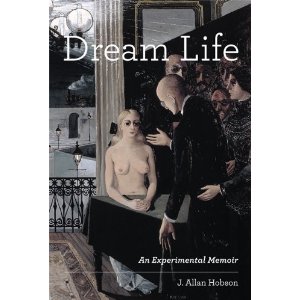
J. Allan Hobson’s scientific experimentation began in childhood, with a soot-filled investigation into the capacity of a chimney to admit Santa Claus. (He discovered that even with the damper open the chimney was far too narrow.) Hobson’s life as an experimentalist has continued through a pioneering career devoted to aligning psychology and biology and to investigating the relationship of dreaming and consciousness. In Dream Life, Hobson conducts an experimental investigation into his life and work.
Hobson charts his developing consciousness through a vividly imagined conception (in October of 1932), birth, and babyhood, offering a theory about “protoconsciousness” in fetuses and infants. He recounts his youthful zeal for scientific discovery, his early sexual experimentation, and his education. He describes taking on the entrenched Freudians at Harvard Medical School in the 1950s, as a maverick psychiatrist who wanted to replace psychoanalysis with biological science. He describes his further studies, his marriages and love affairs, his travels, and what he learned about the brain from his whiplash-induced amnesia after a 1963 automobile accident and from his “brain death” after a stroke in 2001. Through it all, Hobson uses his life as the ultimate case study for his theory that REM sleep provides a test pattern that allows the brain to develop “offline.” Dreams—most intense in REM sleep, when the brain is active—need no Freudian-style decoding, he says. Dreaming is a glorious mental state, to be enjoyed and studied for what it tells us about consciousness.
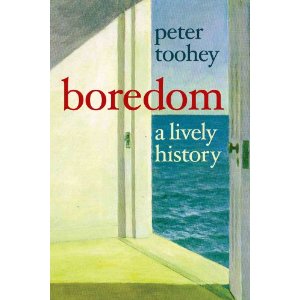
In the first book to argue for the benefits of boredom, Peter Toohey dispels the myth that it’s simply a childish emotion or an existential malaise like Jean-Paul Sartre’s nausea. He shows how boredom is, in fact, one of our most common and constructive emotions and is an essential part of the human experience.
This informative and entertaining investigation of boredom—what it is and what it isn’t, its uses and its dangers—spans more than 3,000 years of history and takes readers through fascinating neurological and psychological theories of emotion, as well as recent scientific investigations, to illustrate its role in our lives. There are Australian aboriginals and bored Romans, Jeffrey Archer and caged cockatoos, Camus and the early Christians, Dürer and Degas. Toohey also explores the important role that boredom plays in popular and highbrow culture and how over the centuries it has proven to be a stimulus for art and literature.
Toohey shows that boredom is a universal emotion experienced by humans throughout history and he explains its place, and value, in today’s world. Boredom: A Lively History is vital reading for anyone interested in what goes on when supposedly nothing happens.
When a chimpanzee stockpiles rocks as weapons or when a frog sends out mating calls, we might easily assume these animals know their own motivations–that they use the same psychological mechanisms that we do. But as Beyond the Brain indicates, this is a dangerous assumption because animals have different evolutionary trajectories, ecological niches, and physical attributes. How do these differences influence animal thinking and behavior? Removing our human-centered spectacles, Louise Barrett investigates the mind and brain and offers an alternative approach for understanding animal and human cognition. Drawing on examples from animal behavior, comparative psychology, robotics, artificial life, developmental psychology, and cognitive science, Barrett provides remarkable new insights into how animals and humans depend on their bodies and environment–not just their brains–to behave intelligently.
Barrett begins with an overview of human cognitive adaptations and how these color our views of other species, brains, and minds. Considering when it is worth having a big brain–or indeed having a brain at all–she investigates exactly what brains are good at. Showing that the brain’s evolutionary function guides action in the world, she looks at how physical structure contributes to cognitive processes, and she demonstrates how these processes employ materials and resources in specific environments.
Arguing that thinking and behavior constitute a property of the whole organism, not just the brain, Beyond the Brain illustrates how the body, brain, and cognition are tied to the wider world.
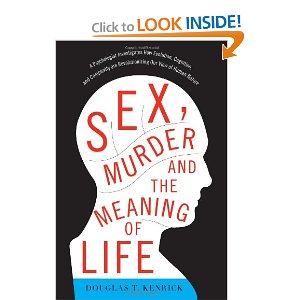
What do sex and murder have to do with the meaning of life? Everything.
In Sex, Murder, and the Meaning of Life, social psychologist Douglas Kenrick exposes the selfish animalistic underside of human nature, and shows how it is intimately connected to our greatest and most selfless achievements. Masterfully integrating cognitive science, evolutionary psychology, and complexity theory, this intriguing book paints a comprehensive picture of the principles that govern our lives. As Kenrick divulges, beneath our civilized veneer, human beings are a lot like howling hyenas and barking baboons, with heads full of homicidal tendencies and sexual fantasies. But, in his view, many ingrained, apparently irrational behaviors—such as inclinations to one-night stands, racial prejudices, and conspicuous consumption—ultimately manifest what he calls “Deep Rationality.”
Although our heads are full of simple selfish biases that evolved to help our ancestors survive, modern human beings are anything but simple and selfish cavemen. Kenrick argues that simple and selfish mental mechanisms we inherited from our ancestors ultimately give rise to the multifaceted social lives that we humans lead today, and to the most positive features of humanity, including generosity, artistic creativity, love, and familial bonds. And out of those simple mechanisms emerge all the complexities of society, including international conflicts and global economic markets. By exploring the nuance of social psychology and the surprising results of his own research, Kenrick offers a detailed picture of what makes us caring, creative, and complex—that is, fully human.
Illuminated with stories from Kenrick’s own colorful experiences — from his criminally inclined shantytown Irish relatives, his own multiple high school expulsions, broken marriages, and homicidal fantasies, to his eventual success as an evolutionary psychologist and loving father of two boys separated by 26 years — this book is an exploration of our mental biases and failures, and our mind’s great successes. Idiosyncratic, controversial, and fascinating, Sex, Murder, and the Meaning of Life uncovers the pitfalls and promise of our biological inheritance.
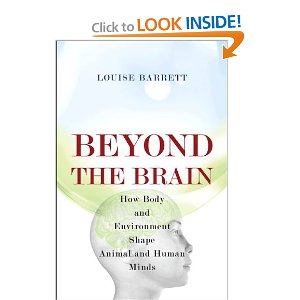 Beyond the Brain: How Body and Environment Shape Animal and Human Minds