October 6, 2011
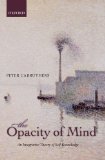
The Opacity of Mind: An Integrative Theory of Self-Knowledge by Peter Carruthers (Oxford University Press, USA)
(amazon.co.uk)
Product description from the publisher:
It is widely believed that people have privileged and authoritative access to their own thoughts, and many theories have been proposed to explain this supposed fact. The Opacity of Mind challenges the consensus view and subjects the theories in question to critical scrutiny, while showing that they are not protected against the findings of cognitive science by belonging to a separate ‘explanatory space’. The book argues that our access to our own thoughts is almost always interpretive, grounded in perceptual awareness of our own circumstances and behavior, together with our own sensory imagery (including inner speech). In fact our access to our own thoughts is no different in principle from our access to the thoughts of other people, utilizing the conceptual and inferential resources of the same ‘mindreading’ faculty, and relying on many of the same sources of evidence. Peter Carruthers proposes and defends the Interpretive Sensory-Access (ISA) theory of self-knowledge. This is supported through comprehensive examination of many different types of evidence from across cognitive science, integrating a diverse set of findings into a single well-articulated theory. One outcome is that there are hardly any kinds of conscious thought. Another is that there is no such thing as conscious agency.
Written with Carruthers’ usual clarity and directness, this book will be essential reading for philosophers interested in self-knowledge, consciousness, and related areas of philosophy. It will also be of vital interest to cognitive scientists, since it casts the existing data in a new theoretical light. Moreover, the ISA theory makes many new predictions while also suggesting constraints and controls that should be placed on future experimental investigations of self-knowledge.
See also: Author’s website
Comments (0)
- cognitive science,consciousness,new books,philosophy of mind
October 5, 2011
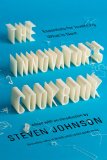
The Innovator’s Cookbook: Essentials for Inventing What Is Next, edited by Steven Johnson (Riverhead Trade, 2011) has been issued in conjunction with the paperback edition of Where Good Ideas Come From: The Natural History of Innovation.
(kindle ed.), (amazon.co.uk)
Product description from the publisher:
Essential reading-and progressive thinking-on the subject of innovation, from the national bestselling author.
Steven Johnson, an acknowledged bestselling leader on the subject of innovation, gathers-for a foundational text on the subject of innovation-essays, interviews, and cutting-edge insights by such exciting field leaders as Peter Drucker, Richard Florida, Eric Von Hippel, Dean Keith Simonton, Arthur Koestler, John Seely Brown, and Marshall Berman. Johnson also provides new material from Marisa Mayer of Google, Twitter’s Biz Stone and Jack Dorsey, and Ray Ozzie, Microsoft’s former Chief Software Architect. With additional commentary by Johnson himself, this book reveals the innovation found in a wide range of fields, including science, technology, energy, transportation, education, art, and sociology, making it vital, fresh, and fascinating reading for our time, and for the future.
See also: Author’s website
Comments (0)
- culture,new books
October 4, 2011
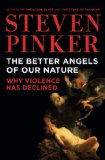
The Better Angels of Our Nature: Why Violence Has Declined by Steven Pinker (Viking, 2011)
(kindle ed.), (amazon.co.uk)
Product description from the publisher:
The author of The New York Times bestseller The Stuff of Thought offers a controversial history of violence.
Faced with the ceaseless stream of news about war, crime, and terrorism, one could easily think we live in the most violent age ever seen. Yet as New York Times bestselling author Steven Pinker shows in this startling and engaging new work, just the opposite is true: violence has been diminishing for millennia and we may be living in the most peaceful time in our species’s existence. For most of history, war, slavery, infanticide, child abuse, assassinations, pogroms, gruesome punishments, deadly quarrels, and genocide were ordinary features of life. But today, Pinker shows (with the help of more than a hundred graphs and maps) all these forms of violence have dwindled and are widely condemned. How has this happened?
This groundbreaking book continues Pinker’s exploration of the essence of human nature, mixing psychology and history to provide a remarkable picture of an increasingly nonviolent world. The key, he explains, is to understand our intrinsic motives- the inner demons that incline us toward violence and the better angels that steer us away-and how changing circumstances have allowed our better angels to prevail. Exploding fatalist myths about humankind’s inherent violence and the curse of modernity, this ambitious and provocative book is sure to be hotly debated in living rooms and the Pentagon alike, and will challenge and change the way we think about our society.
See also: Author’s website, Edge Master Class 2011 on “A History of Violence,” Bing news search
Comments (0)
- culture,new books
October 3, 2011
Why Religion is Natural and Science is Not by Robert N. McCauley (Oxford University Press, 2011)
(kindle ed.), (amazon.co.uk – Jan 2012)
Product description from the publisher:
The battle between religion and science, competing methods of knowing ourselves and our world, has been raging for many centuries. Now scientists themselves are looking at cognitive foundations of religion–and arriving at some surprising conclusions.
Over the course of the past two decades, scholars have employed insights gleaned from cognitive science, evolutionary biology, and related disciplines to illuminate the study of religion. In Why Religion is Natural and Science Is Not, Robert N. McCauley, one of the founding fathers of the cognitive science of religion, argues that our minds are better suited to religious belief than to scientific inquiry. Drawing on the latest research and illustrating his argument with commonsense examples, McCauley argues that religion has existed for many thousands of years in every society because the kinds of explanations it provides are precisely the kinds that come naturally to human minds. Science, on the other hand, is a much more recent and rare development because it reaches radical conclusions and requires a kind of abstract thinking that only arises consistently under very specific social conditions. Religion makes intuitive sense to us, while science requires a lot of work. McCauley then draws out the larger implications of these findings. The naturalness of religion, he suggests, means that science poses no real threat to it, while the unnaturalness of science puts it in a surprisingly precarious position.
Rigorously argued and elegantly written, this provocative book will appeal to anyone interested in the ongoing debate between religion and science, and in the nature and workings of the human mind.
See also: Author’s website
Comments (0)
- cognitive science,culture,mind,new books
October 1, 2011
States of Consciousness: Experimental Insights into Meditation, Waking, Sleep and Dreams (The Frontiers Collection), ed. by Dean Cvetkovic, Irena Cosic (Springer, 2011)
(amazon.co.uk)
Book description from the publisher:
In this accessible overview of current knowledge, an expert team of editors and authors describe experimental approaches to consciousness. These approaches are shedding light on some of the hitherto unknown aspects of the distinct states of human consciousness, including the waking state, different states of sleep and dreaming, meditation and more. The book presents the latest research studies by the contributing authors, whose specialities span neuroscience, neurology, biomedical engineering, clinical psychology and psychophysiology, psychosocial medicine and anthropology. Overall this anthology provides the reader with a clear picture of how different states of consciousness can be defined, experimentally measured and analysed. A future byproduct of this knowledge may be anticipated in the development of systematic corrective treatments for many disorders and pathological problems of consciousness.
Google Books preview:
Comments (0)
- consciousness,meditation,new books