[ View menu ]

Archive for 'new books'

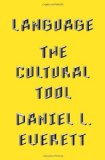
new book – ‘Language: The Cultural Tool’ by Daniel L. Everett

March 14, 2012
Language: The Cultural Tool

Language: The Cultural Tool by Daniel L. Everett (Pantheon, 2012)

(kindle ed.), (amazon.co.uk – 22 Mar 2012)

Book description from the publisher:

A bold and provocative study that presents language not as an innate component of the brain—as most linguists do—but as an essential tool unique to each culture worldwide.

For years, the prevailing opinion among academics has been that language is embedded in our genes, existing as an innate and instinctual part of us. But linguist Daniel Everett argues that, like other tools, language was invented by humans and can be reinvented or lost. He shows how the evolution of different language forms—that is, different grammar—reflects how language is influenced by human societies and experiences, and how it expresses their great variety.

For example, the Amazonian Pirahã put words together in ways that violate our long-held understanding of how language works, and Pirahã grammar expresses complex ideas very differently than English grammar does. Drawing on the Wari’ language of Brazil, Everett explains that speakers of all languages, in constructing their stories, omit things that all members of the culture understand. In addition, Everett discusses how some cultures can get by without words for numbers or counting, without verbs for “to say” or “to give,” illustrating how the very nature of what’s important in a language is culturally determined.

Combining anthropology, primatology, computer science, philosophy, linguistics, psychology, and his own pioneering—and adventurous—research with the Amazonian Pirahã, and using insights from many different languages and cultures, Everett gives us an unprecedented elucidation of this society-defined nature of language. In doing so, he also gives us a new understanding of how we think and who we are.

Google books preview:

See also: Author’s website
Comments (0) - culture,language,new books

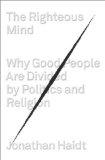
new book – ‘The Righteous Mind: Why Good People Are Divided by Politics and Religion’ by Jonathan Haidt

March 13, 2012

The Righteous Mind

The Righteous Mind: Why Good People Are Divided by Politics and Religion by Jonathan Haidt (Pantheon, 2012)

(kindle ed.), (amazon.co.uk – 29 Mar 2012)

Book description from the publisher:

Why can’t our political leaders work together as threats loom and problems mount? Why do people so readily assume the worst about the motives of their fellow citizens? In The Righteous Mind, social psychologist Jonathan Haidt explores the origins of our divisions and points the way forward to mutual understanding.

His starting point is moral intuition—the nearly instantaneous perceptions we all have about other people and the things they do. These intuitions feel like self-evident truths, making us righteously certain that those who see things differently are wrong. Haidt shows us how these intuitions differ across cultures, including the cultures of the political left and right. He blends his own research findings with those of anthropologists, historians, and other psychologists to draw a map of the moral domain, and he explains why conservatives can navigate that map more skillfully than can liberals. He then examines the origins of morality, overturning the view that evolution made us fundamentally selfish creatures. But rather than arguing that we are innately altruistic, he makes a more subtle claim—that we are fundamentally groupish. It is our groupishness, he explains, that leads to our greatest joys, our religious divisions, and our political affiliations. In a stunning final chapter on ideology and civility, Haidt shows what each side is right about, and why we need the insights of liberals, conservatives, and libertarians to flourish as a nation.

Google books preview:

See also: Book website

Comments (0) - culture,new books,psychology

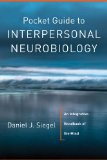
new book – ‘Pocket Guide to Interpersonal Neurobiology: An Integrative Handbook of the Mind’ by Daniel J. Siegel

March 11, 2012

Pocket Guide to Interpersonal Neurobiology

Pocket Guide to Interpersonal Neurobiology: An Integrative Handbook of the Mind by Daniel J. Siegel (W.W. Norton, 2012)

(kindle ed.), (amazon.co.uk)

Book description from the publisher:

The central concepts of the theory of interpersonal neurobiology.
Many fields have explored the nature of mental life from psychology to psychiatry, literature to linguistics. Yet no common “framework” where each of these important perspectives can be honored and integrated with one another has been created in which a person seeking their collective wisdom can find answers to some basic questions, such as, What is the purpose of life? Why are we here? How do we know things, how are we conscious of ourselves? What is the mind? What makes a mind healthy or unwell? And, perhaps most importantly: What is the connection among the mind, the brain, and our relationships with one another?

Our mental lives are profoundly relational. The interactions we have with one another shape our mental world. Yet as any neuroscientist will tell you, the mind is shaped by the firing patterns in the brain. And so how can we reconcile this tension—that the mind is both embodied and relational? Interpersonal Neurobiology is a way of thinking across this apparent conceptual divide.

This Pocket Guide to Interpersonal Neurobiology is designed to aid in your personal and professional application of the interpersonal neurobiology approach to developing a healthy mind, an integrated brain, and empathic relationships. It is also designed to assist you in seeing the intricate foundations of interpersonal neurobiology as you read other books.

See also: Author’s website

Comments (0) - cognitive science,new books,psychology

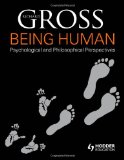
new book – ‘Being Human: Psychological and Philosophical Perspectives’

March 9, 2012

Being Human

Being Human: Psychological and Philosophical Perspectives by Richard Gross (Hodder Arnold, 2012)

(amazon.co.uk)

Book description from the publisher:

Richard Gross turns his expert eye to the psychology of human nature in a contemplative account encompassing cognition, consciousness, language, time perception, sense of mortality and human society. This book will help you to consider the unique aspects of being human and to understand the biological underpinnings for the intriguing and distinct behaviors and experiences common to human beings.

The book is enhanced throughout by:
*its logical arrangement of topics, with key questions, issues for additional focus and reflection points highlighted throughout.
*useful chapter introductions and summaries to provide clarity and insight
*diagrams to help explain difficult concepts
*detailed selection of references and useful sources including works from the fields of psychology, philosophy, religion and literature

This book is essential reading for students of psychology and related disciplines as well as general readers seeking insights into one of the most enduring questions to have faced humankind throughout history.

Comments (0) - new books,philosophy of mind,psychology

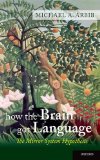
new book – ‘How the Brain Got Language: The Mirror System Hypothesis’

March 8, 2012

How the Brain Got Language

How the Brain Got Language: The Mirror System Hypothesis by Michael A. Arbib (Oxford University Press, USA, 2012)

(amazon.co.uk – July)

Book description from the publisher:

Unlike any other species, humans can learn and use language. This book explains how the brain evolved to make language possible, through what Michael Arbib calls the Mirror System Hypothesis. Because of mirror neurons, monkeys, chimps, and humans can learn by imitation, but only “complex imitation,” which humans exhibit, is powerful enough to support the breakthrough to language. This theory provides a path from the openness of manual gesture, which we share with nonhuman primates, through the complex imitation of manual skills, pantomime, protosign (communication based on conventionalized manual gestures), and finally to protospeech. The theory explains why we humans are as capable of learning sign languages as we are of learning to speak. This fascinating book shows how cultural evolution took over from biological evolution for the transition from protolanguage to fully fledged languages. The author explains how the brain mechanisms that made the original emergence of languages possible, perhaps 100,000 years ago, are still operative today in the way children acquire language, in the way that new sign languages have emerged in recent decades, and in the historical processes of language change on a time scale from decades to centuries. Though the subject is complex, this book is highly readable, providing all the necessary background in primatology, neuroscience, and linguistics to make the book accessible to a general audience.

See also: Author’s webpage

Comments (0) - cognitive science,language,new books