April 22, 2012
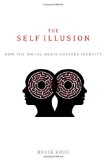
The Self Illusion: How the Social Brain Creates Identity by Bruce Hood (Oxford University Press, USA)
(amazon.co.uk – 19 Apr)
Book description from the publisher:
Most of us believe that we are an independent, coherent self–an individual inside our head who thinks, watches, wonders, dreams, and makes plans for the future. This sense of our self may seem incredibly real but a wealth of recent scientific evidence reveals that it is not what it seems–it is all an illusion.
In The Self Illusion, Bruce Hood reveals how the self emerges during childhood and how the architecture of the developing brain enables us to become social animals dependent on each other. Humans spend proportionally the greatest amount of time in childhood compared to any other animal. It’s not only to learn from others, Hood notes, but also to learn to become like others. We learn to become our self. Even as adults we are continually developing and elaborating this story, learning to become different selves in different situations–the work self, the home self, the parent self. Moreover, Hood shows that this already fluid process–the construction of self–has dramatically changed in recent years. Social networking activities–such as blogging, Facebook, LinkedIn, and Twitter–are fast becoming socialization on steroids. The speed and ease at which we can form alliances and relationships are outstripping the same selection processes that shaped our self prior to the internet era. Things will never be the same again in the online social world. Hood offers our first glimpse into this unchartered territory.
Who we are is, in short, a story of our self–a narrative that our brain creates. Like the science fiction movie, we are living in a matrix that is our mind. But Hood concludes that though the self is an illusion, it is an illusion we must continue to embrace to live happily in human society.
Google books preview:
See also: Author’s website, Royal Institution 2011 Christmas Lectures
Comments (0)
- cognitive science,consciousness,new books,psychology,self
April 20, 2012
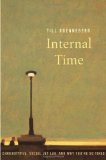
Internal Time: Chronotypes, Social Jet Lag, and Why You’re So Tired by Till Roenneberg (Harvard University Press, 2012)
(amazon.co.uk)
Book description from the publisher:
Early birds and night owls are born, not made. Sleep patterns may be the most obvious manifestation of the highly individualized biological clocks we inherit, but these clocks also regulate bodily functions from digestion to hormone levels to cognition. Living at odds with our internal timepieces, Till Roenneberg shows, can make us chronically sleep deprived and more likely to smoke, gain weight, feel depressed, fall ill, and fail geometry. By understanding and respecting our internal time, we can live better.
Internal Time combines storytelling with accessible science tutorials to explain how our internal clocks work—for example, why morning classes are so unpopular and why “lazy” adolescents are wise to avoid them. We learn why the constant twilight of our largely indoor lives makes us dependent on alarm clocks and tired, and why social demands and work schedules lead to a social jet lag that compromises our daily functioning.
Many of the factors that make us early or late “chronotypes” are beyond our control, but that doesn’t make us powerless. Roenneberg recommends that the best way to sync our internal time with our external environment and feel better is to get more sunlight. Such simple steps as cycling to work and eating breakfast outside may be the tickets to a good night’s sleep, better overall health, and less grouchiness in the morning.
Comments (1)
- cognitive science,new books,psychology
April 19, 2012

The Creation of Inequality: How Our Prehistoric Ancestors Set the Stage for Monarchy, Slavery, and Empire by Kent Flannery and Joyce Marcus (Harvard University Press, 2012)
(amazon.co.uk)
Book description from the publisher:
Our early ancestors lived in small groups and worked actively to preserve social equality. As they created larger societies, however, inequality rose, and by 2500 BCE truly egalitarian societies were on the wane. In The Creation of Inequality, Kent Flannery and Joyce Marcus demonstrate that this development was not simply the result of population increase, food surplus, or the accumulation of valuables. Instead, inequality resulted from conscious manipulation of the unique social logic that lies at the core of every human group.
A few societies allowed talented and ambitious individuals to rise in prestige while still preventing them from becoming a hereditary elite. But many others made high rank hereditary, by manipulating debts, genealogies, and sacred lore. At certain moments in history, intense competition among leaders of high rank gave rise to despotic kingdoms and empires in the Near East, Egypt, Africa, Mexico, Peru, and the Pacific.
Drawing on their vast knowledge of both living and prehistoric social groups, Flannery and Marcus describe the changes in logic that create larger and more hierarchical societies, and they argue persuasively that many kinds of inequality can be overcome by reversing these changes, rather than by violence.
Comments (0)
- culture,human evolution,new books
April 12, 2012
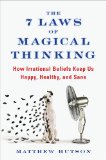
The 7 Laws of Magical Thinking: How Irrational Beliefs Keep Us Happy, Healthy, and Sane by Matthew Hutson (Hudson Street Press, 2012)
(kindle ed.), (amazon.co.uk – 12 Apr 2012)
Book description from the publisher:
What is so special about touching a piano John Lennon once owned? Why do we yell at our laptops? What drove the Yankees to dig up the Red Sox jersey secretly buried beneath their new stadium? And what’s up with the phrase “Everything happens for a reason”?
Psychologists have documented a litany of cognitive biases — misperceptions of reality — and explained their positive functions. Now, Matthew Hutson shows that all of us, even the staunchest skeptics, engage in magical thinking all the time — and that we can use it to our advantage, if we know how to outsmart it.
Drawing on cognitive science, neuroscience, psychology, and anthropology, Hutson shows us that magical thinking has been so useful to us that it’s hardwired into our brains. It encourages us to think that we actually have free will. It helps us believe that we have an underlying purpose in the world. It can even protect us from the paralyzing awareness of our own mortality. In other words, magical thinking is a completely irrational way of making our lives make sense.
With wonderfully entertaining stories, personal reflections, and sharp observations, Hutson has written a book that is entertaining, useful, and ever so slightly alarming.
Google books preview:
See also: Book website
Comments (0)
- cognitive science,new books,psychology
April 11, 2012

Brains, Buddhas, and Believing: The Problem of Intentionality in Classical Buddhist and Cognitive-Scientific Philosophy of Mind by Dan Arnold (Columbia University Press, 2012)
(amazon.co.uk – 1 May 2012)
Book description from the publisher:
In the recent, burgeoning discourse on Buddhist thought and cognitive science, premodern Buddhists are sometimes characterized as veritable “mind scientists” whose insights anticipate modern research on the brain and mind. Aiming to complicate this story, Dan Arnold confronts a significant obstacle to popular attempts at harmonizing classical Buddhist and modern scientific thought: since most Indian Buddhists believe that the mental continuum is uninterrupted by death (its continuity is what Buddhists mean by “rebirth”), they would have no truck with claims that everything about the mental is explicable with reference to brain events. Yet despite this significant divergence, a predominant stream of Indian Buddhist thought, associated with the seventh-century thinker Dharmakirti, turns out to be vulnerable to arguments modern philosophers have leveled against physicalism.
By characterizing the philosophical problems commonly faced by Dharmakirti and contemporary philosophers such as Jerry Fodor and Daniel Dennett, Arnold seeks to advance an understanding of both first-millennium Indian arguments and contemporary debates in philosophy of mind. The issues center on what modern philosophers have called intentionality — the fact that the mind can be about (or represent or mean) other things. Tracing an account of intentionality through Kant, Wilfrid Sellars, and John McDowell, Arnold argues that intentionality cannot, in principle, be explained in causal terms. Elaborating some of Dharmakirti’s central commitments (chiefly his apoha theory of meaning and his account of self-awareness), Arnold shows that despite Dharmakirti’s interest in refuting physicalism, his causal explanations of the mental mean that modern arguments from intentionality cut as much against his project as they do against physicalist philosophies of mind. This is evident in the arguments of some of Dharmakirti’s contemporaneous Indian critics (proponents of the orthodox Brahmanical Mimamsa school as well as fellow Buddhists from the Madhyamaka school of thought), whose critiques exemplify the same logic as modern arguments from intentionality. Arnold’s complex study shows that seemingly arcane arguments among first-millennium Indian thinkers illuminate matters still very much at issue among contemporary philosophers.
Comments (0)
- cognitive science,consciousness,new books,philosophy of mind