[ View menu ]

Archive for 'new books'

new book – ‘What Are You Laughing At? A Comprehensive Guide to the Comedic Event’ by Dan O’Shannon

July 21, 2012
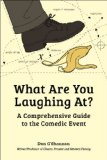
What Are You Laughing At?

What Are You Laughing At?: A Comprehensive Guide to the Comedic Event by Dan O’Shannon (Continuum, 2012)

(amazon.co.uk)

Book description from the publisher:

If you’re looking for a book that will teach you how to write comedy, we suggest you keep moving. You still have time to pick up a copy of Writing Big Yucks for Big Bucks before the store closes. However, if you want to understand the bigger picture — what is comedy, why do we respond to it the way we do — then you’ve come to the right place.

What Are You Laughing At? presents an entirely new approach to comedy theory. It challenges long-held beliefs and shows how the three main theories of comedy (incongruity, superiority, and relief) are not in conflict; but rather, work as parts of a larger model. There are many examples pulled from the author’s own experiences, writing for shows such as Cheers, Frasier, and Modern Family. By the end, you’ll have an understanding of just what happens when man meets comedy. It will change the way you hear laughter.

Table of Contents

INTRODUCTION
OVERVIEW
Common Comedy Theories
The Comedic Event
Documenting the Comedic Event
PART I: ELEMENTS OF CONTEXT: THE RECEPTION FACTORS
CHAPTER 1: THE RECEIVER AND HIS WORLD
1-1. A Comedy Frame of Mind
1-2. Early Reception Factors
1-3. Levels of Social Interaction
CHAPTER 2: ELEMENTS OF COMMUNICATION
2-1. Modes of Communication
2-2. Device and Specific Device
CHAPTER 3: VEHICLES
3-1. Vehicles
3-2. Vehicle-based Reception Factors
CHAPTER 4: LEVEL OF CONTROL AND IDENTIFYING THE SOURCE
4-1. Level of Control
4-2. Identifying The Source
PART II: THE INCONGRUOUS PICTURE
CHAPTER 5: FUNDAMENTAL COMPONENTS
5-1. The Receiver’s Brain: Hard-wired for Comedy?
5-2. The Triangle
5-3. The Core Variables
CHAPTER 6: INCONGRUITY
6-1. Incongruity
6-2. Estimating Levels of Incongruity
6-3. Types of Incongruity
CHAPTER 7: COGNITIVE PROCESS
7-1. Cognitive Process: Overview
7-2. Level One: Straightforward Information
7-3. Level Two: Gap-filling
7-4: Level Three: Recontextualization
CHAPTER 8: VARIATIONS
8-1. Exploring the Four Corners of the Triangle
8-2. What are Practical Jokes?
CHAPTER 9: COMEDY AND ENTROPY
9-1. Sustaining the Laugh
9-2. Entropy
PART III: ENHANCERS AND INHIBITORS
CHAPTER 10: HOW COMEDIC INFORMATION TRIGGERS ENHANCERS AND INHIBITORS
10-1. Overview
10-2. On-going Social Needs: Superiority, Identification, and Inclusion
10-3. Aspects of Awareness
CHAPTER 11: ELEMENTS OF THE JOKE’S COMMUNICATION, STRUCTURE, AND CONTENT
11-1. Resuming the Chart: The Joke as a Whole
11-2. Elements of Communication and Structure
11-3. Elements of Content
SUMMING IT ALL UP
The Completed Chart
Final Thoughts and Acknowledgments
Comments (0) - fiction,new books,psychology

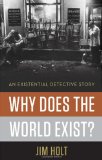
new book – ‘Why Does the World Exist?: An Existential Detective Story’ by Jim Holt

July 18, 2012

Why Does the World Exist?

Why Does the World Exist?: An Existential Detective Story by Jim Holt (Liveright, 2012)

(kindle ed.), (amazon.co.uk)

Book description from the publisher:

In this astonishing and profound work, an irreverent sleuth traces the riddle of existence from the ancient world to modern times.

Whether framed philosophically as “Why is there a world rather than nothing at all?” or more colloquially as “But, Mommy, who made God?” the metaphysical mystery about how we came into existence remains the most fractious and fascinating question of all time. Following in the footsteps of Christopher Hitchens, Roger Penrose, and even Stephen Hawking, Jim Holt emerges with an engrossing narrative that traces our latest efforts to grasp the origins of the universe. As he takes on the role of cosmological detective, the brilliant yet slyly humorous Holt contends that we might have been too narrow in limiting our suspects to God vs. the Big Bang. Whether interviewing a cranky Oxford philosopher, a Physics Nobel Laureate, or a French Buddhist monk, Holt pursues unexplored and often bizarre angles to this cosmic puzzle. The result is a brilliant synthesis of cosmology, mathematics, and physics—one that propels his own work to the level of philosophy itself.

Google Books preview:

Comments (0) - new books,reality

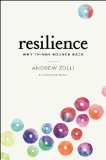
new book – ‘Resilience: Why Things Bounce Back’ by Andrew Zolli

July 14, 2012

Resilience

Resilience: Why Things Bounce Back by Andrew Zolli and Ann Marie Healy (Free Press, 2012)

(kindle ed.), (amazon.co.uk)

Book description from the publisher:

IN THIS TIME OF TURBULENCE, scientists, economists, social innovators, corporate and civic leaders, and citizens alike are asking the same basic questions: What causes one system to break down and another to rebound? Are we merely subject to the whim of forces beyond our control? Or, in the face of constant disruption, can we build better shock absorbers—for ourselves, our communities, our economies, and for the planet as a whole?

The answers to these vital questions are shaping a new field of inquiry, and a new agenda, focused on resilience: the ability of people, communities, and systems to maintain their core purpose and integrity amid unforeseen shocks and surprises. By encouraging adaptation, agility, and cooperation, this new approach can not only help us weather disruptions, but also bring us to a different way of being in and engaging with the world.

Reporting firsthand from the coral reefs of Palau to the back streets of Palestine, Andrew Zolli and Ann Marie Healy relate breakthrough scientific discoveries, pioneering social and ecological innovations, and important new approaches to constructing a more resilient world. Along the way, they share insights to bolster our own psychological resilience, foster greater stability within our communities, and establish leadership imperatives for more resilient organizations. Zolli and Healy show how this new concept of resilience is a powerful lens through which we can assess major issues afresh: from business planning to social development, from urban planning to national energy security—circumstances that affect us all.

Provocative, optimistic, and eye-opening, Resilience sheds light on why some systems, people, and communities fall apart in the face of disruption and, ultimately, how they can learn to bounce back.

Google Books preview:

See also: book website, “It’s the End of the World, And I Feel Fine: 10 Questions with Andrew Zolli” at Wired.com (7.11.12), “‘Resilience’ Author Andrew Zolli on the Secrets of Failure” at the Daily Beast (Jul 8, 2012)

Comments (0) - new books,psychology

new book – ‘Sincerity: How a moral ideal born five hundred years ago inspired religious wars, modern art, hipster chic, and the curious notion that we all have something to say (no matter how dull)’

July 13, 2012

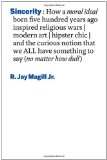
Sincerity

Sincerity: How a moral ideal born five hundred years ago inspired religious wars, modern art, hipster chic, and the curious notion that we all have something to say (no matter how dull) by R. Jay McGill Jr. (W.W. Norton & Co., 2012)

(kindle ed.), (amazon.co.uk)

Book description from the publisher:

A cultural and intellectual history of sincerity, from its emergence during the Protestant Reformation to its present incarnations and adversaries.

People have long been duped by “straight-talking” politicians, confessional talk-show hosts, and fake-earnest advertisers. As sincerity has become suspect, the upright and honest have taken refuge in irony. Yet our struggle for authenticity in back-to-the-woods movements, folksy songwriting, and a craving for plainspoken presidential candidates betrays our longing for the holy grail of sincerity.

Bringing deep historical perspective and a brilliant contemporary spin to Lionel Trilling’s 1972 Sincerity and Authenticity, R. Jay Magill Jr. argues that we can’t shake sincerity’s deep theological past, emotional resonance, and the sense of conscience it has carved in the Western soul. From Protestant theology to paintings by crazy people, from French satire to the anti-hipster movement, Magill navigates history, religion, art, and politics to create a portrait of an ideal that, despite its abuse, remains a strange magnetic north in our secular moral compass.

See also: Review in the Wall Street Journal

Comments (0) - culture,new books

new book – ‘How to Do Things with Fictions’ by Joshua Landy

July 6, 2012

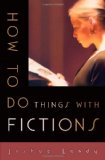
How to Do Things with Fictions

How to Do Things with Fictions by Joshua Landy (Oxford University Press, USA, 2012)

(amazon.co.uk – July 2012)

Book description from the publisher:

Why does Mark’s Jesus speak in parables? Why does Plato’s Socrates make bad arguments? Why are Beckett’s novels so inscrutable? And why don’t stage magicians even pretend to summon spirits anymore? In a series of captivating chapters on Mark, Plato, Beckett, Mallarmé, and Chaucer, Joshua Landy not only answers these questions but explains why they are worth asking in the first place.

Witty and approachable, How to Do Things with Fictions challenges the widespread assumption that literary texts must be informative or morally improving in order to be of any real benefit. It reveals that authors are sometimes best thought of not as entertainers or as educators but as personal trainers of the brain, putting their willing readers through exercises designed to fortify specific mental capacities, from form-giving to equanimity, from reason to faith.

Delivering plenty of surprises along the way-that moral readings of literature can be positively dangerous; that the parables were deliberately designed to be misunderstood; that Plato knowingly sets his main character up for a fall; that metaphor is powerfully connected to religious faith; that we can sustain our beliefs even when we suspect them to be illusions-How to Do Things with Fictions convincingly shows that our best allies in the struggle for more rigorous thinking, deeper faith, richer experience, and greater peace of mind may well be the imaginative writings sitting on our shelves.

See also: article “Fiction books give a boost to the brain, says Stanford professor”

Comments (0) - fiction,new books,psychology,reading