January 26, 2013
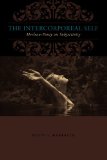
The Intercorporeal Self: Merleau-Ponty on Subjectivity by Scott L. Marratto (SUNY Press, 2013)
(kindle ed.), (amazon.co.uk)
Book description from the publisher:
An original interpretation of Merleau-Ponty on subjectivity, drawing from and challenging both the continental and analytic traditions. Challenging a prevalent Western idea of the self as a discrete, interior consciousness, Scott L. Marratto argues instead that subjectivity is a characteristic of the living, expressive movement establishing a dynamic intertwining between a sentient body and its environment. He draws on the work of the French philosopher Maurice Merleau-Ponty, contemporary European philosophy, and research in cognitive science and development to offer a compelling investigation into what it means to be a self.
“The Intercorporeal Self amounts to a kind of dialectic between Merleau-Ponty’s thought and naturalism as it functions within contemporary analytic thought and deconstruction as it appears in Derrida’s thought. Marratto constructs argumentation that shows that Merleau-Ponty’s thought cannot be reduced to naturalism and that it does not fall prey to the deconstructive critique. Consequently, Marratto, better than anyone else, shows the contribution that Merleau-Ponty makes to contemporary philosophy.This is an important book. I would even venture to say that it is a genuine work of philosophy.” — Leonard Lawlor, Sparks Professor of Philosophy, Penn State University
“Marratto brings Merleau-Ponty’s phenomenology into a mutually transformative dialogue with the latest trends in the embodied sciences of the mind. His book puts side by side notions of intercorporeality, habit, style, and auto-affection with Gestalt, ecological, sensorimotor, and enactive perspectives on perception and subjectivity. Marratto weaves together the threads of conceptual traditions that saw themselves as incompatible not so long ago. A significant contribution to current efforts toward reconceptualizing the lived body as the matrix of significance and expressive being-in-the-world, and subjectivity as self-affecting, self-initiated movement and intercorporeal attunement to the demands of other bodies.” — Ezequiel A. Di Paolo, coeditor of Enaction: Toward a New Paradigm for Cognitive Science
Google Books preview:
Comments (0)
- new books,self
January 23, 2013

Missing Out: In Praise of the Unlived Life by Adam Phillips (Farrar, Straus, and Giroux, 2013)
(kindle ed.), (amazon.co.uk)
Book description from the publisher:
A transformative book about the lives we wish we had and what they can teach us about who we are
All of us lead two parallel lives: the one we are actively living, and the one we feel we should have had or might yet have. As hard as we try to exist in the moment, the unlived life is an inescapable presence, a shadow at our heels. And this itself can become the story of our lives: an elegy to unmet needs and sacrificed desires. We become haunted by the myth of our own potential, of what we have in ourselves to be or to do. And this can make of our lives a perpetual falling-short.
But what happens if we remove the idea of failure from the equation? With his flair for graceful paradox, the acclaimed psychoanalyst Adam Phillips suggests that if we accept frustration as a way of outlining what we really want, satisfaction suddenly becomes possible. To crave a life without frustration is to crave a life without the potential to identify and accomplish our desires.
In this elegant, compassionate, and absorbing book, Phillips draws deeply on his own clinical experience as well as on the works of Shakespeare and Freud, of D. W. Winnicott and William James, to suggest that frustration, not getting it, and and getting away with it are all chapters in our unlived lives—and may be essential to the one fully lived.
Google Books preview:
Comments (0)
- new books,psychology
January 20, 2013
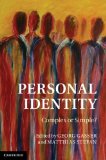
Personal Identity: Complex or Simple? ed. by Georg Gasser and Matthias Stefan (Cambridge University Press, 2012)
(kindle ed.), (amazon.co.uk)
Book description from the publisher:
We take it for granted that a person persists over time: when we make plans, we assume that we will carry them out; when we punish someone for a crime, we assume that she is the same person as the one who committed it. Metaphysical questions underlying these assumptions point towards an area of deep existential and philosophical interest. In this volume, leading metaphysicians discuss key questions about personal identity, including ‘What are we?’, ‘How do we persist?’, and ‘Which conditions guarantee our identity over time?’ They discuss whether personal identity is ‘complex’, whereby it is analyzable in terms of simpler relations such as physical or psychological features, or whether it is ‘simple’, namely something that cannot be analyzed in terms of more fundamental relations. Their essays offer an innovative discussion of this topic and will be of interest to a wide readership in metaphysics.
Comments (0)
- new books,self
January 10, 2013
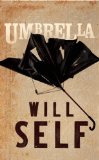
Shortlisted for the Man Booker Prize 2012:
Umbrella by Will Self (Grove Press, 2013)
(kindle ed.), (amazon.co.uk)
Book description from the publisher:
“A brother is as easily forgotten as an umbrella.”—James Joyce, Ulysses
Radical and uncompromising, Umbrella is a tour de force from one of England’s most acclaimed contemporary writers, and Self’s most ambitious novel to date. Moving between Edwardian London and a suburban mental hospital in 1971, Umbrella exposes the twentieth century’s technological searchlight as refracted through the dark glass of a long term mental institution. While making his first tours of the hospital at which he has just begun working, maverick psychiatrist Zachary Busner notices that many of the patients exhibit a strange physical tic: rapid, precise movements that they repeat over and over. One of these patients is Audrey Dearth, an elderly woman born in the slums of West London in 1890. Audrey’s memories of a bygone Edwardian London, her lovers, involvement with early feminist and socialist movements, and, in particular, her time working in an umbrella shop, alternate with Busner’s attempts to treat her condition and bring light to her clouded world. Busner’s investigations into Audrey’s illness lead to discoveries about her family that are shocking and tragic.
Google Books preview:
See also: Author’s website
Comments (0)
- fiction,new books
January 9, 2013
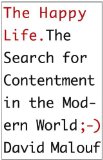
The Happy Life: The Search for Contentment in the Modern World by David Malouf (Pantheon, 2013)
(kindle ed.), (amazon.co.uk)
By Australia’s greatest contemporary author, an elegant, succinct meditation on what makes for a happy life. ;-)
“Happiness surely is among the simplest of human emotions and the most spontaneous,” says David Malouf. But what exactly are we looking for when we chase happiness? At this particular moment in history, privileged, industrialized nations have lessened much of what makes us unhappy: widespread poverty, illness, famine. Yet we are still unfulfilled, turning increasingly to yoga, church, Match.com, drugs, clinical therapy and retail therapy. What is at the root of our collective stress, and how can we find our way to contentment?
Drawing on mythology, philosophy, art and literature, Malouf traces our conception of happiness throughout history, distilling centuries of thought into a lucid narrative. He discusses the creation myths of ancient Greece and the philosophical schools of Athens, analyzes Thomas Jefferson’s revolutionary declaration that “the pursuit of happiness” is a right, explores the celebration of sensual delight in Rembrandt and Rubens and offers a perceptive take on a modern society growing larger and more impersonal.
With wisdom and insight, Malouf investigates that simplest, most spontaneous of feelings and urges us to do the same.
Comments (0)
- happiness,new books