[ View menu ]

Archive for 'new books'

new book – ‘Failures of Agency: Irrational Behavior and Self-Understanding’

November 2, 2011

Failures of Agency: Irrational Behavior and Self-Understanding by Annemarie Kalis (Lexington Books, 2011)

(amazon.co.uk – 16 Nov)

Product description from the publisher:

Failures of Agency: Irrational Behavior and Self-Understanding begins by exploring classic philosophical questions regarding the phenomenon of weakness of will or akrasia: doing A, even though all things considered, you judge it best to do B. Does this phenomenon really exist and if so, how should it be explained? Author Annemarie Kalis provides an historical overview of some traditional answers to these questions and addresses the main question: how does the phenomenon of ‘going against your own judgment’ relate to the idea that we are rational beings? She elaborates on the notion of rational agency and shows how different types of behavior express or fail to express our rational agency. This leads to the speculation of what is needed for akratic action to be free action. A novel position is developed, stating that certain widespread philosophical accounts of free action must conclude that ‘going against your own judgment’ is necessarily unfree. This also requires a reflection on possible implications for moral responsibility. Would it mean that people cannot be held accountable for irrational behavior? Kalis offers insight on whether everyday irrational behavior differs from irrational behavior occurring in the context of psychiatric dysfunction, and develops a view on how we should understand ourselves when we do something other than what we judge best. Written for philosophers, psychologists and psychiatrists interested in issues of irrationality and philosophy of action, this is an indispensable book for both professionals and students interested in interdisciplinary endeavors in the science of mind and behavior.
Comments (0) - new books,philosophy of mind

new book – ‘Neurogastronomy: How the Brain Creates Flavor and Why It Matters’

November 1, 2011

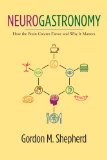
Neurogastronomy

Neurogastronomy: How the Brain Creates Flavor and Why It Matters by Gordon Shepherd (Columbia University Press, 2011)

(amazon.co.uk- 1 Dec)

Product description from the publisher:

Leading neuroscientist Gordon M. Shepherd embarks on a paradigm-shifting trip through the “human brain flavor system,” laying the foundations for a new scientific field: neurogastronomy. Challenging the belief that the sense of smell diminished during human evolution, Shepherd argues that this sense, which constitutes the main component of flavor, is far more powerful and essential than previously believed.

Shepherd begins Neurogastronomy with the mechanics of smell, particularly the way it stimulates the nose from the back of the mouth. As we eat, the brain conceptualizes smells as spatial patterns, and from these and the other senses it constructs the perception of flavor. Shepherd then considers the impact of the flavor system on contemporary social, behavioral, and medical issues. He analyzes flavor’s engagement with the brain regions that control emotion, food preferences, and cravings, and he even devotes a section to food’s role in drug addiction and, building on Marcel Proust’s iconic tale of the madeleine, its ability to evoke deep memories.

Shepherd connects his research to trends in nutrition, dieting, and obesity, especially the challenges that many face in eating healthily. He concludes with human perceptions of smell and flavor and their relationship to the neural basis of consciousness. Everyone from casual diners and ardent foodies to wine critics, chefs, scholars, and researchers will delight in Shepherd’s fascinating, scientific-gastronomic adventures.

Comments (0) - cognitive science,new books,psychology

new book – ‘Incomplete Nature: How Mind Emerged from Matter’

October 31, 2011

Incomplete Nature

Incomplete Nature: How Mind Emerged from Matter by Terrence W. Deacon (W.W. Norton, 2011)

(kindle ed.), (amazon.co.uk – 7 Feb 2012)

Product description from the publisher:

A radical new explanation of how life and consciousness emerge from physics and chemistry.
As physicists work toward completing a theory of the universe and biologists unravel the molecular complexity of life, a glaring incompleteness in this scientific vision becomes apparent. The “Theory of Everything” that appears to be emerging includes everything but us: the feelings, meanings, consciousness, and purposes that make us (and many of our animal cousins) what we are. These most immediate and incontrovertible phenomena are left unexplained by the natural sciences because they lack the physical properties—such as mass, momentum, charge, and location—that are assumed to be necessary for something to have physical consequences in the world. This is an unacceptable omission. We need a “theory of everything” that does not leave it absurd that we exist.

Incomplete Nature begins by accepting what other theories try to deny: that, although mental contents do indeed lack these material-energetic properties, they are still entirely products of physical processes and have an unprecedented kind of causal power that is unlike anything that physics and chemistry alone have so far explained. Paradoxically, it is the intrinsic incompleteness of these semiotic and teleological phenomena that is the source of their unique form of physical influence in the world. Incomplete Nature meticulously traces the emergence of this special causal capacity from simple thermodynamics to self-organizing dynamics to living and mental dynamics, and it demonstrates how specific absences (or constraints) play the critical causal role in the organization of physical processes that generate these properties.

The book’s radically challenging conclusion is that we are made of these specific absences—such stuff as dreams are made on—and that what is not immediately present can be as physically potent as that which is. It offers a figure/background shift that shows how even meanings and values can be understood as legitimate components of the physical world.

See also: Author’s webpage at UC Berkeley Anthropology Department

Comments (0) - consciousness,mind,new books

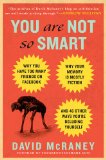
new book – ‘You Are Not So Smart: Why You Have Too Many Friends on Facebook, Why Your Memory Is Mostly Fiction, and 46 Other Ways You’re Deluding Yourself’

October 29, 2011

You Are Not So Smart

You Are Not So Smart: Why You Have Too Many Friends on Facebook, Why Your Memory Is Mostly Fiction, and 46 Other Ways You’re Deluding Yourself by David McRaney (Gotham, 2011)

(kindle ed.), (amazon.co.uk)

Product description from the publisher:

An entertaining illumination of the stupid beliefs that make us feel wise.

You believe you are a rational, logical being who sees the world as it really is, but journalist David McRaney is here to tell you that you’re as deluded as the rest of us. But that’s OK- delusions keep us sane. You Are Not So Smart is a celebration of self-delusion. It’s like a psychology class, with all the boring parts taken out, and with no homework.

Based on the popular blog of the same name, You Are Not So Smart collects more than 46 of the lies we tell ourselves everyday, including:
* Dunbar’s Number – Humans evolved to live in bands of roughly 150 individuals, the brain cannot handle more than that number. If you have more than 150 Facebook friends, they are surely not all real friends.
* Hindsight bias – When we learn something new, we reassure ourselves that we knew it all along.
* Confirmation bias – Our brains resist new ideas, instead paying attention only to findings that reinforce our preconceived notions.
* Brand loyalty – We reach for the same brand not because we trust its quality but because we want to reassure ourselves that we made a smart choice the last time we bought it.

Packed with interesting sidebars and quick guides on cognition and common fallacies, You Are Not So Smart is a fascinating synthesis of cutting-edge psychology research to turn our minds inside out.

See also: book blog

Google Books preview:

Comments (0) - cognitive science,new books,psychology

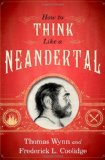
new book – ‘How to Think Like a Neandertal’

October 28, 2011

How to Think Like a Neandertal

How To Think Like a Neandertal by Thomas Wynn and Frederick L. Coolidge (Oxford University Press, USA)

(kindle ed.), (amazon.co.uk – Jan 2012)

Product description from the publisher:

There have been many books, movies, and even TV commercials featuring Neandertals–some serious, some comical. But what was it really like to be a Neandertal? How were their lives similar to or different from ours?

In How to Think Like a Neandertal, archaeologist Thomas Wynn and psychologist Frederick L. Coolidge team up to provide a brilliant account of the mental life of Neandertals, drawing on the most recent fossil and archaeological remains. Indeed, some Neandertal remains are not fossilized, allowing scientists to recover samples of their genes–one specimen had the gene for red hair and, more provocatively, all had a gene called FOXP2, which is thought to be related to speech. Given the differences between their faces and ours, their voices probably sounded a bit different, and the range of consonants and vowels they could generate might have been different. But they could talk, and they had a large (perhaps huge) vocabulary–words for places, routes, techniques, individuals, and emotions. Extensive archaeological remains of stone tools and living sites (and, yes, they did often live in caves) indicate that Neandertals relied on complex technical procedures and spent most of their lives in small family groups. The authors sift the evidence that Neandertals had a symbolic culture–looking at their treatment of corpses, the use of fire, and possible body coloring–and conclude that they probably did not have a sense of the supernatural. The book explores the brutal nature of their lives, especially in northwestern Europe, where men and women with spears hunted together for mammoths and wooly rhinoceroses. They were pain tolerant, very likely taciturn, and not easy to excite.

Wynn and Coolidge offer here an eye-opening portrait of Neandertals, painting a remarkable picture of these long-vanished people and providing insight, as they go along, into our own minds and culture.

See also: “The expert Neandertal mind” by Thomas Wynn & Frederick L. Coolidge, Journal of Human Evolution 46 (2004) 467–487 (pdf)

Comments (0) - human evolution,mind,new books