[ View menu ]

Archive for 'new books'

new book – ‘Dirty Minds: How Our Brains Influence Love, Sex, and Relationships’

January 4, 2012
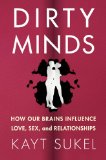
Dirty Minds

Dirty Minds: How Our Brains Influence Love, Sex, and Relationships by Kayt Sukel (Free Press, 2012)

(kindle ed.), (amazon.co.uk)

Product description from the publisher:

Philosophers, theologians, artists, and boy bands have waxed poetic about the nature of love for centuries. But what does the brain have to say about the way we carry our hearts? In the wake of a divorce, science writer and single mother Kayt Sukel made herself a guinea pig in the labs of some unusual love experts to find out.

In each chapter of this edgy romp through the romantic brain, Sukel looks at a different aspect of love above the belt. What in your brain makes you love someone—or simply lust after them? (And is there really a difference?) Why do good girls like bad boys? Is monogamy practical? How thin is that line between love and hate? Do mothers have a stronger bond with their children than their fathers do? How do our childhood experiences affect our emotional control? Should you be taking an oxytocin supplement to improve your luck in love? Who is most at risk for love addiction? In her search for truth, Sukel also has an fMRI during orgasm, ponders a cure for heartbreak, and samples a pheromone spray called Boarmate.

As science allows us a more focused examination on the intricate dance between the brain and our environments, we can use it to shed new light on humanity’s oldest question: What is love and why does it torture, delight, and transform us so?

Fiercely honest and wonderfully funny, Sukel can offer no simple solutions for the curveballs love throws our way. But after reading this gimlet-eyed look at love, sex, and the brain, you’ll never look at romance the same way again.

See also: Author’s website
Comments (0) - cognitive science,new books,psychology

early Kindle edition – ‘A User’s Guide to Thought and Meaning’ by Ray Jackendoff

January 3, 2012

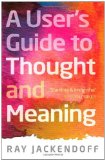
User's Guide to Thought and Meaning

Although the hardcover edition has a scheduled publication date of April 15, 2012, the Kindle edition of A User’s Guide to Thought and Meaning by Ray Jackendoff is available now.

(amazon.co.uk – Feb 2012 – hardcover)

Product description from the publisher (OUP Oxford):

A User’s Guide to Thought and Meaning presents a profound and arresting integration of the faculties of the mind – of how we think, speak, and see the world. Ray Jackendoff starts out by looking at languages and what the meanings of words and sentences actually do. He shows that meanings are more adaptive and complicated than they’re commonly given credit for, and he is led to some basic questions: How do we perceive and act in the world? How do we talk about it? And how can the collection of neurons in the brain give rise to conscious experience? As it turns out, the organization of language, thought, and perception does not look much like the way we experience things, and only a small part of what the brain does is conscious. Jackendoff concludes that thought and meaning must be almost completely unconscious. What we experience as rational conscious thought – which we prize as setting us apart from the animals – in fact rides on a foundation of unconscious intuition. Rationality amounts to intuition enhanced by language. Written with an informality that belies both the originality of its insights and the radical nature of its conclusions, A User’s Guide to Thought and Meaning is the author’s most important book since the groundbreaking Foundations of Language in 2002.

Comments (0) - cognitive science,consciousness,language,mind,new books

new book – ‘New: Understanding Our Need for Novelty and Change’ by Winifred Gallagher

December 29, 2011

New

New: Understanding Our Need for Novelty and Change by Winifred Gallagher (Penguin, 2011)

(kindle ed.), (amazon.co.uk)

Product description from the publisher:

Exploring our unique human genius for responding to the new with curiosity and creativity, the bestselling author of Rapt shows us how to embrace our changing world while living a fuller, saner life.

In today’s fast-paced world, it’s easy to feel overwhelmed by the mind-boggling number of new things-whether products, ideas, or bits of data-bombarding us daily. But adapting to new circumstance is so crucial to our survival that “love of the new,” or neophilia, is hardwired into our brains at the deepest levels. Navigating between our innate love of novelty and the astonishingly new world around us is the task of New: helping us adapt to, learn about, and create new things that matter, while dismissing the rest as distractions.

With wit and clarity, acclaimed behavioral science writer Winifred Gallagher takes us to the archaeological sites and neuroscience laboratories exploring our species’ special affinity for novelty. All of us are attuned to things that are new or unfamiliar because they convey vital information about potential threats and resources. As individuals, however, we vary in how we balance the sometimes conflicting needs to avoid risk and approach rewards.

Some 15 percent of us are die-hard “neophiliacs” who are biologically predisposed to passionately pursue new experiences, and another 15 percent are “neophobes” who adamantly resist change.

Most of us fall squarely in the spectrum’s roomy middle range. Whether we love change, avoid change, or take the middle path, neophilia plays a crucial role in all of our lives. No matter where we sit on neophilia’s continuum, New shows us how to use it more skillfully to improve our lives.

At this time of unprecedented change- when the new information we handle daily has quadrupled in the past thirty years, with no sign of slowing-we must look beyond such secondary issues as voracious consumerism, attention problems, and electronics addiction to refocus on neophilia’s true purpose: to learn about and create the new things that really matter. This big-picture perspective has long been missing, and New will jump-start that discussion by offering the tools we need to control our love of the new-rather than letting it control us.

Google Books preview:

See also: three-part series of excerpts at Bloomberg.com

Comments (0) - new books,psychology

new book – ‘A Brief History of Thought: A Philosophical Guide to Living’

December 28, 2011

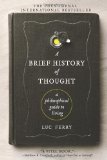
A Brief History of Thought

A Brief History of Thought: A Philosophical Guide to Living by Luc Ferry (Harper Perennial, 2011)

(kindle ed.), (amazon.co.uk)

Product description from the publisher:

Eight months on the bestseller lists in France!

From the timeless wisdom of the ancient Greeks to Christianity, the Enlightenment, existentialism, and postmodernism, Luc Ferry’s instant classic brilliantly and accessibly explains the enduring teachings of philosophy—including its profound relevance to modern daily life and its essential role in achieving happiness and living a meaningful life. This lively journey through the great thinkers will enlighten every reader, young and old.

See also: Wall Street Journal review – “How to Think About How to Live”

Comments (0) - culture,happiness,new books

out in paperback – ‘Beyond Reduction: Philosophy of Mind and Post-Reductionist Philosophy of Science’

December 21, 2011

Beyond Reduction

Beyond Reduction: Philosophy of Mind and Post-Reductionist Philosophy of Science by Steven Horst (Oxford University Press, USA, 2012)

(amazon.co.uk), (hardcover ed. at amazon.co.uk), (hardcover at amazon.com), (kindle ed., 2007)

Product description from the publisher:

Contemporary philosophers of mind tend to assume that the world of nature can be reduced to basic physics. Yet there are features of the mind consciousness, intentionality, normativity that do not seem to be reducible to physics or neuroscience. This explanatory gap between mind and brain has thus been a major cause of concern in recent philosophy of mind. Reductionists hold that, despite all appearances, the mind can be reduced to the brain. Eliminativists hold that it cannot, and that this implies that there is something illegitimate about the mentalistic vocabulary. Dualists hold that the mental is irreducible, and that this implies either a substance or a property dualism. Mysterian non-reductive physicalists hold that the mind is uniquely irreducible, perhaps due to some limitation of our self-understanding.

In this book, Steven Horst argues that this whole conversation is based on assumptions left over from an outdated philosophy of science. While reductionism was part of the philosophical orthodoxy fifty years ago, it has been decisively rejected by philosophers of science over the past thirty years, and for good reason. True reductions are in fact exceedingly rare in the sciences, and the conviction that they were there to be found was an artifact of armchair assumptions of 17th century Rationalists and 20th century Logical Empiricists. The explanatory gaps between mind and brain are far from unique. In fact, in the sciences it is gaps all the way down. And if reductions are rare in even the physical sciences, there is little reason to expect them in the case of psychology.

Horst argues that this calls for a complete re-thinking of the contemporary problematic in philosophy of mind. Reductionism, dualism, eliminativism and non-reductive materialism are each severely compromised by post-reductionist philosophy of science, and philosophy of mind is in need of a new paradigm.

Horst suggests that such a paradigm might be found in Cognitive Pluralism: the view that human cognitive architecture constrains us to understand the world through a plurality of partial, idealized, and pragmatically-constrained models, each employing a particular representational system optimized for its own problem domain. Such an architecture can explain the disunities of knowledge, and is plausible on evolutionary grounds.

See also: Review of hardcover edition at Notre Dame Philosophical Reviews

Google Books preview:

Comments (1) - new books,philosophy of mind