[ View menu ]

Archive for 'new books'

new book – ‘Re-Emergence: Locating Conscious Properties in a Material World’

August 8, 2011

Re-Emergence

Re-Emergence: Locating Conscious Properties in a Material World by Gerald Vision (MIT Press, 2011)

(amazon.co.uk – 30 Sep)

Product description from the publisher:

The presence of sentience in a basically material reality is among the mysteries of existence. Many philosophers of mind argue that conscious states and properties are nothing beyond the matter that brings them about. Finding these arguments less than satisfactory, Gerald Vision offers a nonphysicalist theory of mind. Revisiting and defending a key doctrine of the once widely accepted school of philosophy known as emergentism, Vision proposes that conscious states are emergents, although they depend for their existence on their material bases. Although many previous emergentist theories have been decisively undermined, Vision argues that emergent options are still viable on some issues. In Re-Emergence he explores the question of conscious properties arising from brute, unthinking matter, making the case that there is no equally plausible non-emergent alternative. Vision defends emergentism even while conceding that conscious properties and states are realized by or strongly supervene on the physical. He argues, however, that conscious properties cannot be reduced to, identified with, or given the right kind of materialist explanation in terms of the physical reality on which they depend. Rather than use emergentism simply to assail the current physicalist orthodoxy, Vision views emergentism as a contribution to understanding conscious aspects. After describing and defending his version of emergentism, Vision reviews several varieties of physicalism and near-physicalism, finding that his emergent theory does a better job of coming to grips with these phenomena.

See also: Works by Gerald Vision at PhilPapers
Comments (0) - consciousness,new books,philosophy of mind

new book – ‘The Wonder of Consciousness: Understanding the Mind Through Philosophical Reflection’

August 6, 2011

The Wonder of Consciousness - MIT Press

The Wonder of Consciousness: Understanding the Mind through Philosophical Reflection by Harold Langsam (MIT Press, 2011)

(amazon.co.uk – 30 Sep)

Product description from the publisher:

Consciousness is a wonderful thing. But if we are fully to appreciate the wonder of consciousness, we need to articulate what it is about consciousness that makes it such an interesting and important phenomenon to us. In this book, Harold Langsam argues that consciousness is intelligible–that there are substantive facts about consciousness that can be known a priori–and that it is the intelligibility of consciousness that is the source of its wonder. Langsam first examines the way certain features of some of our conscious states intelligibly relate us to features of the world of which we are conscious. Consciousness is radically different from everything else in the world, and yet it brings us into intimate connection with the things of the world. Langsam then examines the causal powers of some of our conscious states. Some of these causal powers are determined in an intelligible way by the categorical natures of their conscious states: if you know what consciousness is, then you can also know (by the mere exercise of your intelligence) some of what consciousness does. Langsam’s intent is to get the philosophy of mind away from the endless and distracting debates about whether consciousness is physical or not. He shows that there are substantive things that we can discover about consciousness merely through philosophical reflection. The philosopher who takes this approach is not ignoring the empirical facts; he is reflecting on these facts to discover further, nonempirical facts.

Comments (0) - consciousness,new books,philosophy of mind

new book – ‘On the Origin of Tepees: The Evolution of Ideas (and Ourselves)’

August 5, 2011

On the Origin of Tepees

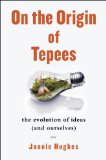
On the Origin of Tepees: The Evolution of Ideas (and Ourselves) by Jonnie Hughes (Free Press, 2011)

(kindle ed.), (amazon.co.uk)

Product description from the publisher:

Why do some ideas spread, while others die off? Does human culture have its very own “survival of the fittest”? And if so, does that explain why our species is so different from the rest of life on Earth?

Throughout history, we humans have prided ourselves on our capacity to have ideas, but perhaps this pride is misplaced. Perhaps ideas have us. After all, ideas do appear to have a life of their own. And it is they, not us, that benefit most when they are spread. Many biologists have already come to the opinion that our genes are selfish entities, tricking us into helping them to reproduce. Is it the same with our ideas?

Jonnie Hughes, a science writer and documentary filmmaker, investigates the evolution of ideas in order to find out. Adopting the role of a cultural Charles Darwin, Hughes heads off, with his brother in tow, across the Midwest to observe firsthand the natural history of ideas—the patterns of their variation, inheritance, and selection in the cultural landscape. In place of Darwin’s oceanic islands, Hughes visits the “mind islands” of Native American tribes. Instead of finches, Hughes searches for signs of natural selection among the tepees.

With a knack for finding the humor in the quirks of the American cultural landscape, Hughes takes us on a tour from the Mall of America in Minneapolis to what he calls the “maul” of America—Custer’s last stand—stopping at road-sides and discoursing on sandwiches, the shape of cowboy hats, the evolution of barn roofs, the 28.99 wording of jokes, the wearing of moustaches, and, of course, the telling features from tepees of different tribes. Original, witty, and engaging, On the Origin of Tepees offers a fresh way of understanding both our ideas and ourselves.

See also: Author’s website

Comments (0) - culture,new books

new book – ‘A First-Rate Madness: Uncovering the Links Between Leadership and Mental Illness’

August 4, 2011

A First-Rate Madness

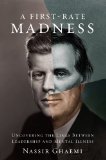
A First-Rate Madness: Uncovering the Links Between Leadership and Mental Illness by Nassir Ghaemi (Penguin, 2011)

(kindle ed.), (amazon.co.uk – 4 Aug)

Product description from the publisher:

An investigation into the surprisingly deep correlation between mental illness and successful leadership, as seen through some of history’s greatest politicians, generals, and businesspeople.

In A First-Rate Madness, Nassir Ghaemi, who runs the Mood Disorders Program at Tufts Medical Center, draws from the careers and personal plights of such notable leaders as Lincoln, Churchill, Gandhi, Martin Luther King, Jr., JFK, and others from the past two centuries to build an argument at once controversial and compelling: the very qualities that mark those with mood disorders- realism, empathy, resilience, and creativity-also make for the best leaders in times of crisis. By combining astute analysis of the historical evidence with the latest psychiatric research, Ghaemi demonstrates how these qualities have produced brilliant leadership under the toughest circumstances.

Take realism, for instance: study after study has shown that those suffering depression are better than “normal” people at assessing current threats and predicting future outcomes. Looking at Lincoln and Churchill among others, Ghaemi shows how depressive realism helped these men tackle challenges both personal and national. Or consider creativity, a quality psychiatrists have studied extensively in relation to bipolar disorder. A First-Rate Madness shows how mania inspired General Sherman and Ted Turner to design and execute their most creative-and successful-strategies.

Ghaemi’s thesis is both robust and expansive; he even explains why eminently sane men like Neville Chamberlain and George W. Bush made such poor leaders. Though sane people are better shepherds in good times, sanity can be a severe liability in moments of crisis. A lifetime without the cyclical torment of mood disorders, Ghaemi explains, can leave one ill equipped to endure dire straits. He also clarifies which kinds of insanity-like psychosis-make for despotism and ineptitude, sometimes on a grand scale.

Ghaemi’s bold, authoritative analysis offers powerful new tools for determining who should lead us. But perhaps most profoundly, he encourages us to rethink our view of mental illness as a purely negative phenomenon. As A First-Rate Madness makes clear, the most common types of insanity can confer vital benefits on individuals and society at large-however high the price for those who endure these illnesses.

See also: Author’s website

Comments (0) - new books,psychology

new book – ‘What Language Is: And What It Isn’t and What It Could Be’

What Language Is

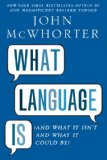
What Language Is: And What It Isn’t and What It Could Be by John McWhorter (Gotham, 2011)

(amazon.co.uk)

Product description from the publisher:

New York Times bestselling author and renowned linguist, John McWhorter, explores the complicated and fascinating world of languages. From Standard English to Black English; obscure tongues only spoken by a few thousand people in the world to the big ones like Mandarin – What Language Is celebrates the history and curiosities of languages around the world and smashes our assumptions about “correct” grammar.

An eye-opening tour for all language lovers, What Language Is offers a fascinating new perspective on the way humans communicate. From vanishing languages spoken by a few hundred people to major tongues like Chinese, with copious revelations about the hodgepodge nature of English, John McWhorter shows readers how to see and hear languages as a linguist does. Packed with Big Ideas about language alongside wonderful trivia, What Language Is explains how languages across the globe (the Queen’s English and Surinam creoles alike) originate, evolve, multiply, and divide. Raising provocative questions about what qualifies as a language (so-called slang does have structured grammar), McWhorter also takes readers on a marvelous journey through time and place-from Persian to the languages of Sri Lanka- to deliver a feast of facts about the wonders of human linguistic expression.

Here’s author John McWhorter on bloggingheads.tv – “This Vale of Words” (9/15/10):

See also: NPR interview (8/4/11)

Comments (0) - language,new books