February 8, 2013
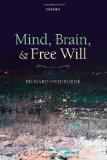
Mind, Brain, and Free Will by Richard Swinburne (Oxford University Press, USA, 2013)
(amazon.co.uk)
Book description from the publisher:
Mind, Brain, and Free Will presents a powerful new case for substance dualism (the idea that humans consist of two parts–body and soul) and for libertarian free will (that humans have some freedom to choose between alternatives, independently of the causes which influence them). Richard Swinburne argues that answers to questions about mind, body, and free will depend crucially on the answers to more general philosophical questions. He begins by analyzing the criteria for one event being the same as another, one substance being the same as another, and a state of affairs being metaphysically possible; and then goes on to analyze the criteria for a belief about these issues being justified. Pure mental events (including conscious events) are distinct from physical events and interact with them. Swinburne claims that no result from neuroscience or any other science could show that interaction does not take place; and illustrates this claim by showing that recent scientific work (such as Libet’s experiments) has no tendency whatever to show that our intentions do not cause brain events. He goes on to argue for agent causation, and claims that–to speak precisely–it is we, and not our intentions, that cause our brain events. It is metaphysically possible that each of us could acquire a new brain or continue to exist without a brain; and so we are essentially souls. Brain events and conscious events are so different from each other that it would not be possible to establish a scientific theory which would predict what each of us would do in situations of moral conflict. Hence given a crucial epistemological principle (the Principle of Credulity) we should believe that things are as they seem to be: that we make choices independently of the causes which influence us. According to Swinburne’s lucid and ambitious account, it follows that we are morally responsible for our actions.
Comments (0)
- new books,philosophy of mind
February 5, 2013

How Literature Saved My Life by David Shields (Knopf, 2013)
(kindle ed.), (amazon.co.uk)
Book description from the publisher:
In this wonderfully intelligent, stunningly honest, and painfully funny book, acclaimed writer David Shields uses himself as a representative for all readers and writers who seek to find salvation in literature.
Blending confessional criticism and anthropological autobiography, Shields explores the power of literature (from Blaise Pascal’s Pensées to Maggie Nelson’s Bluets, Renata Adler’s Speedboat to Proust’s A Remembrance of Things Past) to make life survivable, maybe even endurable. Shields evokes his deeply divided personality (his “ridiculous” ambivalence), his character flaws, his woes, his serious despairs. Books are his life, but when they come to feel unlifelike and archaic, he revels in a new kind of art that is based heavily on quotation and consciousness and self-consciousness–perfect, since so much of what ails him is acute self-consciousness. And he shares with us a final irony: he wants “literature to assuage human loneliness, but nothing can assuage human loneliness. Literature doesn’t lie about this–which is what makes it essential.”
A captivating, thought-provoking, utterly original way of thinking about the essential acts of reading and writing.
Google Books preview:
See also: Author’s website
Comments (0)
- culture,new books,reading
January 30, 2013
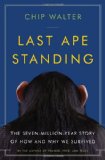
Last Ape Standing: The Seven-Million-Year Story of How and Why We Survived by Chip Walter (Walker & Co., 2013)
(kindle ed.), (amazon.co.uk)
Book description from the publisher:
Over the past 180 years scientists have sifted through evidence that at least twenty-seven human species have evolved on planet Earth. And as you may have noticed, twenty-six of them are no longer with us, done in by their environment, predators, disease, or the unfortunate shortcomings of their DNA. What enabled us to survive when so many other human species were shown the evolutionary door? Last Ape Standing: The Seven-Million-Year Story of How and Why We Survived by acclaimed science journalist Chip Walter tells the intriguing tale of how against all odds and despite nature’s brutal and capricious ways we stand here today, the only surviving humans, and the planet’s most dominant species.Drawing on a wide variety of scientific disciplines, Walter reveals how a rare evolutionary phenomenon led to the uniquely long childhoods that make us so resourceful and emotionally complex. He looks at why we developed a new kind of mind and how our highly social nature has shaped our moral (and immoral) behavior. And in exploring the traits that enabled our success, he plumbs the roots of our creativity and investigates why we became self-aware in ways that no other animal is. Along the way, Last Ape Standing profiles other human species who evolved with us and who have also shaped our kind in startling ways – the Neanderthals of Europe, the “Hobbits” of Indonesia, the Denisovans of Siberia, and the recently discovered Red Deer Cave people of China, who died off just as we stood at the brink of civilizations eleven thousand years ago.Last Ape Standing is an engaging and accessible story that explores the forces that molded us into the peculiar and astonishing creature that we are.
See also: Author’s website All Things Human
Comments (0)
- human evolution,new books
January 28, 2013
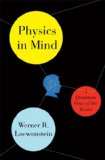
Physics in Mind: A Quantum View of the Brain by Werner R. Loewenstein (Basic Books, 2013)
(amazon.co.uk)
Book description from the publisher:
No one can escape a sense of awe when reflecting on the workings of the mind: we see, we hear, we feel, we are aware of the world around us. But what is the mind? What do we mean when we say we are “aware” of something? What is this peculiar state in our heads, at once utterly familiar and bewilderingly mysterious, that we call awareness or consciousness?
In Physics in Mind, eminent biophysicist Werner R. Loewenstein argues that to answer these questions, we must first understand the physical mechanisms that underlie the workings of the mind. And so begins an exhilarating journey along the sensory data stream of the brain, which shows how our most complex organ processes the vast amounts of information coming in through our senses to create a coherent, meaningful picture of the world. Bringing information theory to bear on recent advances in the neurosciences, Loewenstein reveals a web of immense computational power inside the brain. He introduces the revolutionary idea that quantum mechanics could be fundamental to how our minds almost instantaneously deal with staggering amounts of information, as in the case of the information streaming through our eyes.
Combining cutting-edge research in neuroscience and physics, Loewenstein presents an ambitious hypothesis about the parallel processing of sensory information that is the heart, hub, and pivot of the cognitive brain. Wide-ranging and brimming with insight, Physics in Mind breaks new ground in our understanding of how the mind works.
Google Books preview:
See also: Book website
Comments (0)
- cognitive science,new books
January 26, 2013
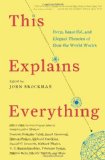
This Explains Everything: Deep, Beautiful, and Elegant Theories of How the World Works ed. by John Brockman (Harper Perennial, 2013)
(kindle ed.), (amazon.co.uk)
Book description from the publisher:
Drawn from the cutting-edge frontiers of science, This Explains Everything will revolutionize your understanding of the world.
What is your favorite deep, elegant, or beautiful explanation?
This is the question John Brockman, publisher of Edge.org (“The world’s smartest website”—The Guardian), posed to the world’s most influential minds. Flowing from the horizons of physics, economics, psychology, neuroscience, and more, This Explains Everything presents 150 of the most surprising and brilliant theories of the way of our minds, societies, and universe work.
Jared Diamond on biological electricity • Nassim Nicholas Taleb on positive stress • Steven Pinker on the deep genetic roots of human conflict • Richard Dawkins on pattern recognition • Nobel Prize-winning physicist Frank Wilczek on simplicity • Lisa Randall on the Higgs mechanism • BRIAN Eno on the limits of intuition • Richard Thaler on the power of commitment • V. S. Ramachandran on the “neural code” of consciousness • Nobel Prize winner ERIC KANDEL on the power of psychotherapy • Mihaly Csikszentmihalyi on “Lord Acton’s Dictum” • Lawrence M. Krauss on the unification of electricity and magnetism • plus contributions by Martin J. Rees • Kevin Kelly • Clay Shirky • Daniel C. Dennett • Sherry Turkle • Philip Zimbardo • Lee Smolin • Rebecca Newberger Goldstein • Seth Lloyd • Stewart Brand • George Dyson • Matt Ridley
See also: 2012 Annual Question at Edge.org
Comments (0)
- culture,new books,reality