[ View menu ]

Archive for 'new books'

new book – ‘Space to Reason: A Spatial Theory of Human Thought’ by Markus Knauff

March 1, 2013
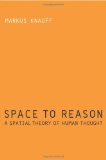
Space to Reason

Space to Reason: A Spatial Theory of Human Thought by Markus Knauff (MIT Press, 2013)

(amazon.co.uk)

Book description from the publisher:

Many scholars believe that visual mental imagery plays a key role in reasoning. In Space to Reason, Markus Knauff argues against this view, proposing that visual images are not relevant for reasoning and can even impede the process. He also argues against the claim that human thinking is solely based on abstract symbols and is completely embedded in language. Knauff proposes a third way to think about human reasoning that relies on supramodal spatial layout models, which are more abstract than pictorial images and more concrete than linguistic representations. He argues that these spatial layout models are at the heart of human thought, even thought about nonspatial relations in the world.

For Knauff the visual images that we so often associate with reasoning are only in the foreground of conscious experience. Behind the images, the actual logical work is carried out by reasoning-specific operations on these spatial layout models. Knauff also offers a solution to the problem of indeterminacy in human reasoning, introducing the notion of a preferred layout model, which is one layout model among others that has the best chance of being mentally constructed and thus guides the further process of thought. Knauff’s “space to reason” theory covers the functional, the algorithmic, and the implementational level of analysis and is corroborated by psychological experiments, functional brain imaging, and computational modeling.

Google Books preview:
Comments (0) - cognitive science,new books

new book – ‘The Secrets of Happy Families: Improve Your Mornings, Rethink Family Dinner, Fight Smarter, Go Out and Play, and Much More’ by Bruce Feiler

February 20, 2013

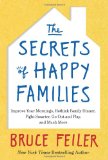
The Secrets of Happy Families

The Secrets of Happy Families: Improve Your Mornings, Rethink Family Dinner, Fight Smarter, Go Out and Play, and Much More by Bruce Feiler (William Morrow, 2013)

(kindle ed.), (amazon.co.uk)

Book description from the publisher:

In The Secrets of Happy Families, New York Times bestselling author Bruce Feiler has drawn up a blueprint for modern families — a new approach to family dynamics, inspired by cutting-edge techniques gathered from experts in the disciplines of science, business, sports, and the military.

The result is a funny and thought-provoking playbook for contemporary families, with more than 200 useful strategies, including: the right way to have family dinner, what your mother never told you about sex (but should have), and why you should always have two women present in difficult conversations…

Timely, compassionate, and filled with practical tips and wise advice, Bruce Feiler’s The Secrets of Happy Families: Improve Your Mornings, Rethink Family Dinner, Fight Smarter, Go Out and Play, and Much More should be required reading for all parents.

See also: Author’s website

Comments (0) - happiness,new books

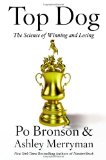
new book – ‘Top Dog: The Science of Winning and Losing’ by Po Bronson and Ashley Merryman

February 19, 2013

Top Dog

Top Dog: The Science of Winning and Losing by Po Bronson and Ashley Merryman (Twelve, 2013)

(kindle ed.), (amazon.co.uk)

Book description from the publisher:

It’s a Dog Eat Dog World. Don’t Be on the Menu.

What are the differences between a winning and losing performance? Why are we able to rise to the challenge one day, but wilt from it the next? Can we in fact become better competitors? In TOP DOG, Po Bronson and Ashley Merryman use cutting edge science to tease out the hidden factors at the core of every great triumph – and every tragic failure. By enabling you to identify your own competitive style, TOP DOG will help you tip the odds of success in your favor. Integrating wisdom from politics, finance, genetics, neuroscience, psychology, military training, sports, economics, education and more, TOP DOG offers counterintuitive, game-changing insights into the nature of competition, such as:

  • Why the home field advantage in sports is just as relevant in diplomacy and deal-making
  • That women are better at judging risk, while men are better at ignoring it – and how this plays out on K Street and Wall Street
  • Why younger siblings are more competitive than first-borns, and how early-childhood influences shape competitive styles forever
  • That the shape of entrepreneurs’ hands can be just as revealing as their business plans
  • How a single biochemical can predict a winner before an event has even begun
  • Why discord can be better than harmony, and why stars on a team do deserve special treatment.

As President Dwight Eisenhower said, “What counts is not necessarily the size of the dog in the fight-it’s the size of the fight in the dog.” In TOP DOG, Po Bronson and Ashley Merryman reveal the size of the fight in all of us.

See also: Book website

Comments (0) - cognitive science,new books,psychology

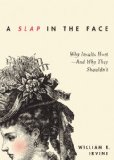
new book – ‘A Slap in the Face: Why Insults Hurt–And Why They Shouldn’t’ by William B. Irvine

February 18, 2013

A Slap in the Face

A Slap in the Face: Why Insults Hurt–And Why They Shouldn’t by William B. Irvine (Oxford University Press, USA, 2013)

(kindle ed.), (amazon.co.uk)

Book description from the publisher:

Insults are part of the fabric of daily life. But why do we insult each other? Why do insults cause us such pain? Can we do anything to prevent or lessen this pain? Most importantly, how can we overcome our inclination to insult others?

In A Slap in the Face, William Irvine undertakes a wide-ranging investigation of insults, their history, the role they play in social relationships, and the science behind them. He examines not just memorable zingers, such as Elizabeth Bowen’s description of Aldous Huxley as “The stupid person’s idea of a clever person,” but subtle insults as well, such as when someone insults us by reporting the insulting things others have said about us: “I never read bad reviews about myself,” wrote entertainer Oscar Levant, “because my best friends invariably tell me about them.” Irvine also considers the role insults play in our society: they can be used to cement relations, as when a woman playfully teases her husband, or to enforce a social hierarchy, as when a boss publicly berates an employee. He goes on to investigate the many ways society has tried to deal with insults-by adopting codes of politeness, for example, and outlawing hate speech-but concludes that the best way to deal with insults is to immunize ourselves against them: We need to transform ourselves in the manner recommended by Stoic philosophers. We should, more precisely, become insult pacifists, trying hard not to insult others and laughing off their attempts to insult us.

A rousing follow-up to A Guide to the Good Life, A Slap in the Face will interest anyone who’s ever delivered an insult or felt the sting of one–in other words, everyone.

Google Books preview:

See also: Author’s website

Comments (0) - happiness,new books,psychology

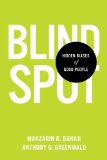
new book – ‘Blindspot: Hidden Biases of Good People’ by Mahzarin R. Banaji and Anthony G. Greenwald

February 12, 2013

Blindspot

Blindspot: Hidden Biases of Good People by Mahzarin R. Banaji and Anthony G. Greenwald (Delacorte Press, 2013)

(kindle ed.), (amazon.co.uk)

Product description from the publisher:

I know my own mind.
I am able to assess others in a fair and accurate way.

These self-perceptions are challenged by leading psychologists Mahzarin R. Banaji and Anthony G. Greenwald as they explore the hidden biases we all carry from a lifetime of exposure to cultural attitudes about age, gender, race, ethnicity, religion, social class, sexuality, disability status, and nationality.

“Blindspot” is the authors’ metaphor for the portion of the mind that houses hidden biases. Writing with simplicity and verve, Banaji and Greenwald question the extent to which our perceptions of social groups—without our awareness or conscious control—shape our likes and dislikes and our judgments about people’s character, abilities, and potential.

In Blindspot, the authors reveal hidden biases based on their experience with the Implicit Association Test, a method that has revolutionized the way scientists learn about the human mind and that gives us a glimpse into what lies within the metaphoric blindspot.

The title’s “good people” are those of us who strive to align our behavior with our intentions. The aim of Blindspot is to explain the science in plain enough language to help well-intentioned people achieve that alignment. By gaining awareness, we can adapt beliefs and behavior and “outsmart the machine” in our heads so we can be fairer to those around us. Venturing into this book is an invitation to understand our own minds.

Brilliant, authoritative, and utterly accessible, Blindspot is a book that will challenge and change readers for years to come.

Google Books preview:

See also: Book website

Comments (0) - cognitive science,culture,new books,psychology