February 7, 2016
(NOTE: As an Amazon Associate I earn from qualifying purchases.)
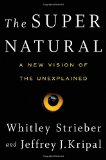
The Super Natural: A New Vision of the Unexplained by Whitley Streiber and Jeffrey J. Kripal (Tarcher, 2016)
,
(kindle ed.), (amazon.co.uk), (UK Kindle ed.)
Book description from the publisher:
Two of today’s maverick authors on anomalous experience present a perception-altering and intellectually thrilling analysis of why the paranormal is real, but radically different from what is conventionally
understood.
Whitley Strieber (Communion) and Jeffrey J. Kripal (J. Newton Rayzor professor of religion at Rice University) team up on this unprecedented and intellectually vibrant new framing of inexplicable events and experiences.
Rather than merely document the anomalous, these authors–one the man who popularized alien abduction and the other a renowned scholar and “renegade advocate for including the paranormal in religious studies” (The New York Times)–deliver a fast-paced and exhilarating study of why the supernatural is neither fantasy nor fiction but a vital and authentic aspect of life.
Their suggestion? That all kinds of “impossible” things, from extra-dimensional beings to bilocation to bumps in the night, are not impossible at all: rather, they are a part of our natural world. But this natural world is immeasurably more weird, more wonderful, and probably more populated than we have so far imagined with our current categories and cultures, which are what really make these things seem “impossible.”
The Super Natural considers that the natural world is actually a “super natural world”–and all we have to do to see this is to change the lenses through which we are looking at it and the languages through which we are presently limiting it. In short: The extraordinary exists if we know how to look at and think about it.
Google Books preview:
Comments (0)
- new books,reality
May 23, 2015
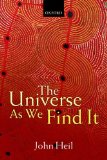
The Universe As We Find It by John Heil (Oxford University Press, 2015)
(amazon.co.uk)
Book description from the publisher:
What does reality encompass? Is reality exclusively physical? Or does reality include nonphysical–mental, and perhaps ‘abstract’–aspects? What is it to be physical or mental, or to be an abstract entity? What are the elements of being, reality’s raw materials? How is the manifest image we inherit from our culture and refine in the special sciences related to the scientific image as we have it in fundamental physics? Can physics be understood as providing a ‘theory of everything’, or do the various sciences make up a hierarchy corresponding to autonomous levels of reality? Is our conscious human perspective on the universe in the universe or at its limits? What, if anything, makes ordinary truths, truths of the special sciences, and truths of mathematics true? And what is it for an assertion or judgment to be ‘made true’? In The Universe As We Find It, John Heil offers answers to these questions framed in terms of a comprehensive ontology of substances and properties inspired by Descartes, Locke, their successors, and their latter day exemplars. Substances are simple, lacking parts that are themselves substances. Properties are modes–particular ways particular substances are–and arrangements of propertied substances serve as truthmakers for all the truths that have truthmakers. Heil argues that the deep story about the nature of these truthmakers can only be told by fundamental physics.
Comments (0)
- new books,reality
October 3, 2014
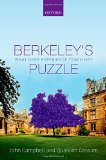
Berkeley’s Puzzle: What Does Experience Teach Us? by John Campbell and Quassim Cassam (Oxford University Press, 2014)
(kindle ed.), (amazon.co.uk), (UK kindle ed.)
Book description from the publisher:
Sensory experience seems to be the basis of our knowledge and conception of mind-independent things. The puzzle is to understand how that can be: even if the things we experience (apples, tables, trees etc), are mind-independent how does our sensory experience of them enable us to conceive of them as mind-independent? George Berkeley thought that sensory experience can only provide us with the conception of mind-dependent things, things which cannot exist when they aren’t being perceived.
It’s easy to dismiss Berkeley’s conclusion but harder to see how to avoid it. In this book, John Campbell and Quassim Cassam propose very different solutions to Berkeley’s Puzzle. For Campbell, sensory experience can be the basis of our knowledge of mind-independent things because it is a relation, more primitive than thought, between the perceiver and high-level objects and properties in the mind-independent world. Cassam opposes this ‘relationalist’ solution to the Puzzle and defends a ‘representationalist’ solution: sensory experience can give us the conception of mind-independent things because it represents its objects as mind-independent, but does so without presupposing concepts of mind-independent things.
This book is written in the form of a debate between two rival approaches to understanding the relationship between concepts and sensory experience. Although Berkeley’s Puzzle frames the debate, the questions addressed by Campbell and Cassam aren’t just of historical interest. They are among the most fundamental questions in philosophy.
Google Books preview:
See also: John Campbell on Berkeley’s Puzzle at Philosophy Bites
Comments (0)
- new books,reality
August 27, 2014
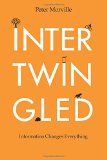
Intertwingled: Information Changes Everything by Peter Morville (Semantic Studios, 2014)
(kindle ed.), (amazon.co.uk), (UK kindle ed.)
Book description from the publisher:
This is a book about everything. Or, to be precise, it explores how everything is connected from code to culture. We think we’re designing software, services, and experiences, but we’re not. We are intervening in ecosystems. Until we open our minds, we will forever repeat our mistakes. In this spirited tour of information architecture and systems thinking, Peter Morville connects the dots between authority, Buddhism, classification, synesthesia, quantum entanglement, and volleyball. In 1974 when Ted Nelson wrote “everything is deeply intertwingled,” he hoped we might realize the true potential of hypertext and cognition. This book follows naturally from that.
See also: Author’s website, book excerpt
Comments (0)
- new books,reality
June 6, 2014
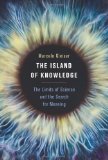
The Island of Knowledge: The Limits of Science and the Search for Meaning by Marcelo Gleiser (Basic Books, 2014)
(kindle ed.), (amazon.co.uk), (UK kindle ed.)
Book description from the publisher:
Do all questions have answers? How much can we know about the world? Is there such a thing as an ultimate truth?
To be human is to want to know, but what we are able to observe is only a tiny portion of what’s “out there.” In The Island of Knowledge, physicist Marcelo Gleiser traces our search for answers to the most fundamental questions of existence. In so doing, he reaches a provocative conclusion: science, the main tool we use to find answers, is fundamentally limited.
These limits to our knowledge arise both from our tools of exploration and from the nature of physical reality: the speed of light, the uncertainty principle, the impossibility of seeing beyond the cosmic horizon, the incompleteness theorem, and our own limitations as an intelligent species. Recognizing limits in this way, Gleiser argues, is not a deterrent to progress or a surrendering to religion. Rather, it frees us to question the meaning and nature of the universe while affirming the central role of life and ourselves in it. Science can and must go on, but recognizing its limits reveals its true mission: to know the universe is to know ourselves.
Telling the dramatic story of our quest for understanding, The Island of Knowledge offers a highly original exploration of the ideas of some of the greatest thinkers in history, from Plato to Einstein, and how they affect us today. An authoritative, broad-ranging intellectual history of our search for knowledge and meaning, The Island of Knowledge is a unique view of what it means to be human in a universe filled with mystery.
Google Books preview:
See also: Author’s website
Comments (1)
- culture,new books,reality